Science & Tech · Space · 8 hrs ago
New measurement finds primordial helium makes up 24.58% of early matter
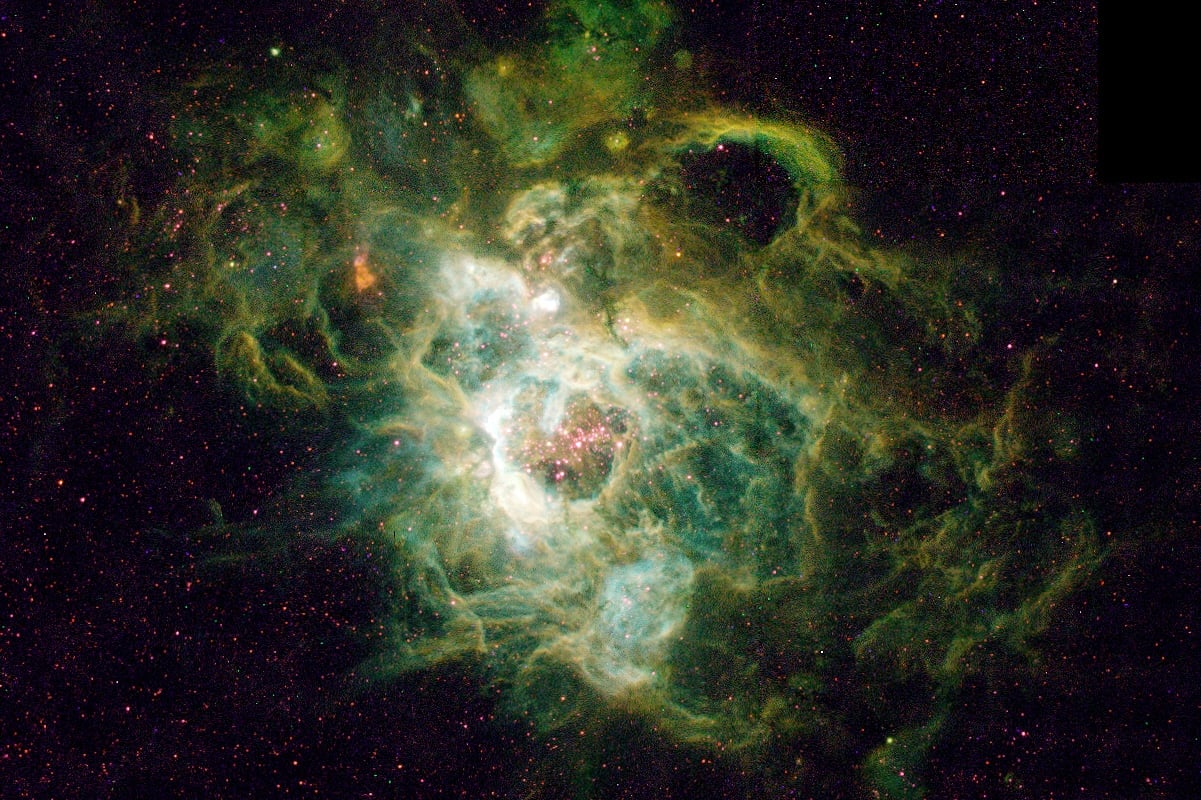
The Big Bang produced mostly hydrogen and helium, while stars later made many heavier elements and added more helium.
Astronomers use the early hydrogen-to-helium balance to test the Big Bang model, but helium made by stars can complicate that measurement.
A team with the Large Binocular Telescope Primordial Helium Abundance Project studied gas in 54 metal-poor galaxies.
These galaxies have fewer heavy elements and are expected to contain less helium added by stars.
The team measured primordial helium at 24.58% of the early universe’s matter by mass.
That is close to the 24.67% estimate from observations of the cosmic microwave background, strengthening support for the Big Bang model.
The researchers also estimated that about 90% of cosmic helium is primordial and 10% formed through stellar fusion, which may help scientists study star formation and how elements are made.

A study found that primordial helium accounts for 24.58% of the early cosmos’s matter by mass.
The Large Binocular Telescope Primordial Helium Abundance Project measured hydrogen and helium in gas regions from 54 metal-poor galaxies.
The result is close to the 24.67% estimate from Planck observations of the cosmic microwave background.
The team estimated that about 90% of cosmic helium is primordial and the remaining 10% formed through stellar fusion.
The finding strengthens a key line of evidence for the Big Bang model.
- Who
- The Large Binocular Telescope Primordial Helium Abundance Project team.
- What
- The team measured primordial helium at 24.58% of the early cosmos’s matter by mass.
- When
- The results were recently published; the article was published on 2026-10-12.
- Where
- The study examined interstellar gas regions in 54 metal-poor galaxies.
- Why
- To measure primordial helium while reducing the effect of helium later produced by stars.
This story does not have two clearly opposing sides.
The team measured hydrogen and helium in interstellar gas regions from 54 metal-poor galaxies.
The project reported a primordial helium abundance of 24.58% by mass.
- Primordial helium
- 24.58% of early matter by mass
- Galaxy sample
- 54 metal-poor galaxies
- Planck estimate
- 24.67%
- Cosmic helium
- About 90% primordial and 10% formed through stellar fusion
- Publication date
- 2026-10-12
Sources
Related news

SpaceX plans to launch 27 Starlink satellites from California
Red dwarf appears to slowly draw matter from a brown dwarf

SpaceX plans ISS cargo launch carrying solar arrays and research equipment
Black hole in NGC 1275 launches radio jets after an X-ray flare

French astronaut Sophie Adenot says space brought a full range of emotions

NASA releases nearly 800 GB of Artemis II lunar data

Astronomers trace record-distant radio burst to a young galaxy

Hubble data point to a possible second-generation planet around a white dwarf

NASA seeks ways to prevent electrical sparks during moonwalks

NASA releases more than 800GB of Artemis II mission data

Camera captures aurora over parts of the Netherlands