1 week ago
Why World Mosquito Day Honors Ronald Ross’s India Discovery
World Mosquito Day happens every year on August 20.
It remembers an important malaria discovery made in India in 1897.
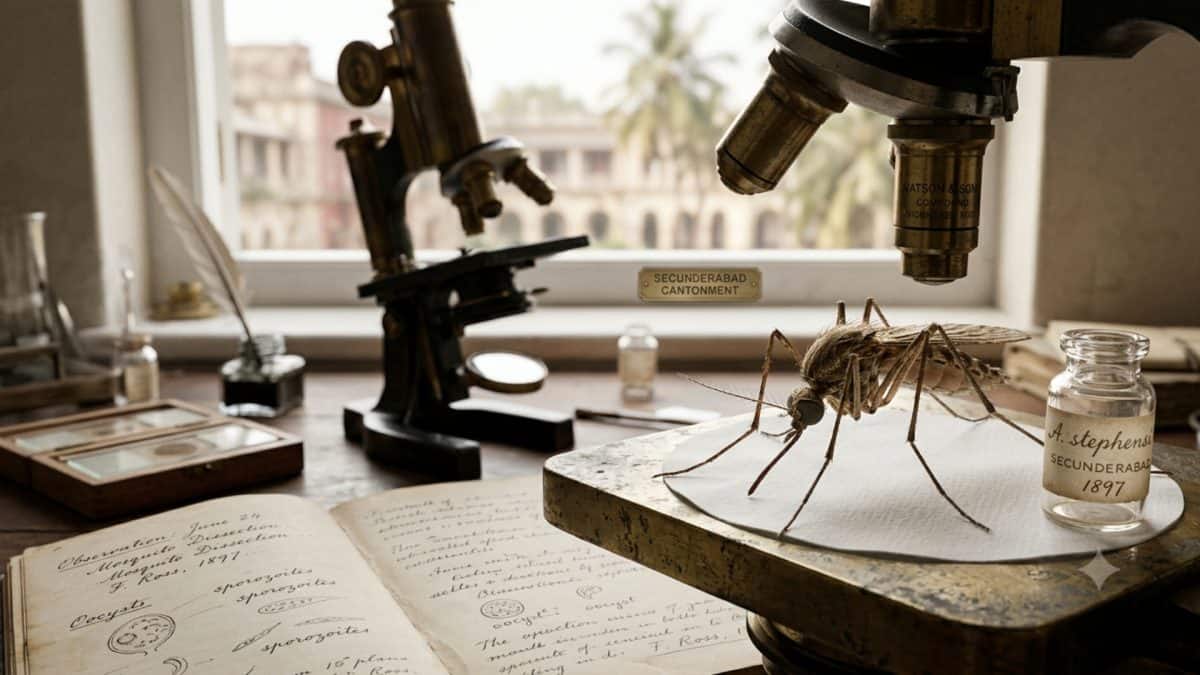
A scientist named Sir Ronald Ross studied mosquitoes in Secunderabad.
He showed that female Anopheles mosquitoes can carry malaria between people.
This helped doctors understand that mosquitoes themselves must be controlled to prevent disease.
Ross later received the Nobel Prize for his malaria research.
Mosquitoes can also spread diseases such as dengue, chikungunya and yellow fever.
People can reduce risks by removing stagnant water, using nets or screens, and wearing repellent.
The day reminds us that mosquito prevention is still important today.

World Mosquito Day is observed every August 20 to commemorate Sir Ronald Ross’s 1897 malaria research in India.
Ross’s experiments in Secunderabad showed that female Anopheles mosquitoes transmit malaria between humans.
His discovery shifted malaria prevention toward controlling mosquitoes as well as treating infected people.
Ross’s laboratory in Begumpet, Secunderabad, is now associated with the Sir Ronald Ross Institute of Parasitology and a small museum.
The observance highlights continuing risks from mosquito-borne diseases and the need for personal and community-level prevention.
- Who
- Sir Ronald Ross, a British doctor and scientist, made the malaria-related discovery commemorated by World Mosquito Day.
- What
- The day commemorates Ross’s 1897 discovery that female Anopheles mosquitoes transmit malaria between humans.
- Where
- Ross made the discovery while working in Secunderabad, in present-day Telangana, India, at a laboratory in the Begumpet area.
- When
- World Mosquito Day is observed on August 20; the discovery occurred in 1897.
- Why
- The observance honors the discovery’s importance to malaria prevention and highlights the continuing threat of mosquito-borne diseases.
Key facts
- Observance date
- August 20
- Discovery year
- 1897
- Scientist
- Sir Ronald Ross
- Location of research
- Secunderabad, present-day Telangana, India
- Mosquito linked to malaria
- Female Anopheles mosquitoes
- Nobel Prize
- Ross received the Nobel Prize in Physiology or Medicine in 1902 for his malaria work.
- Other diseases mentioned
- Dengue, chikungunya, yellow fever, Zika, Japanese encephalitis and lymphatic filariasis
Sources
Related news
World Mosquito Day: Which Mosquito Spreads Which Disease?

Imported Mosquito on Plane Linked to Two German Malaria Deaths
Airport Malaria Outbreak Kills Two Frankfurt Workers

Ponnam Prabhakar Launches Monsoon Drive Against Mosquito-Borne Diseases in Hyderabad

Kerala Minister Calls for Public Action Against Mosquito-Borne Diseases