2 days ago
Bangladesh Gas Supply Hits Decade Low, Disrupting Power and Factories

Bangladesh is not receiving enough natural gas to run many power plants and factories.
In August 2026, the country’s average daily gas supply fell to its lowest August level in ten years.
Reports said conflict in the region disrupted supplies of liquefied natural gas, or LNG.
The two articles described the conflict differently, with one referring to a US-Israel war and the other to US-Iran tensions.
Qatar was reportedly unable to deliver some gas under its contracts.
Buying replacement gas on the spot market became harder and more expensive.
As a result, Bangladesh had large electricity shortages and frequent outages.
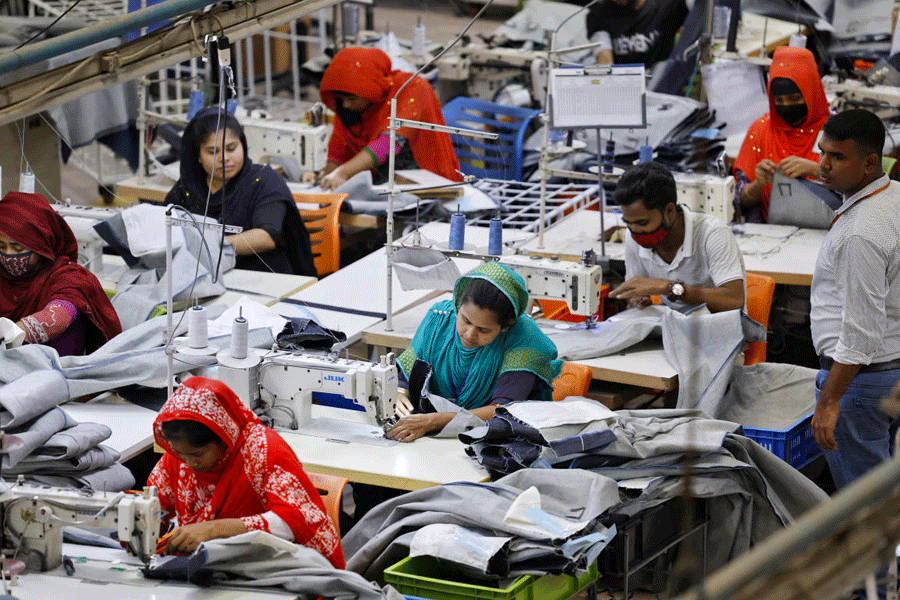
Many factories had to slow down or sometimes stop production.
Industry representatives warned that some factories could eventually close if the government does not act.

Bangladesh’s average daily gas supply fell to 2,235 million cubic feet per day in August 2026, the lowest August level in a decade.
Reports attributed disrupted LNG supplies to conflict-related tensions, though the articles differed over whether the cause was a US-Israel or US-Iran war.
Qatar reportedly could not provide contracted LNG volumes, forcing Bangladesh to rely more heavily on costly and difficult spot-market purchases.
The peak average hourly power-generation deficit reached nearly 3,000 megawatts, with gas-fired plants producing about 5,000 MW against at least 12,000 MW of installed capacity.
Factories reported sharply reduced and unpredictable production, with industry officials warning that prolonged shortages could push some businesses toward closure.
- Who
- Bangladesh, its gas and power sectors, Qatar as a major LNG supplier, and affected industrial and garment factories.
- What
- A severe gas-supply shortage disrupted electricity generation and forced factories to reduce or halt production.
- Where
- Across Bangladesh, including its major industrial belts.
- When
- August 2026, with the crisis peaking during the month and a reported power-generation figure recorded on Sunday afternoon.
- Why
- Reports linked the shortage to conflict-related disruptions to LNG supplies, Qatar’s reported inability to provide contracted volumes, and difficult, costly spot-market purchases.
First report’s conflict attribution
Second report’s conflict attribution
Cause of LNG disruption
First report’s conflict attribution
The first article said local media reports linked the disruption to a US-Israel war affecting Bangladesh’s LNG supplies.
Second report’s conflict attribution
The second article attributed the disruption to ongoing tensions between the United States and Iran and described it as a West Asia conflict.
Impact on factories
First report’s conflict attribution
Industry representatives said production was highly unpredictable, sometimes falling to zero and sometimes reaching only around 20 percent, with many factories potentially facing closure.
Second report’s conflict attribution
The reports also cited production reductions of up to 50 percent and warned that such a decline could double production costs and push factories into losses.
Key facts
- Average daily gas supply
- 2,235 million cubic feet per day in August 2026
- Power-generation deficit
- Nearly 3,000 megawatts at the peak of the August crisis
- Recorded generation and demand
- 12,688 MW generated against demand of 16,278 MW on Sunday afternoon
- Gas-based generation
- About 5,000 MW produced against installed capacity of at least 12,000 MW
- Reported LNG supplier problem
- Qatar was reportedly unable to provide contracted volumes
- Factory production impact
- Some production fell to zero on certain days or reached only about 20 percent; other reports said output fell by up to 50 percent
- Industry cost impact
- A 50 percent output decline could double production costs for some garment factories
Quotes
Fazlee Shamim Ehsan
Executive president of the Bangladesh Knitwear Manufacturers and Exporters Association and managing director of Fatullah Apparels
“It is difficult to describe the situation simply in terms of factory closures because production is fluctuating sharply from day to day -- on some days, production falls to zero, while on other days it may reach only around 20 per cent.”
 thehansindia.com
 thestatesman.com
“If the government does not take action, many factories could move towards closure.”
thehansindia.com
Sources
Related news
Bangladesh curbs power use amid gas shortages and Iran crisis

Bangladesh power crisis deepens, seeks more diesel from India

Bangladesh Gas Crisis Exposes LNG Logistics and Concentration Risks
Bangladesh textile sector faces gas crisis, weighs alternative fuels
Bangladesh Imposes Shopping Centre Curbs to Manage Power Crisis
Pakistan’s Power Crisis Returns Amid 4,000MW Shortfall And Outages

Bangladesh Recall Shanto, Mahmud for Asian Games T20 Squad

Sharma and Malik share halfway lead at Telangana Golconda Masters

India Replaces Sri Lanka as 2027 Women’s Champions Trophy Host

Centre Assures JDU Bihar’s Interests In Farakka Treaty Decision
India’s Record Wheat Harvest Opens $1.5 Billion Export Window