3 weeks ago
Bangladesh textile sector faces gas crisis, weighs alternative fuels
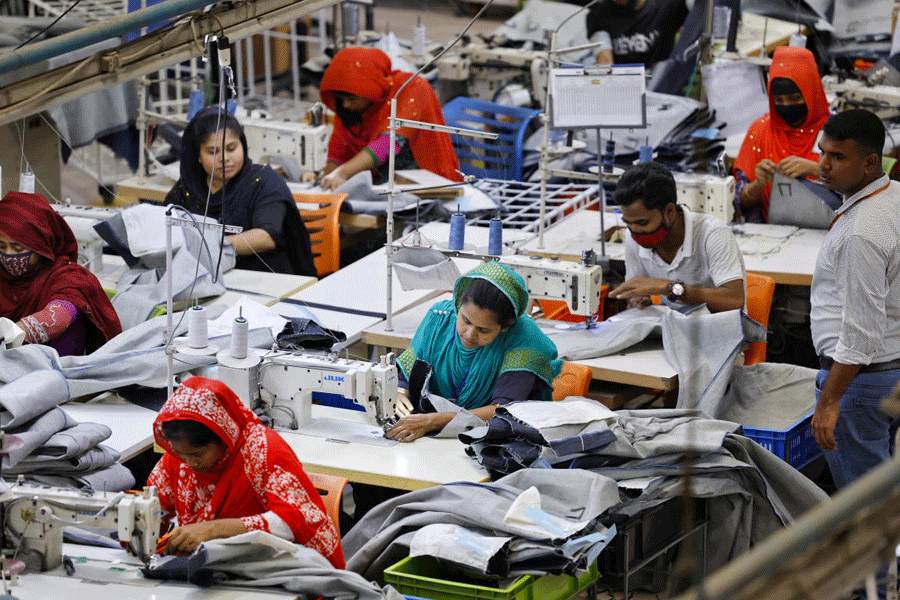
In Bangladesh, making clothes is the country's biggest business.
Its clothes factories need lots of gas to wash, dye and finish the clothes.
Right now, there is not enough gas for these factories.
A fire at one of the two big stations where gas arrives from other countries made the problem much worse.
Another country called Qatar, which sends gas to Bangladesh, also said it has to send less because of fighting in the Middle East.
With less gas, many factories are working at only a little more than half their usual speed.
Some factories are buying really expensive fuel from car stations, or diesel, just to finish orders that must go out on time.
Factory owners are trying new ideas, like burning leftover plants for energy, using electricity or putting solar panels on roofs.
An expert says burning leftover plants can only help a few factories, not all of them, so leaders are also asking the government to find more gas and help buy machines that use less energy.

A fire at one of Bangladesh's two LNG terminals last month cut gas supply to just over half of demand, according to Petrobangla.
The textile industry employs about 4 million people, produces around 80% of Bangladesh's exports and about 13% of its GDP.
Qatar said it will slash LNG supply to Bangladesh due to Iran's near closure of the Strait of Hormuz and Iran's bombing of Qatari LNG export facilities.
Factories in the industrial belts of Savar, Ashulia and Narayanganj are now operating up to 40% below capacity.
Some factories have turned to costlier compressed natural gas from roadside filling stations or diesel, while leaders weigh biomass, electric boilers, heat pumps and rooftop solar.
- Who
- Bangladesh's textile industry, including the Bangladesh Textile Mills Association (BTMA) and companies such as Plummy Fashions
- What
- A gas crisis forcing textile factories to cut production and explore alternative fuels after a fire at an LNG terminal and reduced Qatari supply
- Where
- Bangladesh, particularly the industrial belts of Savar, Ashulia and Narayanganj
- When
- Following a fire at one of Bangladesh's two LNG terminals last month; no exact dates are stated in the article
- Why
- Bangladesh has a longstanding gas supply shortfall from falling local production and rising import costs, worsened by the Middle East war, Iran's actions affecting Qatari LNG exports, and the terminal fire
Short-term, case-by-case fixes
Long-term structural energy security
Biomass as a fuel alternative
Short-term, case-by-case fixes
Some textile factories have already begun burning biomass made from agricultural residues, and rural households use it widely, making it a practical alternative where gas is unavailable.
Long-term structural energy security
Experts like Dr. Laxmikant Jawale say biomass cannot be a sector-wide strategy because textile fuel demand far exceeds the country's biomass base, it would compete with rural households, and industrial-scale logistics and boiler retrofits are underdeveloped.
Quick fuels versus energy security
Short-term, case-by-case fixes
To keep production going, some factories now buy costlier compressed natural gas from roadside filling stations that normally fuel cars, or use expensive diesel, to fulfil urgent orders.
Long-term structural energy security
Industry leaders such as Fazlul Hoque of Plummy Fashions argue Bangladesh needs structural energy security — electrification, renewables, duty-free energy-efficient technology and more domestic gas exploration — rather than piecemeal firefighting.
Key facts
- Textile share of exports
- Around 80%
- Textile share of GDP
- About 13%
- Textile employment
- About 4 million of a ~14 million industrial workforce
- Capacity reduction
- Factories operating up to 40% below capacity
- LNG supply after terminal fire
- Cut to just over half of demand (Petrobangla data)
- Affected industrial belts
- Savar, Ashulia, Narayanganj
- Potential energy savings
- Up to 45% with electric boilers and heat pumps
Quotes

Fazlul Hoque
Managing director of Plummy Fashions, a leading textile producer
“The country cannot build future industrial investment on uncertain LNG supplies and repeated supply disruptions. We need energy security, not piecemeal firefighting.”
 telegraphindia.com
Dr. Laxmikant Jawale
Regional lead for South Asia and Southeast Asia, Apparel Impact Institute
“Biomass thus cannot be a sector-wide strategy, rather it works better as a facility-by-facility, case-by-case option.”
telegraphindia.com
Sources
Related news

Bangladesh Gas Supply Hits Decade Low, Disrupting Power and Factories
Bangladesh power crisis deepens, seeks more diesel from India
Bangladesh curbs power use amid gas shortages and Iran crisis

Bangladesh Gas Crisis Exposes LNG Logistics and Concentration Risks
Bangladesh seeks more diesel supply from India amid shortages
Bangladesh Imposes Shopping Centre Curbs to Manage Power Crisis

Bangladesh Recall Shanto, Mahmud for Asian Games T20 Squad

Sharma and Malik share halfway lead at Telangana Golconda Masters

India Replaces Sri Lanka as 2027 Women’s Champions Trophy Host
Centre Assures JDU Bihar’s Interests In Farakka Treaty Decision
India’s Record Wheat Harvest Opens $1.5 Billion Export Window