3 hrs ago
NCERT Textbook Details Invasions and Indian Resistance

A new school history book describes invasions into the Indian subcontinent from the seventh century onward.
It says some invaders wanted more land, while religion was also a motive.
The book explains that fertile farming areas were wealthy and may have attracted invasions.
It also tells how Indian rulers and communities fought back.
The groups discussed include rulers in several regions, the Jats, Sikhs and Ahoms.
The book mentions battles such as Dewair and Saraighat.
It says resistance was possible because people were resilient and able to endure difficulties.
The chapter also says the period included cooperation as well as conflict.

A new Class 9 NCERT textbook says invasions of the Indian subcontinent began in the seventh century and involved territorial and religious motives.
The book says Arab, Turkish, Mughal and European forces faced resistance from Indian rulers and communities.
It describes Mahmud of Ghazni’s first invasion in 1001 and Turkish incursions into northern and western India during the 11th and 12th centuries.
The chapter covers the Jat uprising under Gokul Jat, Sikh resistance, the Battle of Dewair and Ahom resistance at Saraighat.
The textbook says Indian history involved both conflict and cooperation, with resilience helping sustain society through different periods.
- Who
- The NCERT textbook discusses Arab, Turkish, Mughal and European forces, along with Indian rulers and communities including the Jats, Sikhs and Ahoms.
- What
- A Class 9 social science textbook documents invasions of the Indian subcontinent and the resistance mounted against them.
- Where
- The events covered include the Indian subcontinent, northern and western India, the Deccan, Malwa, Kashmir, Rajasthan, Assam and the Ganga-Yamuna doab.
- When
- The textbook describes events from the mid-seventh century onward; it was released on Tuesday, six months after the new academic session began.
- Why
- The book says invasions were driven by territorial expansion and religious motives, and that fertile, prosperous agrarian regions were another major attraction.
Key facts
- Textbook
- Understanding Society India and Beyond-Part 2
- Publisher
- National Council of Educational Research and Training (NCERT)
- Chapter
- Resistance and Resilience
- Historical period
- From the seventh century onward
- First invasion cited
- Mahmud of Ghazni invaded in 1001, targeting Jayapala of the Hindu Shah dynasty
- Jat uprising
- The Jat rebellion under Gokul Jat began in 1669
- Battle of Saraighat
- The chapter documents Ahom resistance in Assam, including the 1671 Battle of Saraighat
- Textbook release
- Part 2 was released on Tuesday, six months after the new academic session began
Sources
Related news
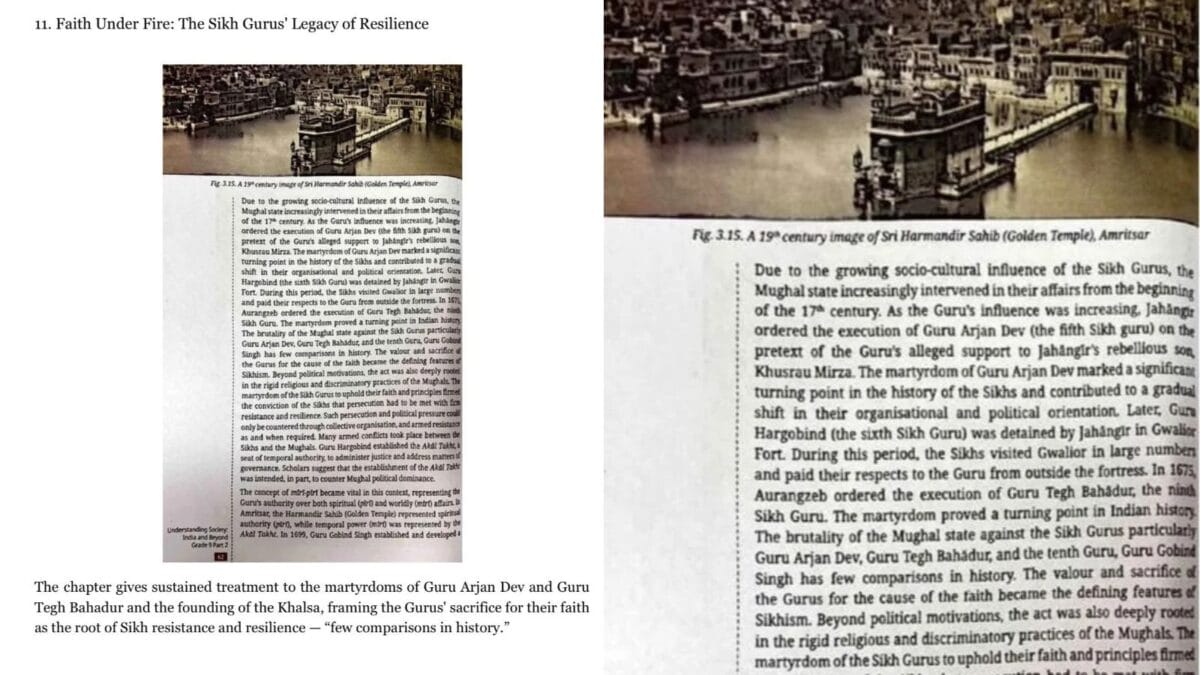
NCERT Textbook Describes Mughal Brutality Against Sikh Gurus as Unparalleled
Yogi Says Ghaznavi Sought to Destroy Sanatan Tradition
UPSC History Quiz Covers Plassey, Heritage and Assam Moidams
Ex-Colonel Says India Faces More Than China and Pakistan

Penguin Random House India Announces Book on India’s Economic Ideas
Fadnavis Attacks Congress Over NCERT Coverage of Shivaji

Delhi’s Red Fort Launches Jai Hind Sound And Light Show
Jain Merchant Family Navigated Mughal Power and Modern Business

Pakistan Tightens Islamabad Security Ahead of Rival Protest Marches