3 weeks ago
Japan's $9,000 'human refrigerator' cooling pods fight record heatwaves
Japan is having very, very hot summers.
When it gets this hot, people can get sick from the heat.
So a company made a special machine called the 'human refrigerator.'
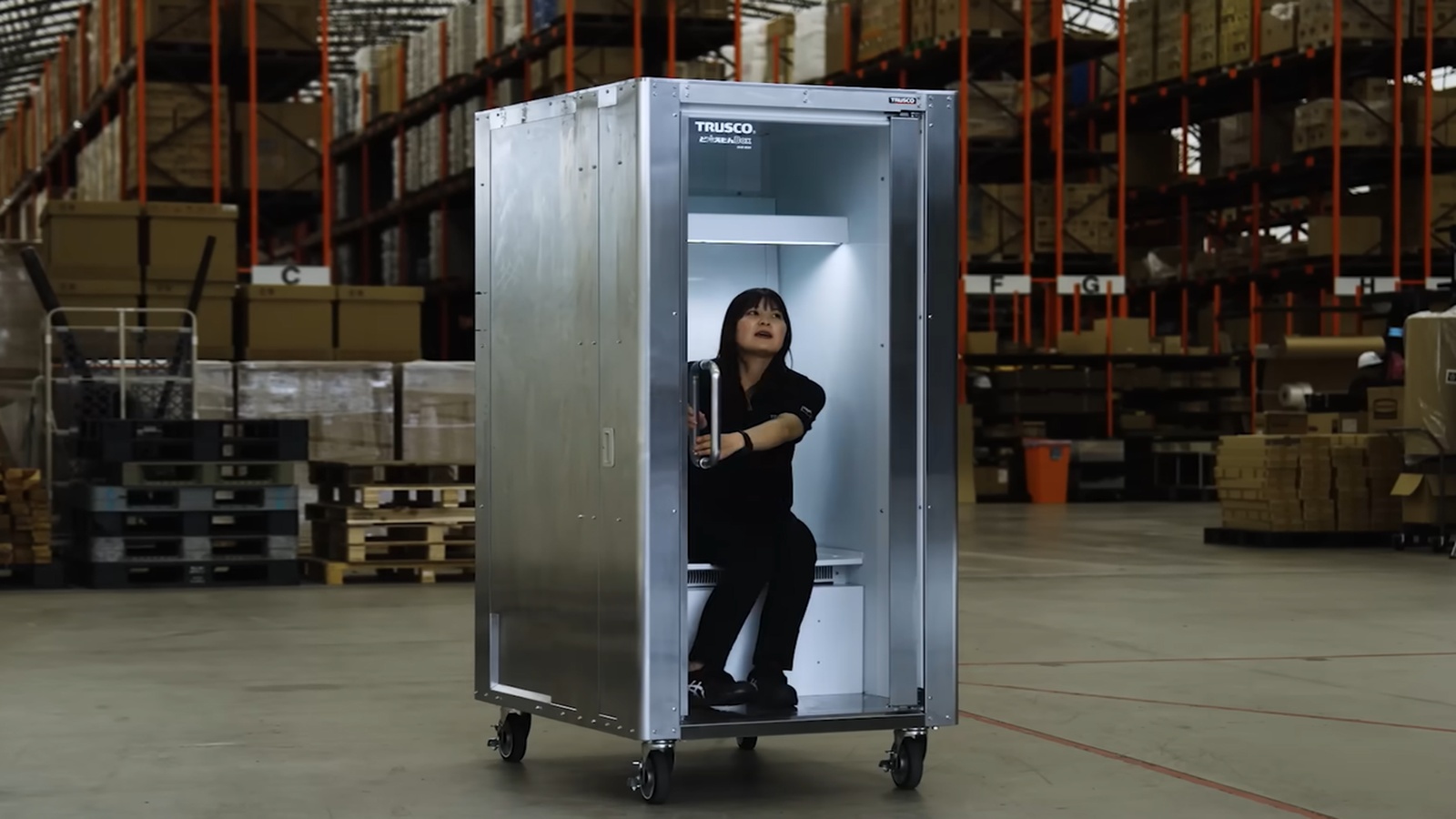
It looks like a big metal box, a bit like a vending machine.
A person can step inside and sit down on a small stool.
Cool air blows on their head and neck to cool them down fast.
That helps stop them from getting heatstroke.
The box turns off by itself after 20 minutes so nobody gets too cold.
Some people think it is a great idea that saves lives.
Other people worry that we should fix the warming weather instead of just cooling people down.

Japan's 'human refrigerator,' the Do Hiemon Box, is a mobile single-person cooling booth that rapidly lowers body temperature to prevent heatstroke.
The stainless-steel booth was introduced to the commercial market in April by manufacturer SDRS Co., Ltd. and distributor TRUSCO Nakayama Corporation.
It creates a 15°C internal microclimate with 5°C airflow directed at the head, neck, and upper back, and includes a 20-minute automatic shut-off timer.
The unit costs ¥1,500,000 (~$9,200 USD) to purchase or ¥300,000 (~$1,800 USD) per month to rent, consuming about 0.51 kWh (~16 yen per hour).
It is deployed during record heatwaves after Japan logged five consecutive Kokushobi days (40°C+) in late July and Tokyo transported over 450 people for heat illness in 24 hours.
- Who
- SDRS Co., Ltd., which developed the Do Hiemon Box, and TRUSCO Nakayama Corporation, which distributes it, targeting workers and residents in Japan.
- What
- A mobile single-person cooling booth, dubbed Japan's 'human refrigerator,' designed to rapidly cool overheated bodies and prevent heatstroke.
- Where
- Japan, including public administrative centres such as Maebashi City Hall in Gunma Prefecture, plus job sites, warehouses, concert venues, and sports facilities.
- When
- Introduced to the commercial market in April of this year, with deployment intensifying during the summer heatwaves, including late July's five consecutive Kokushobi days.
- Why
- To protect outdoor workers and residents from record-breaking heatwaves, as traditional fan jackets fail when temperatures exceed 38°C and humidity is high.
Supporters
Critics
Approach to heatwave protection
Supporters
Workplace safety experts and industrial managers praise the booth as a practical device that saves lives on construction sites where traditional air conditioning is unfeasible.
Critics
Environmental commentators argue that relying on individual cold pods is a technological band-aid for global warming rather than a systemic solution.
Safety of rapid cooling
Supporters
Built-in safety parameters, including a 20-minute auto shut-off and 3 cooling modes, prevent thermal shock, shivering, and accidental hypothermia.
Critics
Health professionals warn users exiting a 15°C booth into 40°C heat must allow brief acclimation periods in shaded transitional areas to avoid acute vascular headaches or dizziness.
Future as urban street fixtures
Supporters
Industry analysts predict single-person cooling pods could soon become standard urban street fixtures in transit hubs, sports venues, and tourist districts.
Critics
Public response remains divided, with concern that individual cooling pods reflect troubling climate adaptation trends rather than lasting solutions.
Key facts
- Product
- Do Hiemon Box ('human refrigerator') — mobile single-person cooling booth
- Developer / Distributor
- SDRS Co., Ltd. / TRUSCO Nakayama Corporation
- Temperatures
- Internal ambient ~15°C (59°F); direct airflow ~5°C (41°F)
- Price
- ¥1,500,000 (~$9,200 USD) purchase; ¥300,000 (~$1,800 USD) monthly rental
- Power use
- ~0.51 kWh on standard 100V outlet; ~16 JPY (~$0.10 USD) per hour
- Safety features
- Automatic 20-minute shut-off timer; 3 cooling speed modes
- Capacity
- 1.75 m interior height; 150 kg maximum capacity
- Deployment example
- Maebashi City Hall, Gunma Prefecture — public lobby emergency cooling stops
Sources
Related news
Japan's 'Human Fridge' Cooling Booth Helps Workers Beat Summer Heat

Japan’s farmers shift to nighttime work as heat intensifies
Data Centre Cooling Evolves from Water Towers to Liquid Systems

Three Lions Die of Suspected Heatstroke at Tokyo Zoo

Record heatwave grips Asia as potatoes boil, lions perish

Japan Cricket Boss Defends Asian Games Facilities Against Concerns

Mitsubishi Revives Pajero With 201PS Fifth-Generation SUV

Europe's Bond Selloff Deepens as Middle East Tensions Lift Oil

Uday Kotak Warns Global Bond Markets Face Roller-Coaster Volatility
Global Bond Sell-Off Pushes Japan Yields To 30-Year High