1 hr ago
Agentic AI Reshapes Business Services With Human Oversight
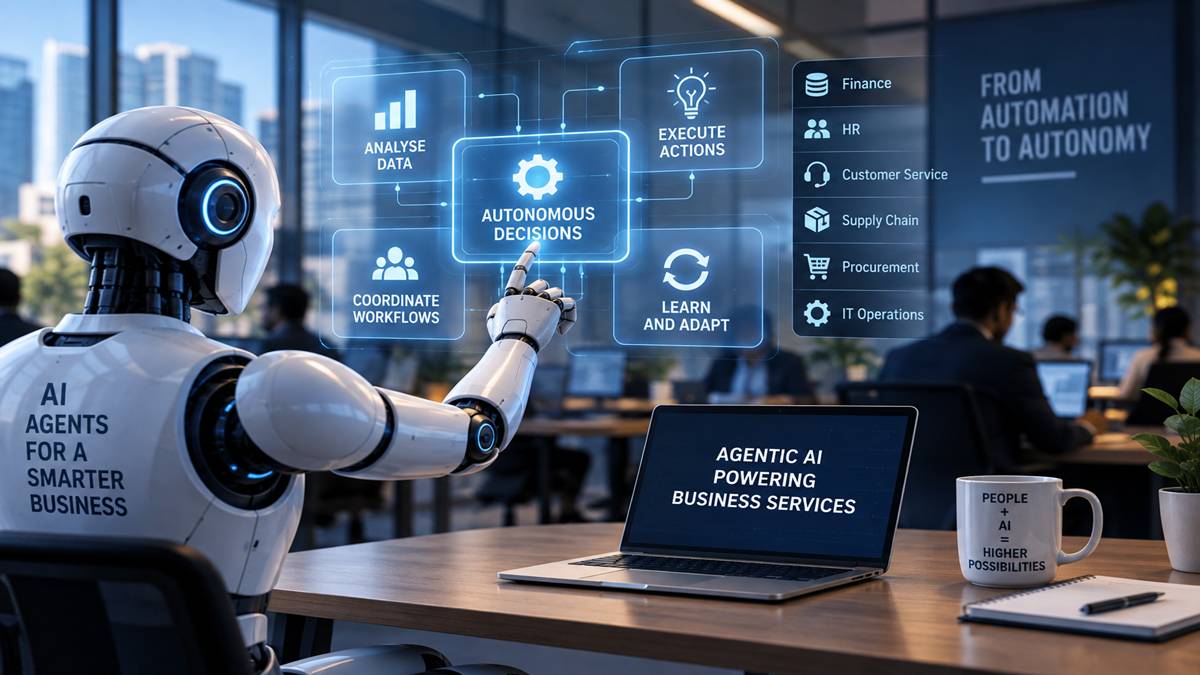
Businesses are beginning to use AI systems that can do more than follow simple instructions.
These systems can study information, make choices and complete several steps of a job.
For example, an AI agent might help answer customer questions or check an insurance claim.
The article says companies need special systems to watch these agents and guide what they are allowed to do.
One part looks for useful automation and possible problems, while another sets rules and keeps records.
People should still decide the goals and review unusual or risky cases.
This combination can make work faster while keeping important decisions safer.
The author says agentic AI is changing how businesses organize and deliver services.

Enterprises are shifting from traditional robotic process automation toward autonomous AI agents that analyze data, make decisions and execute actions.
Gartner forecasts that agentic AI will make at least 15% of day-to-day work decisions by 2028, while 33% of enterprise software applications will include agentic capabilities.
A proposed closed-loop model combines an intelligence layer, called Presto, with an orchestration layer, called DICE, to monitor performance and enforce controls.
Agentic business process services can autonomously manage activities such as customer support, insurance claims, financial reconciliation and human-resources tasks.
The article argues that governance, auditability, access controls and human oversight must be built into agentic systems from the start.
- Who
- Enterprises, business-service providers and human employees are adopting or managing agentic AI systems; the article was written by Rohit Puri, global head of Business Process Services at NTT Data.
- What
- The article describes the shift from robotic process automation to autonomous, agentic business process services and argues for closed-loop governance with human oversight.
- Where
- Across enterprise functions and sectors, including cloud operations, contact centres, insurance, finance and human resources.
- When
- The article discusses current adoption and cites Gartner projections for 2028.
- Why
- Agentic AI is being adopted to automate end-to-end processes, improve agility and speed, while governance and human oversight are needed to manage operational, regulatory and trust risks.
Autonomy and Efficiency
Governance and Human Control
How business processes should operate
Autonomy and Efficiency
Autonomous agents can coordinate multi-stage workflows and run business processes from start to finish, helping organizations improve agility and time-to-value.
Governance and Human Control
Autonomy must remain transparent, auditable and aligned with business objectives, with people reviewing unusual or risky cases.
How AI should be governed
Autonomy and Efficiency
Moving beyond predefined rules allows agents to monitor context, adapt to changing conditions and achieve outcomes across business functions.
Governance and Human Control
Because agents can act autonomously, policy guardrails, role-based permissions, access controls, auditability and real-time oversight must be designed in before deployment.
Impact on human workers
Autonomy and Efficiency
AI agents can amplify the speed and scale of decision-making and allow leaders to focus on broader business priorities.
Governance and Human Control
Human judgment remains essential for setting goals, risk tolerance and ethical boundaries, as well as ensuring accountability and trust.
Key facts
- Gartner forecast
- At least 15% of day-to-day work decisions will be made autonomously by agentic AI by 2028.
- Software projection
- Gartner reports that 33% of enterprise software applications will include agentic capabilities by 2028, compared with less than 1% currently.
- Closed-loop model
- The model combines the Presto intelligence layer with the DICE orchestration layer.
- Intelligence layer
- Presto analyzes enterprise data, workflow patterns and performance metrics and flags inefficiencies, risks and potential compliance gaps.
- Orchestration layer
- DICE governs agent lifecycles and embeds guardrails, policies and audit capabilities into agent design and deployment.
- Example applications
- The article cites customer-service issue resolution, insurance eligibility and claims assessment, financial reconciliation, and human-resources onboarding and resume screening.
- Human role
- People set strategic goals and risk boundaries, review edge cases and retain accountability for governed decisions.
Sources
Related news

Enterprises Move From AI Pilots to Automated Decision-Making

Why Indian Enterprises Struggle to Scale AI Beyond Pilots

Enterprises Move Beyond Digital Transformation to AI-First Operations

Corporate AI Agents Linked to Widespread Breaches and Misbehavior

Agentic Commerce Needs Human Control As AI Agents Shop

AI won't scale without trusted data, says Infosys executive

Indian Para-Cyclists Secure 11 Podiums at French Meet

Uttar Pradesh and Japan Deepen Semiconductor and Investment Cooperation

Aahwahan Foundation and NTT DATA Inaugurate 511th Model Science Lab

UPI Payment System Expands to Japan