2 days ago
Enterprises Move From AI Pilots to Automated Decision-Making

Many companies have already tested AI in small projects.
Now they want AI to do more than answer questions or make suggestions.
They want it to update records, route decisions and complete work inside business systems.
Prasad Rai says companies need good data, connected workflows and clear rules before doing this.
Sukesh Shetty says the biggest problem is trust, especially when AI is allowed to act without a person checking it.
A wrong action can cause real problems, such as a missed flight or booking.
Sri Mookiah says AI can also automate knowledge work that once required people to read documents, check emails and decide what happens next.
The companies that succeed will need to combine automation with careful oversight.
This marks a shift from experimenting with AI to using it in everyday operations.

Businesses are moving AI beyond chatbots and content generation into systems that execute tasks within workflows.
Companies are embedding AI into core processes to support faster, automated decisions rather than analysis alone.
DAAS Labs CEO Prasad Rai says data foundations, workflow integration and governance must come before large-scale execution.
Away.ai CEO Sukesh Shetty argues that trust, accountability and fallback plans—not technology—are the main barriers to unsupervised AI action.
LOWCODEMINDS CEO Sri Mookiah says AI is expanding automation into knowledge work involving documents, emails, multiple systems and human judgment.
- Who
- Businesses and enterprise leaders, including Prasad Rai of DAAS Labs, Sukesh Shetty of Away.ai and Sri Mookiah of LOWCODEMINDS.
- What
- Enterprises are shifting from AI pilots and recommendations toward AI systems that execute tasks and make automated decisions within business workflows.
- Where
- Across business sectors and enterprise workflows; no specific geographic location is given.
- When
- The articles describe a current transition beyond earlier pilot projects and proof-of-concept trials.
- Why
- Companies want faster decisions, automated routine work, improved operations and measurable business outcomes, but must address data quality, governance, integration and trust.
Execution and Integration
Trust and Oversight
Primary obstacle
Execution and Integration
Prasad Rai says organizations must build the data, workflow and governance foundations needed to embed AI into core processes.
Trust and Oversight
Sukesh Shetty says most enterprises already have AI pilots, and the harder problem is earning enough trust to let AI act independently.
Role of AI
Execution and Integration
AI should become a continuous layer of intelligence that supports people, automates routine decisions and produces measurable business outcomes.
Trust and Oversight
AI should progress through small, verifiable decisions, with accountability and fallback plans before it receives authority over larger actions.
Scope of automation
Execution and Integration
Sri Mookiah says AI can automate knowledge work involving documents, emails, multiple systems and decisions beyond predictable, rules-based tasks.
Trust and Oversight
Greater automation must be matched by oversight because recommendations are easier for enterprises to accept than unsupervised actions.
Key facts
- Transition
- From AI experimentation and pilots to execution within business processes
- Core requirements
- A strong data foundation, workflow integration and governance
- DAAS Labs view
- AI execution combines data, analytics, automation and intelligence
- Main barrier identified by Away.ai
- Trust in allowing AI to act without supervision
- Risk of unsupervised action
- Incorrect automated decisions can create consequences such as missed flights or bookings
- Knowledge work automation
- AI can process documents and emails, gather information from systems and help determine next steps
Quotes
Sukesh Shetty
Founder and CEO of Away.ai
“Organisations are now evolving beyond the early stage of AI adoption, which largely involved pilot projects, proof of concepts, and isolated experimentation. The true power of AI lies in embedding intelligence into the very heart of business processes, enabling faster, automated decision-making rather than analysis alone.”
 wionews.com
“What we are seeing now is that enterprises have moved past asking whether they should adopt AI. Most are already experimenting with copilots, agents and different AI models.”
wionews.com
Sources
Related news

Enterprises Move Beyond Digital Transformation to AI-First Operations

AI won't scale without trusted data, says Infosys executive

Why Indian Enterprises Struggle to Scale AI Beyond Pilots

India’s GCCs Evolve Into Testing Grounds for AI-Native Businesses
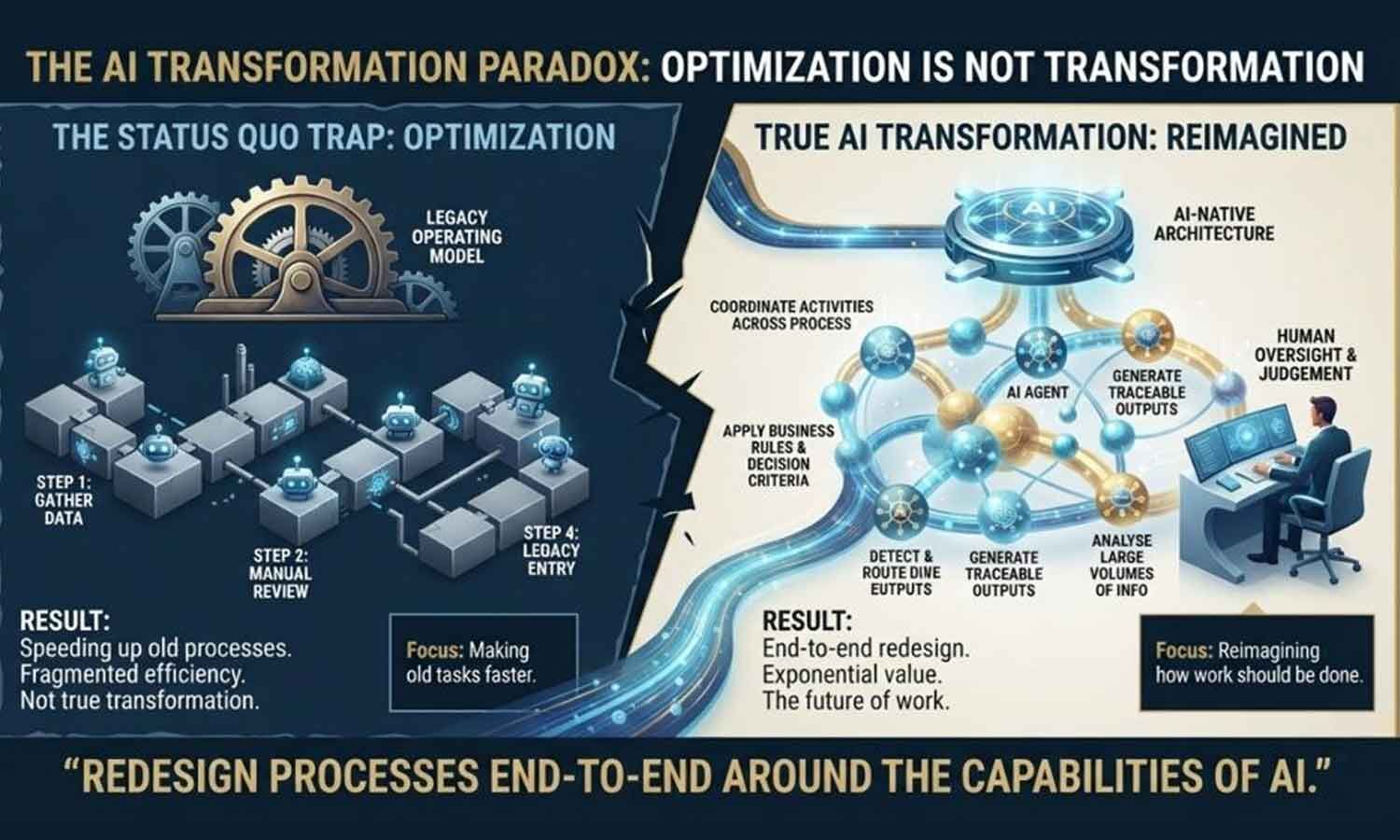
Why AI-Native Workflows Must Replace Old Incremental Automation

Enterprise AI’s Value Depends on Execution, Not Context Alone
India Weighs Access as AI Makes Radiotherapy More Precise

AI in Indian Healthcare: Remote Monitoring, ICU Optimization Drive Growth

AI Reshapes Patient-Centric Healthcare and Life Sciences Progress

CCI Warns AI Could Accelerate Anti-Competitive Digital Practices