1 year ago
New Method Advances Study of Stellar Atmospheres
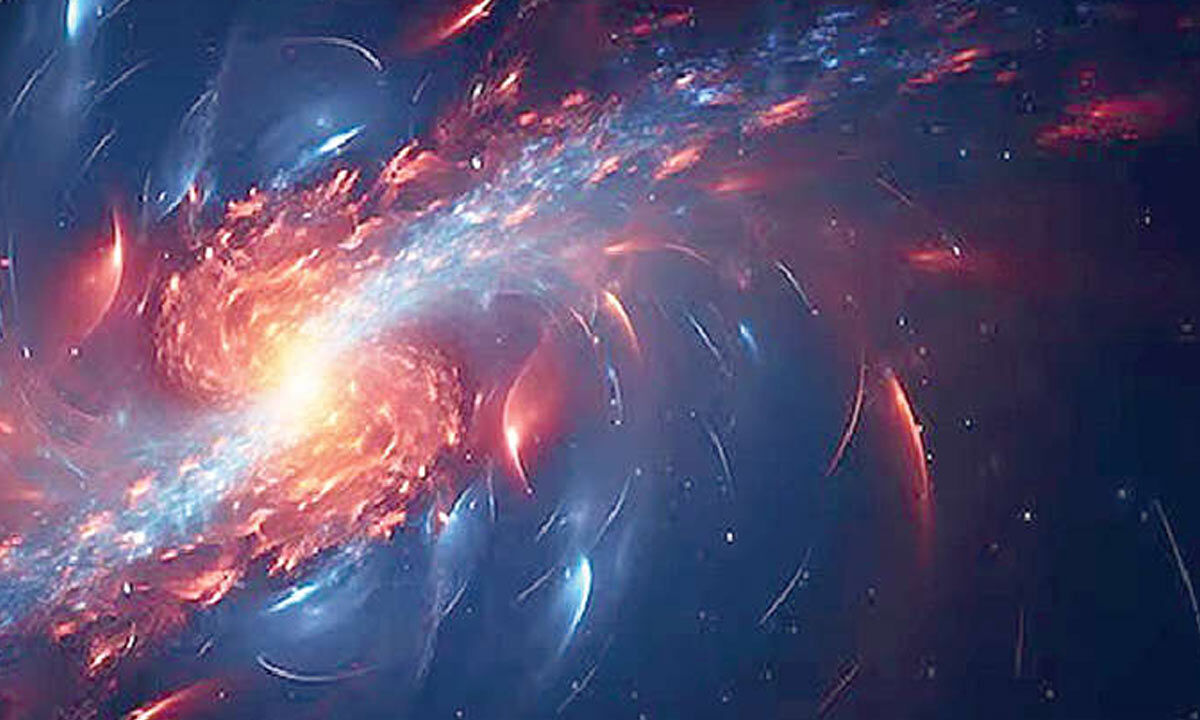
Imagine stars have colorful coats of light around them, and scientists use this light to learn about them.
Scientists have created new ways to study this light, making their star-pictures more accurate.
The old ways assumed the light behaved in a simple way, but the new way acknowledges how complicated the light's behavior can be.
This new method considers atoms with different energy levels and their movements.
It includes processes like Raman scattering that were previously approximated.
The result is more realistic simulations of the light, enabling astronomers to understand stars better.
This could help understand what's happening in stars, and the clouds of gas and dust around them.

Scientists developed a new method for computing stellar atmosphere properties.
The method allows for more realistic simulations of stellar spectra.
The research was published in the journal Astronomy & Astrophysics.
The new method addresses the complexities of full non-local thermodynamic equilibrium (FNLTE).
The team is working on generalizing the method for more complex atoms and faster computation.
- Who
- Scientists from IIA and IRAP
- What
- Developed a new method to simulate stellar spectra with unprecedented realism.
- Where
- Indian Institute of Astrophysics (IIA), IRAP, France
- When
- Published in Astronomy & Astrophysics journal
- Why
- To improve the accuracy of stellar atmosphere simulations.
Key facts
- Research Focus
- Stellar atmosphere properties
- Key Achievement
- Developing method to compute more realistic stellar atmospheres
- Involved Parties
- Scientists from the Indian Institute of Astrophysics (IIA) and IRAP, France
- Publication
- Astronomy & Astrophysics journal
- Advance Type
- Computational Astrophysics
Quotes
Sampoorna M
A researcher at the Indian Institute of Astrophysics (IIA)
“The major conceptual jump from two to three or more atomic levels has now been made.”
 thehansindia.com