3 weeks ago
Centre opposes Supreme Court plea for income-based reservation sub-quota

In India, some groups of people get extra help called 'reservations' when applying for government jobs and school seats.
This help exists because these groups faced unfair treatment for a very long time.
Someone asked India's highest court to say that within each of these groups, the poorest members should get help first.
India's government said no.
It explained that the help is based on history and social conditions, not just how much money a person has.
The government also said that only Parliament, not the courts, can decide how reservations work.
There is a rule called the 'creamy layer' that stops the better-off members of a group from getting help.
The government says this rule applies to Other Backward Classes, but not to Scheduled Castes and Scheduled Tribes.
In 2024, seven judges allowed these groups to be split into smaller subgroups for reservations.
Some judges suggested finding the 'creamy layer' among those groups, but the government said it would not act on that idea.

The Union government opposed a Supreme Court petition seeking income-based prioritisation within SC, ST and OBC reservations.
The Centre argued quotas are based on historical and social backwardness, not economic status alone, and called the petition 'misconceived'.
The government said framing reservation policy is within the executive's domain, and only Parliament can alter quota lists.
The Centre said the creamy layer principle applies only to OBC reservations, not to Scheduled Castes and Scheduled Tribes.
The case, Ramashankar Prajapati versus Union of India, follows an August 2024 verdict permitting SC/ST sub-classification and a March ruling on OBC creamy layer status.
- Who
- The Union government and petitioner Ramashankar Prajapati, in a case before the Supreme Court of India
- What
- The Centre opposed a plea seeking income-based prioritisation within SC, ST and OBC reservations
- Where
- Supreme Court of India
- When
- Thursday, when the government filed its response; the case follows an August 2024 Constitution bench verdict and a March Supreme Court ruling
- Why
- The government says reservations rest on historical and social backwardness, economic criteria alone cannot justify changes, and only Parliament can amend reservation lists
Petitioners and Reform Advocates
Union Government
Income-based sub-quota within reservations
Petitioners and Reform Advocates
Economically weaker persons within each reserved category should get priority through sub-classification within the reservation matrix.
Union Government
The Constitution does not allow reservation lists to be changed on economic criteria alone; quotas reflect historical and social backwardness and only Parliament can set the lists.
Creamy layer for Scheduled Castes and Scheduled Tribes
Petitioners and Reform Advocates
Four of the seven judges in the August 2024 verdict called for identifying the creamy layer among SC and ST so better-off members can be removed from reservations.
Union Government
The creamy layer principle applies only to OBC reservations; excluding economically-advanced SC and ST members would undermine the concept of social backwardness, and the government would not act on non-binding suggestions.
Key facts
- Petitioners' demand
- Income-based sub-quota so economically weaker persons within each reserved category get priority
- Government position
- Quotas are based on historical and social backwardness, not economic status alone
- Case name
- Ramashankar Prajapati versus Union of India
- Authority over quota lists
- Only Parliament can amend reservation lists under Articles 341, 342 and 342A
- Creamy layer applicability
- Applies only to OBC reservations, not to SC and ST reservations
- August 2024 ruling
- Seven-judge bench allowed SC/ST sub-classification based on empirical data in a 6:1 verdict
- March ruling
- Parental income alone cannot determine OBC creamy layer status
Quotes
Union Minister of Finance and other government officials
Official representing the Indian Union government
“The Constitution does not allow for changes to be made to reservations merely on economic criteria. Only Parliament can make changes to the quota lists based on historical, social and educational backwardness.”
 scroll.in
“The creamy layer principle is not applicable in the context of reservations for the Scheduled Castes and Scheduled Tribes.”
scroll.in
Centre (Indian Ministry of Social Justice and Empowerment)
Indian government affidavit presented to the Supreme Court
“The criteria for inclusion in the Scheduled Caste, Scheduled Tribe, and Socially and Educationally Backward Class lists are based on historical, social, and economic backwardness. Scheduled Castes face historical disadvantage from untouchability, while Scheduled Tribes exhibit distinct cultures, geographical isolation, and backwardness. Socially and Educationally Backward Classes are identified by social, educational, and economic disadvantages, along with a lack of representation in services.”
 livemint.com
“These criteria are not spelt out in the Constitution but have become well established. Thus, the identification of Scheduled Castes (SCs), Scheduled Tribes (STs), and Socially and Educationally Backward Classes (SEBCs)/Other Backward Classes (OBCs) is based on historical and social criteria like caste, tribe, and social backwardness, not solely on economic status.”
livemint.com
Sources

Related news
Centre Opposes Income-Based Sub-Quotas, Says Parliament Must Decide Creamy Layer

'Creamy layer' not applicable to SC/ST quota, govt tells SC

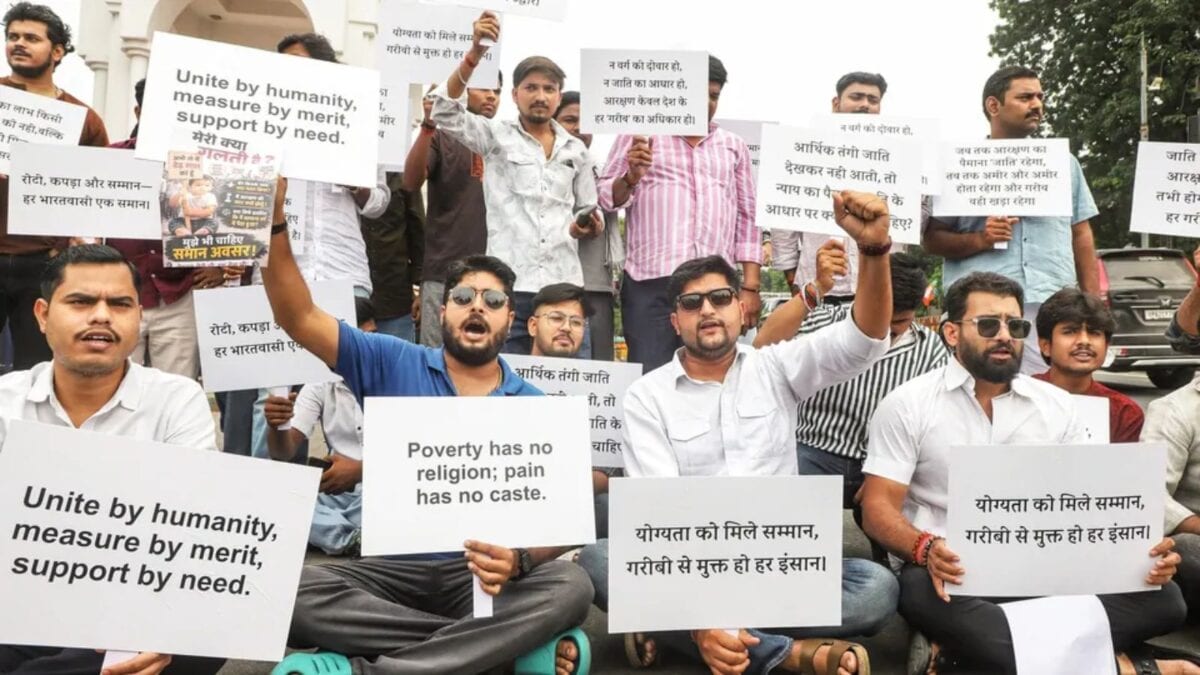
Delhi Protesters Demand Economic Criteria Instead of Caste Quotas

Centre Says Creamy Layer Not Applicable to SC, ST Quotas

Centre's OBC Plea Challenged After Supreme Court Salary Ruling

NDA Ministers Clash Over SC/ST Quota Within Quota

Panel Flags Scholarship Delays, OBC Target Cut, SC Shortfalls
Congress Calls Free Coaching Plan a Gimmick, Condemns Ahmedabad Assault
Why Census 2027 Must Count Nomadic Tribes Separately
AIIMS Bhopal and Brahma Kumaris Launch Anti-Addiction Campaign

NCSK to Celebrate 32nd Foundation Day on August 23