

1 hr ago
India Weighs Lunar Ambitions Amid Rising Space Competition
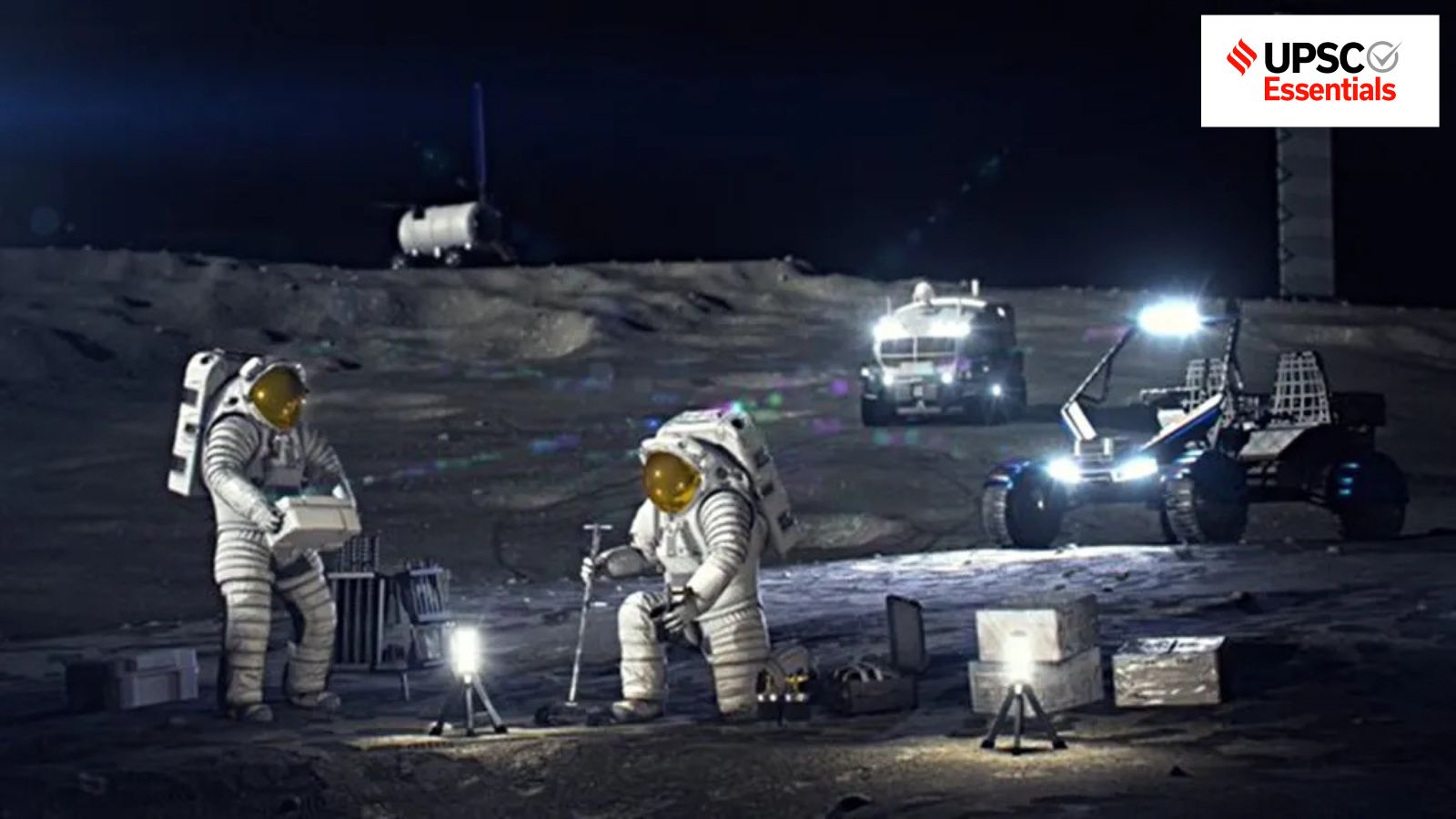
The Moon is becoming important for more than science.
Countries are interested in useful locations and possible resources there.
India wants an indigenous space station by 2035 and an astronaut on the Moon by 2040.
It has joined the United States-led Artemis Accords and was invited to NASA’s Moon Base programme.
Chandrayaan-3 showed India could land near the lunar south pole.
Working with other countries can share costs, risks, and technical knowledge.
But space infrastructure can sometimes be used for military purposes, raising concerns about weaponisation.
Different countries also disagree about resource use, safety zones, technology sharing, and rules.
The article says India should cooperate internationally while protecting its own capabilities and supporting broader rules.

India aims to establish an indigenous space station by 2035 and send an astronaut to the Moon by 2040.
The country has joined the United States-led Artemis Accords and was invited to NASA’s Moon Base programme.
Chandrayaan-3 demonstrated India’s ability to land near the lunar south pole using comparatively efficient resources.
Lunar competition is being driven by strategic locations, possible resources, technological sovereignty, and industrial capacity.
India faces challenges involving weaponisation, resource governance, technology transfers, interoperability, funding, debris, and harmful interference.
- Who
- India, the Indian Space Research Organisation, the United States, NASA, China, and Russia are the main actors discussed.
- What
- India is balancing ambitious lunar and human-spaceflight plans with international cooperation, strategic competition, and the absence of explicit outer-space rules.
- Where
- The discussion concerns the Moon, its south pole, cislunar space, and international cooperation discussed from the Paris summit.
- When
- The article refers to remarks made by Prime Minister Narendra Modi at the International Space Summit in Paris last week, and to targets for 2035 and 2040.
- Why
- The Moon is gaining strategic importance because of key locations, possible resources, technological sovereignty, industrial capacity, and geopolitical influence.
Deeper international cooperation
Strategic caution and autonomy
Value of partnerships
Deeper international cooperation
Working with the United States and other space powers can share the high costs and risks of advanced missions, expand technical expertise, and give India greater influence over emerging lunar rules.
Strategic caution and autonomy
Deeper integration may create dependence, unequal burden-sharing, and difficulties caused by different export controls, funding levels, and institutional capacities.
Lunar resource use
Deeper international cooperation
Using lunar water and other resources could support drinking water, oxygen, rocket propellant, and future deep-space operations.
Strategic caution and autonomy
Resource extraction and Artemis safety zones have raised concerns among non-signatory developing countries about compatibility with the Outer Space Treaty’s non-appropriation principle.
Security and infrastructure
Deeper international cooperation
Shared communication, navigation, surveillance, and positioning systems could support safe and sustained lunar activity.
Strategic caution and autonomy
Because much lunar infrastructure is dual-use, it could also support military activities, increase mistrust, and contribute to the gradual weaponisation of cislunar space.
Key facts
- India’s space-station target
- Establish an indigenous space station by 2035.
- India’s lunar-humanflight target
- Send an astronaut to the Moon by 2040.
- Recent Indian achievement
- Chandrayaan-3 became the first mission to land near the lunar south pole.
- International framework
- India signed the United States-led Artemis Accords.
- Moon Base invitation
- India was formally invited to join NASA’s Moon Base programme.
- Competing approaches
- The Artemis framework and the China-Russia-led International Lunar Research Station are described as two major approaches.
- Main legal tension
- The 1967 Outer Space Treaty prohibits national appropriation of celestial bodies, while the Artemis Accords recognise resource use and temporary safety zones.
Sources
Related news

US Invites ISRO Into Moon Base Cooperation, Ambassador Says

Modi Unveils India’s Space Station and Moon Ambitions

Modi Sets 2035 Space Station, 2040 Moon Landing Goals

India’s Space Ambitions Expand From Moon to Mars, Venus
US Invites Indian Space Startups as Moon Partnership Expands
Modi Urges Safe, Sustainable International Cooperation in Space

UPI Merchant Fee Draws Opposition Attack, Government Defence

India Sends 47 Lakh Litres of Diesel to Bangladesh

Rajnath Singh Praises Suvendu Adhikari’s Four-Month Bengal Governance

How Modi-Era Policies Reshaped India’s Digital Economy

Haifa Commemorates Indian Soldiers’ Role in World War I