11 hrs ago
FSSAI Pushes Food Brands From Claims Toward Verifiable Trust
India’s food regulator is asking companies to prove that their product claims are true.
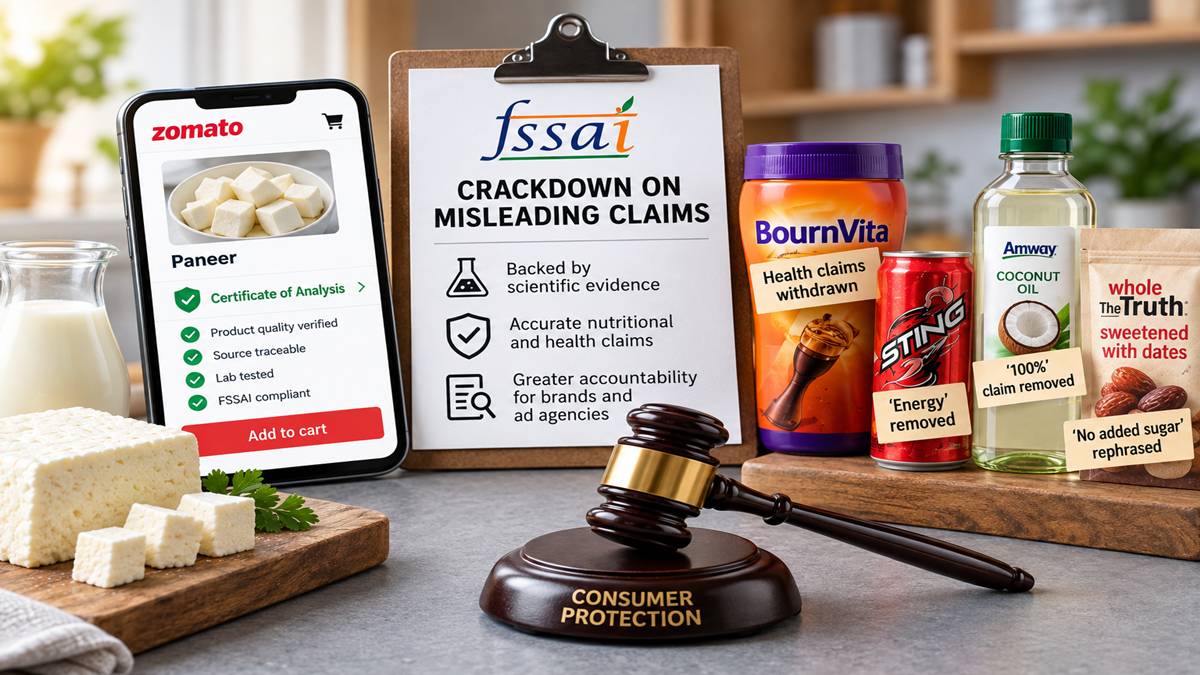
Zomato’s Hyperpure now lets buyers check a certificate for paneer quality and origin.
Zomato also removed analogue dairy products from its platform.
Other companies have changed claims such as “100%,” “no added sugar” and “energy.”
These changes followed notices from the Food Safety and Standards Authority of India.
The regulator said some companies used misleading advertisements or labels.
Experts say customers can quickly check and challenge claims online.
They believe companies should show evidence and fix labels before selling products.
Some experts also want faster recalls and stronger penalties for violations.

Zomato’s Hyperpure introduced in-app Certificates of Analysis for paneer purchases.
Zomato banned analogue dairy products and threatened non-compliant restaurants with delisting.
Several brands recently changed or removed claims involving sugar, energy, health and purity.
FSSAI issued over 150 notices over false claims and labelling violations this year.
Experts called for stronger evidence, transparency, recalls and penalties proportionate to violations.
- Who
- The Food Safety and Standards Authority of India, food and beverage companies, Zomato’s Hyperpure and industry experts.
- What
- Regulatory scrutiny and industry changes over misleading food claims, advertisements and labelling violations.
- Where
- India, across food products, packaging, advertising and online food platforms.
- When
- The latest actions occurred this year, with Hyperpure’s certificate rollout announced on Monday; Volkswagen’s cited emissions scandal dates to 2015.
- Why
- To improve product transparency and protect consumers from false, misleading or unsupported claims.
Stronger enforcement
Greater industry flexibility
Penalties and deterrence
Stronger enforcement
Stronger enforcement, quicker recalls and penalties tied to company size or violation severity are needed to prevent violations from becoming a cost of doing business.
Greater industry flexibility
The articles do not present a direct industry argument against stronger enforcement, but brands are responding by reviewing claims, correcting labels and strengthening compliance.
Evidence behind claims
Stronger enforcement
Regulators and experts argue that brands must demonstrate claims through evidence, transparent ingredients and clearer front-of-pack information.
Greater industry flexibility
Some brands have changed wording after regulatory scrutiny, suggesting that companies may need clearer standards about what evidence is required before making claims.
Responsibility for consumer trust
Stronger enforcement
Marketers, manufacturers and platforms should question claims and build transparency into products, packaging and policies.
Greater industry flexibility
The industry response has included platform controls and revised packaging claims, but the article notes that several direct-to-consumer brands have also faced scrutiny.
Key facts
- Hyperpure initiative
- Zomato’s Hyperpure introduced in-app Certificates of Analysis for paneer purchases.
- Platform policy
- Zomato banned analogue dairy products and said non-compliant restaurant partners could be delisted.
- Regulatory notices
- FSSAI issued over 150 notices to major food and beverage firms this year.
- Advertising violations
- ASCI flagged 331 food and beverage advertising violations in FY26; more than 60% involved misleading health claims.
- Claim changes
- Amway India, Mondelēz, PepsiCo and The Whole Truth removed or revised specified product claims.
- Proposed enforcement
- Experts advocated clearer disclosures, quicker recalls, faster adjudication and penalties proportionate to violations.
Quotes
Yasin Hamidani
Director of Media Care Brand Solutions
“India can move towards greater standardisation and transparency, so brands know exactly what evidence is expected before making a claim, rather than addressing ambiguity after a campaign or pack reaches consumers”
 financialexpress.com
“Marketers can no longer view themselves as translators of a brand’s claims, but they also hold the responsibility of questioning the evidence behind those claims before they reach consumers”
financialexpress.com
Sources
Related news
FSSAI Cracks Down as Bournvita Withdraws Health Claims
FSSAI Notices Prompt Food Firms to Withdraw Misleading Claims
FSSAI Notices Push Food Firms to Withdraw Misleading Claims

FSSAI Action Prompts Bournvita and Amway to Drop Misleading Claims
Nestlé CEO Supports India Crackdown on Misleading Food Labels

FSSAI Expands Dabur Crackdown, Orders Audit of 27 Lines

Wow! Momo Founder Urges Food Platforms to Cut Commissions

Zomato, Blinkit and Valmo Help Delivery Partners Claim Tax Refunds
Zomato, Blinkit Help Gig Workers File Tax Returns

AI May Reshape Indian Jobs, Incomes and Retirement Planning