7 months ago
White Dwarf Star Creates Colorful Shockwave
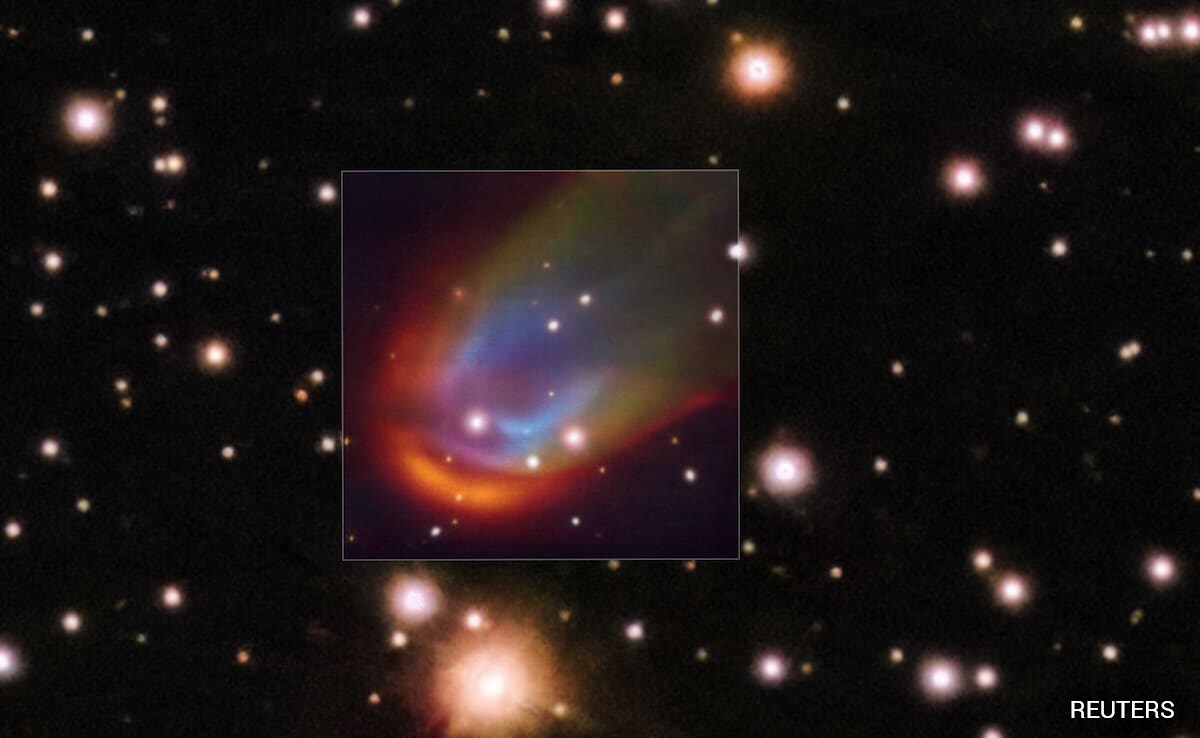
Astronomers have spotted a white dwarf star, which is a tiny but heavy star left behind when a normal star dies.
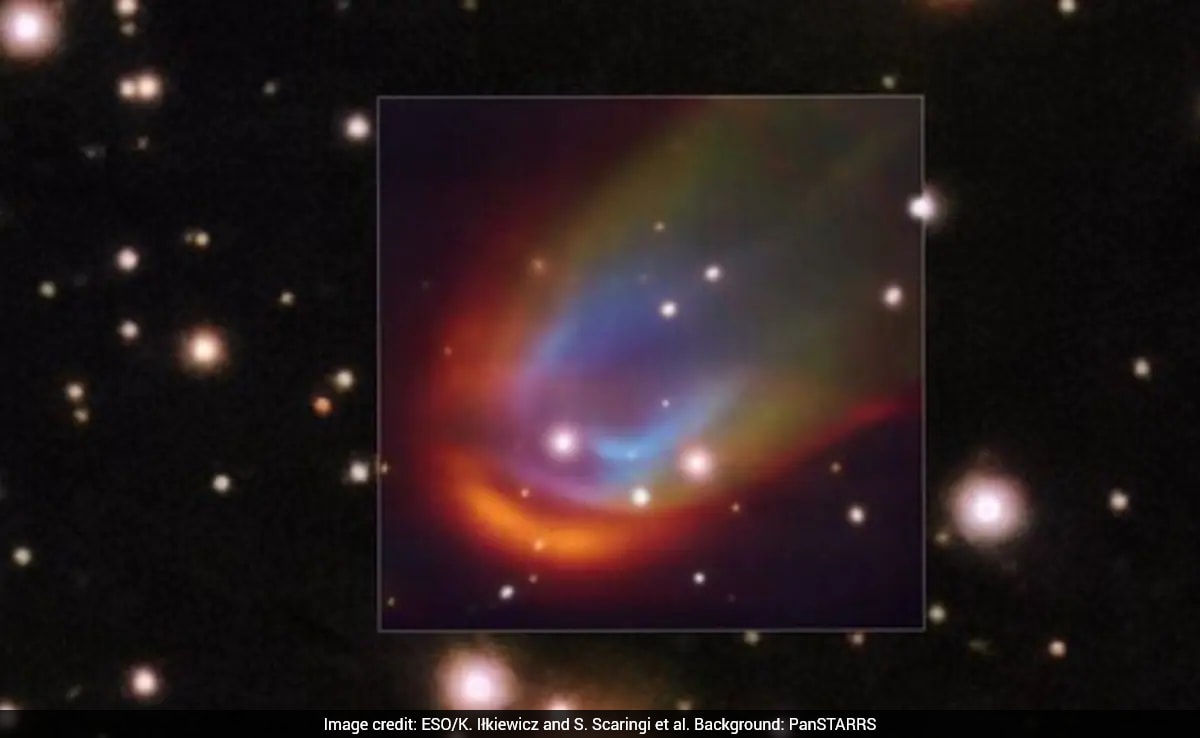
This white dwarf is moving through space and making a colorful shockwave.
The colors come from different gases like hydrogen, nitrogen, and oxygen getting heated up.
The white dwarf is part of a pair of stars, and it's pulling gas from its partner.
Scientists are puzzled because they don't fully understand how the shockwave is being created.
The shockwave has been happening for at least 1,000 years.
This discovery reminds us that space is not empty but full of dynamic and exciting things.

A white dwarf star is creating a colorful shockwave as it moves through space, observed by astronomers using the Very Large Telescope.
The white dwarf is part of a binary system, siphoning gas from its red dwarf companion, which orbits it every 80 minutes.
The shockwave, or bow shock, is caused by the white dwarf's movement and the collision of its ejected material with interstellar gas.
The colors in the shockwave represent different gases: red for hydrogen, green for nitrogen, and blue for oxygen.
Scientists are puzzled because the white dwarf lacks a gas disk, and the mechanism behind the shockwave is not fully understood.
- Who
- Astronomers using the Very Large Telescope
- What
- Observed a white dwarf creating a colorful shockwave
- Where
- In the constellation Auriga, 730 light-years from Earth
- When
- The study was published on Monday
- Why
- The white dwarf is siphoning gas from its binary companion, creating a shockwave as it moves through space
Key facts
- Distance from Earth
- 730 light-years
- Constellation
- Auriga
- Observation Tool
- Very Large Telescope
- White Dwarf Mass
- Comparable to the sun
- Binary Companion
- Red dwarf star
- Orbital Period
- 80 minutes
- Shockwave Duration
- At least 1,000 years
Quotes
Simone Scaringi
Astronomer at Durham University in the UK
“We found something never seen before and, more importantly, entirely unexpected. The surprise that a supposedly quiet, diskless system could drive such a spectacular nebula was one of those rare 'wow' moments.”
 NDTV
NDTV
Krystian Ilkiewicz
Astronomer at the Nicolaus Copernicus Astronomical Center in Poland
“Our observations reveal a powerful outflow that, according to our current understanding, shouldn't be there. Our finding shows that even without a disc, these systems can drive powerful outflows, revealing a mechanism we do not yet understand. This discovery challenges the standard picture of how matter moves and interacts in these extreme binary systems.”
NDTV