1 month ago
Scientists Discover Unusual Planetary System in Milky Way

Scientists have found a strange new planetary system in the Milky Way.
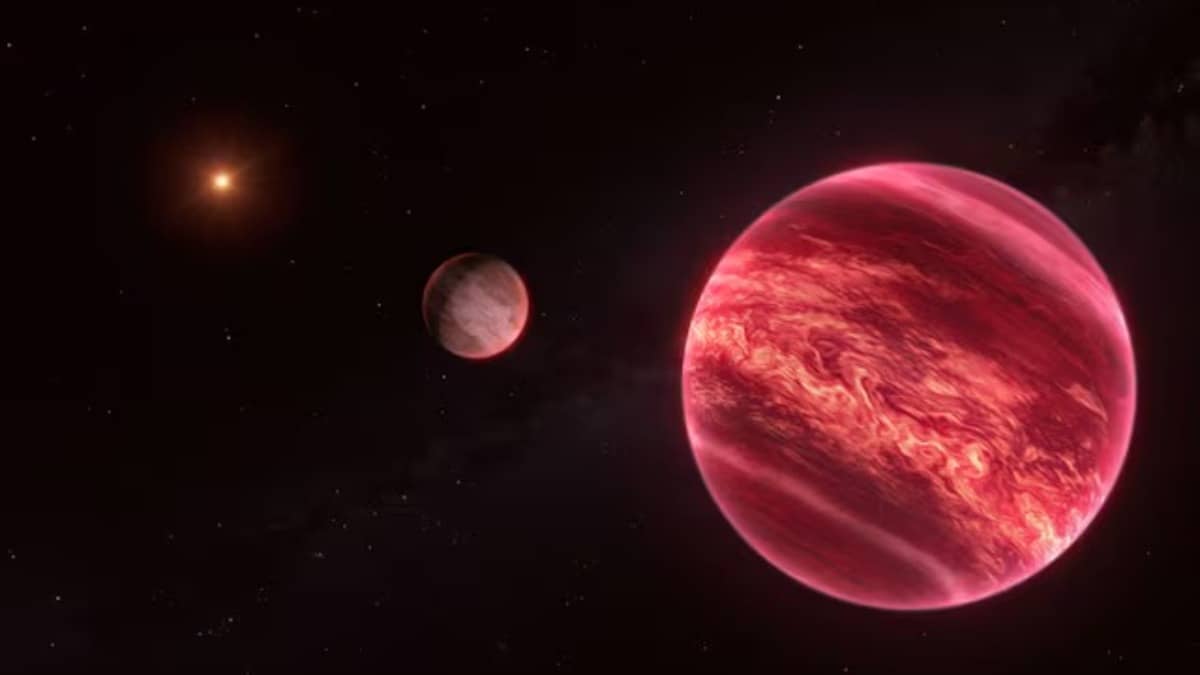
It has a small red star, a brown dwarf (which is like a star that didn't quite become a star), and a huge gas planet orbiting the brown dwarf.
This gas planet is so big and different from any moon in our solar system that scientists are not sure what to call it.
They are debating whether to call it an exosatellite.
The system is very far away, about 71 light-years from Earth.
The brown dwarf is much bigger and hotter than Jupiter, and the gas planet is almost as big as Jupiter.
Scientists are trying to figure out how this system formed and if there are more like it.

Scientists discovered a unique planetary system in the Milky Way with a red dwarf star, a brown dwarf, and a Jupiter-sized exosatellite.
The exosatellite is at least 90% the mass of Jupiter and orbits the brown dwarf every 170 days.
The brown dwarf is 33 times more massive and 50% larger than Jupiter, and much hotter.
Scientists are debating the terminology for the exosatellite, with 'exosatellite' being a placeholder term.
The system is about 71 light-years away from Earth and is considered an outlier among known planetary systems.
- Who
- Scientists from the European Southern Observatory and Universidad Diego Portales
- What
- Discovered a unique planetary system with a red dwarf star, a brown dwarf, and a Jupiter-sized exosatellite
- Where
- Milky Way galaxy, about 71 light-years from Earth
- When
- Published on July 22, 2026
- Why
- To understand the formation and commonality of such objects
Terminology Debate
Scientific Exploration
Terminology Debate
Terminology Debate
The term 'exosatellite' is a placeholder until formal definitions are adopted for objects like the newly discovered one.
Scientific Exploration
The discovery opens a Pandora's box for the scientific community, requiring new definitions and understanding of such objects.
Key facts
- Distance from Earth
- 71 light-years
- Mass of Red Dwarf Star
- 40% of the mass of our sun
- Mass of Exosatellite
- At least 90% of the mass of Jupiter
- Orbital Period of Exosatellite
- 170 days
- Size of Brown Dwarf
- 50% larger than Jupiter
- Mass of Brown Dwarf
- 33 times more massive than Jupiter
- Temperature of Brown Dwarf
- Much hotter than Jupiter
Quotes
Alice Zurlo
astrophysicist and YEMS director
“This will certainly be a matter of debate. In general, most astronomers are fine with the term exosatellite, at least as a placeholder until we formally adopt definitions for objects like the one we found.”
 republicworld.com
“I think this discovery has opened a Pandora's box for the scientific community. This type of object is completely new and unusual, truly different from what we are familiar with in our solar system.”
republicworld.com