

7 months ago
IUCAA Scientists Discover Malin 1 Cannibalizing Dwarf Galaxies
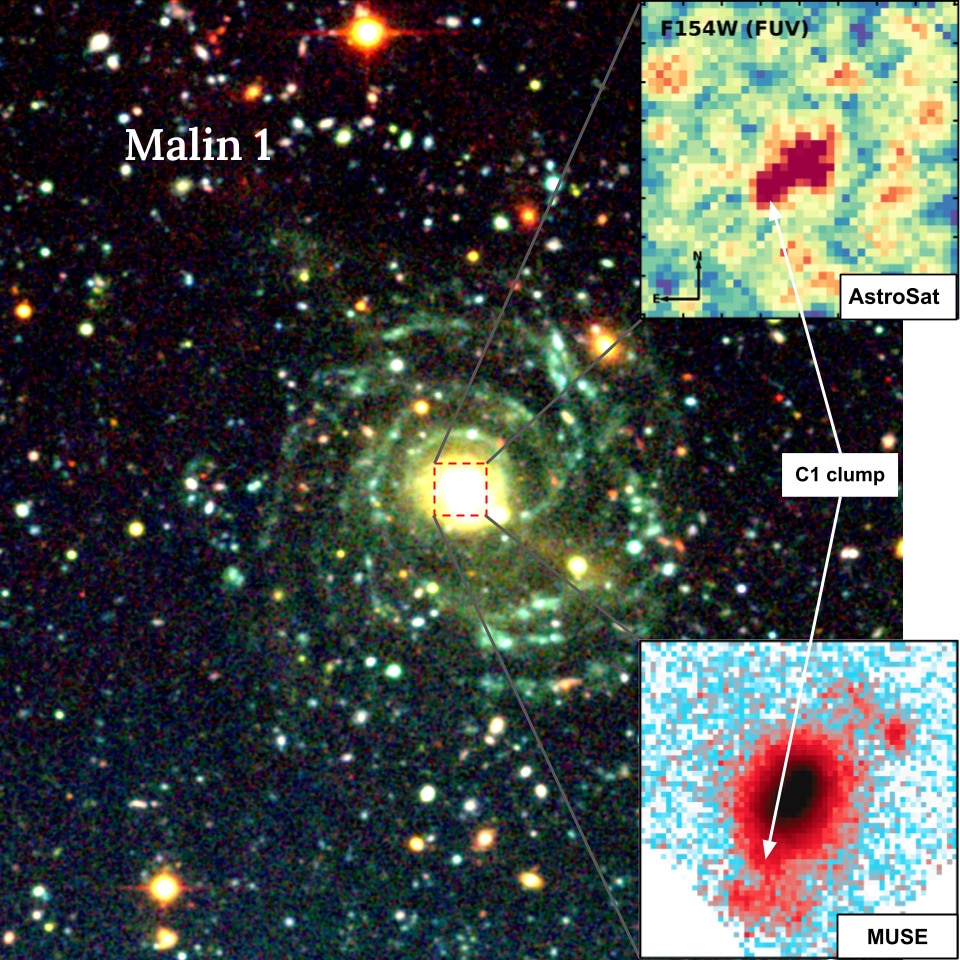
Scientists from Pune have found that a big galaxy called Malin 1 is eating smaller galaxies.
They used special telescopes to see that Malin 1 has bright spots where new stars are forming.
These spots are actually pieces of smaller galaxies that Malin 1 is pulling apart.
The scientists think this process is helping Malin 1 grow.
They also found that the bright spots are moving very fast and have young stars, which shows that Malin 1 is still changing and growing by eating these smaller galaxies.

Scientists from IUCAA, Pune discovered that Malin 1, the largest known low-surface-brightness galaxy, is cannibalizing dwarf galaxies.
The team identified young star-forming clumps in Malin 1's central region using the Ultraviolet Imaging Telescope (UVIT) onboard AstroSat.
The C1 clump in Malin 1's central region is moving 150 km/s faster than the surrounding material, suggesting it is an infalling dwarf galaxy.
The study found that the C1 clump has a young stellar population with rapid enrichment, indicating it is the remnant of a dwarf galaxy being cannibalized.
The findings were published in the Astrophysical Journal Letters in December 2025, shedding light on the growth of giant, low-surface-brightness galaxies.
- Who
- Scientists from IUCAA, Pune, led by Manish Kataria and supervised by Prof Kanak Saha
- What
- Discovered that Malin 1, the largest known low-surface-brightness galaxy, is cannibalizing dwarf galaxies
- Where
- Observations made using UVIT onboard AstroSat and MUSE on VLT in Chile
- When
- Findings published in December 2025
- Why
- To understand the growth of giant, low-surface-brightness galaxies and their impact on galaxy formation theories
Key facts
- Galaxy
- Malin 1
- Research Institution
- Inter-University Centre for Astronomy and Astrophysics (IUCAA), Pune
- Lead Author
- Manish Kataria
- Supervisor
- Prof Kanak Saha
- Telescopes Used
- Ultraviolet Imaging Telescope (UVIT) onboard AstroSat, Multi-Unit Spectroscopic Explorer (MUSE) on the Very Large Telescope (VLT) in Chile
- Key Finding
- Malin 1 is cannibalizing dwarf galaxies, with evidence of young star-forming clumps in its central region
- Publication
- Astrophysical Journal Letters (December 2025)
- Clump Velocity
- 150 km/s faster than surrounding material
Quotes
Manish Kataria
Lead author of the study and PhD student at IUCAA
“Understanding how giant, low-surface-brightness (GLSB) galaxies like Malin 1 grow is crucial, as their enormous, faint structures challenge existing galaxy formation theories.”
 indianexpress.com
Researchers
Scientists involved in the study
“This is unexpected, given that the central region is otherwise quenched, settled, and appears undisturbed. Moreover, the C1 clump appears only in certain velocity channel maps—strongly suggesting it has an external origin, likely a dwarf galaxy being cannibalised.”
indianexpress.com
Prof Kanak Saha
Supervisor of the project and professor at IUCAA
“Thanks to the integral-field data from MUSE and the careful analysis by Manish, this idea was confirmed: Malin 1 is silently cannibalising smaller dwarf galaxies, a process that is transforming its central region.”
indianexpress.com