

1 week ago
West Bengal Faces Fiscal Stress, But Not Literal Bankruptcy
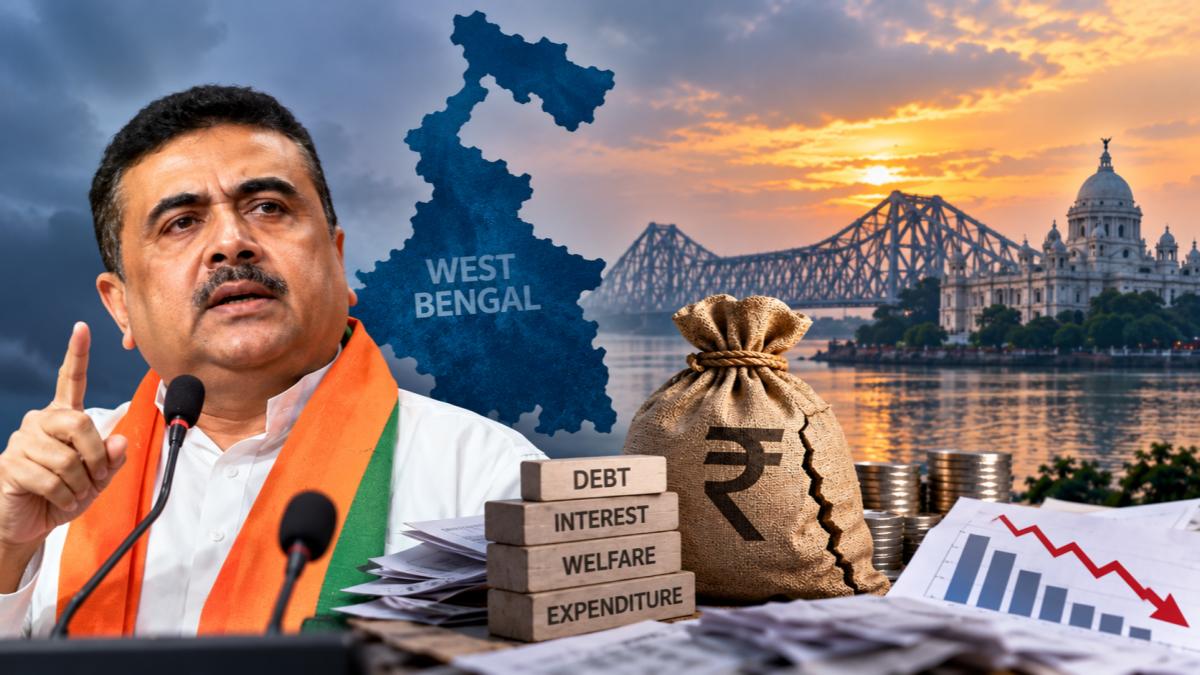
West Bengal has a lot of debt and must pay large amounts of interest.
Much of the state’s income is already committed to salaries, pensions, subsidies and debt payments.
This leaves less money for roads, buildings and other development.
The state’s budgeted fiscal deficit is still below the recommended limit for states.
Its debt ratio has also fallen from its pandemic-era level.
The government plans to raise more money through taxes and receive more funds through Central schemes.
These plans may help, but they depend on collecting the expected revenue and receiving the grants.
The state also has large welfare programmes that cost substantial amounts.
Therefore, West Bengal is under serious financial pressure, but it is not technically bankrupt.

West Bengal’s fiscal deficit is budgeted at Rs 62,421 crore, or 2.9% of GSDP, for 2026-27.
Outstanding liabilities stood at Rs 7.02 lakh crore, equal to 38.66% of GSDP, at the end of March 2025.
Salaries, pensions and interest payments are projected to consume Rs 1.62 lakh crore, or 51% of revenue receipts.
The government expects revenue receipts to rise 31% and own-tax revenue to grow 17% in 2026-27.
The state continues to collect taxes, receive Central transfers and borrow, so the data indicate financial stress rather than literal bankruptcy.
- Who
- West Bengal Chief Minister Suvendu Adhikari and the state government.
- What
- The government is addressing high debt, interest costs, welfare spending and limited fiscal space.
- Where
- West Bengal, India.
- When
- The assessment concerns the 2026-27 budget and finances through March 2025.
- Why
- Years of debt accumulation, weak revenue collection, fixed expenses, subsidies and welfare commitments have increased financial pressure.
Fiscal-distress claim
Not technically bankrupt
Meaning of the financial crisis
Fiscal-distress claim
Suvendu Adhikari says years of fiscal mismanagement, revenue leakage and other problems have left West Bengal practically bankrupt.
Not technically bankrupt
The data show serious financial stress, but the state still collects taxes, receives Central funds, borrows from the market and has a growing economy.
Debt trajectory
Fiscal-distress claim
The state’s Rs 7.02 lakh crore liability, high interest bill and large fixed expenses leave limited room for other spending.
Not technically bankrupt
Debt as a share of GSDP has fallen from 42.6% in 2020-21 to 38.66% in March 2025 and is budgeted to decline further.
Recovery prospects
Fiscal-distress claim
Welfare commitments, weak own-tax revenue and dependence on Central grants could make the government’s one-year recovery target difficult.
Not technically bankrupt
The government expects higher tax revenue, more Central-scheme funding and increased capital spending to improve its finances.
Key facts
- 2026-27 fiscal deficit
- Rs 62,421 crore, or 2.9% of GSDP
- Outstanding liabilities
- Rs 7.02 lakh crore, or 38.66% of GSDP, at the end of March 2025
- Interest provision
- Rs 53,034 crore
- Debt repayment provision
- Rs 54,607 crore
- Fixed spending
- Salaries, pensions and interest are projected to absorb Rs 1.62 lakh crore, or 51% of revenue receipts
- Revenue target
- Revenue receipts are projected to rise 31% to Rs 3.20 lakh crore in 2026-27
- Welfare allocation
- Rs 36,000 crore is budgeted for Annapurna Bhandar
- Central transfers
- Transfers from the Centre are projected to provide about 57% of revenue receipts
Sources
Related news
West Bengal Economy Shows Slow Recovery, Chief Minister Says
West Bengal Ties ₹3,000 Welfare Payments to Economic Growth

CAG Flags Rajasthan Fiscal Deficit Breaches Across Successive Governments
Opposition Calls Karnataka Coastal Budget Financially Unviable
Bengal BJP Government Marks 100 Days, Sets Six Goals

Poll Sweeteners Cross Borders, Reshaping Modern Electoral Politics

Heatwave Relief Recognition Raises Questions About Counting Deaths
GDP Base Revision Debate Should Not Obscure India’s Growth

Andhra Pradesh Restores 34% BC Reservation in Rural Bodies
