1 hr ago
UCL Scientist Develops Light-Driven Atomic Hydrogen Method at Room Temperature
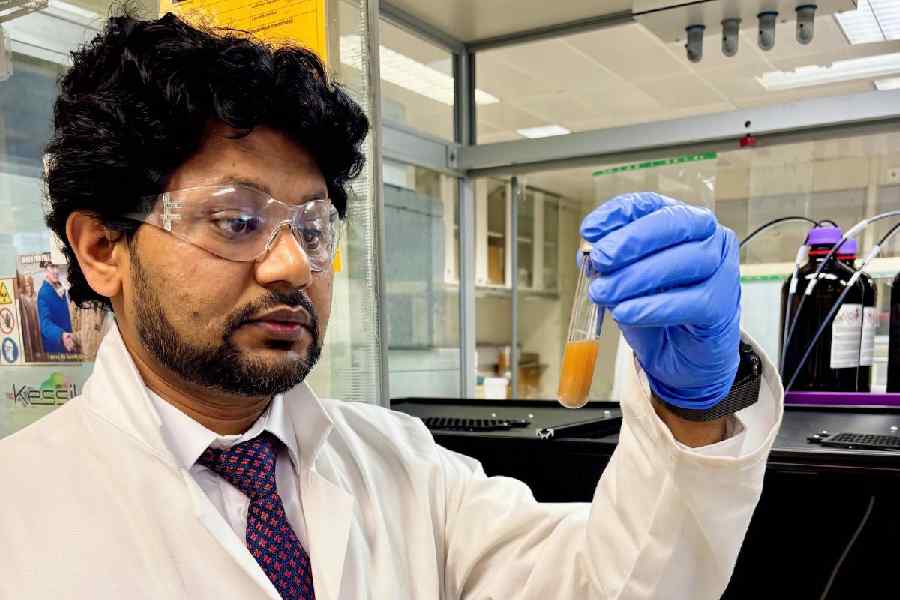

Roopender Kumar and colleagues at University College London developed a light-driven method to generate atomic hydrogen at room temperature.
The process uses hydrazine, thiophenol and near-ultraviolet light from a standard laboratory lamp or LED.
Unlike earlier approaches, the method does not require extreme heat, mercury vapour or specialised equipment.
The researchers demonstrated metal-free hydrogenation of organic molecules, potentially reducing metal contamination in pharmaceutical manufacturing.
An outside chemist called the work notable but cautioned that reliance on ultraviolet light could limit practical applications.
- Who
- Roopender Kumar and colleagues at University College London developed the method; Swadhin Mondol commented independently on the research.
- What
- A light-driven chemical process generates atomic hydrogen at room temperature and demonstrates metal-free hydrogenation.
- Where
- University College London; the method operates in liquid form under laboratory conditions.
- When
- The research was reported after publication in the peer-reviewed Journal of the American Chemical Society; the article does not provide a publication date.
- Why
- To make atomic hydrogen more accessible for chemical synthesis and potentially support applications such as metal-free pharmaceutical manufacturing.
Potential benefits
Remaining limitations
Practicality of atomic hydrogen generation
Potential benefits
The UCL team says a flask and a lamp can generate synthetically useful atomic hydrogen using inexpensive reagents, without mercury or extreme conditions.
Remaining limitations
Swadhin Mondol said the work is notable but cautioned that practical applications may take time, partly because the method relies on ultraviolet light.
Industrial applications
Potential benefits
The method could potentially help pharmaceutical manufacturing avoid expensive removal of residual metal catalysts and might offer milder approaches for semiconductor cleaning or water treatment if scaled up.
Remaining limitations
The article says these applications remain potential outcomes; the researchers have not yet established that the method can be scaled for them.
Key facts
- Lead researcher
- Roopender Kumar, assistant professor of chemistry at University College London
- Reagents
- Hydrazine and thiophenol
- Light source
- Near-ultraviolet light from a standard laboratory lamp or light-emitting diode
- Operating conditions
- Liquid form at room temperature
- Demonstrated use
- Metal-free hydrogenation of organic molecules
- Publication
- Journal of the American Chemical Society
- Key limitation
- The method still relies on ultraviolet light, which may limit applicability
Quotes
Roopender Kumar
Assistant professor of chemistry at University College London and leader of the research
“That work was important, but it required toxic mercury vapour and a specialised UV lamp and the reaction worked only in vapour phase. Our method uses simple reagents, no mercury, a standard light-emitting diode, and works in liquid form at ordinary room temperatures.”
 telegraphindia.com
“Our work resolves a long-standing challenge to make the smallest atom in the universe easily available for chemical synthesis — a flask and a lamp can now do what the extreme conditions could not.”
telegraphindia.com
Sources
Related news
IIT-Guwahati researchers develop low-cost catalyst for cleaner hydrogen production

IIT-Guwahati Unveils Low-Cost Catalyst For Green Hydrogen Production

DRDO, University of Hyderabad Researchers Patent New Rocket Propellant

Andy Green sets hydrogen-powered land speed record at Bonneville

UoH Professor Wins Top Ewald Prize for Crystallography Work
Jitendra Singh Urges Startups to Drive Lab-to-Market Technology Transfer

India Wins 4 Golds, Shares Rank 1 At 2026 Chemistry Olympiad

Bhawanipur College Hosts International Chemistry Conference

IISER Kolkata Hosts Maths Lecture for Students