1 hr ago
UoH Researchers Uncover How Tomatoes Move Phosphate Between Tissues
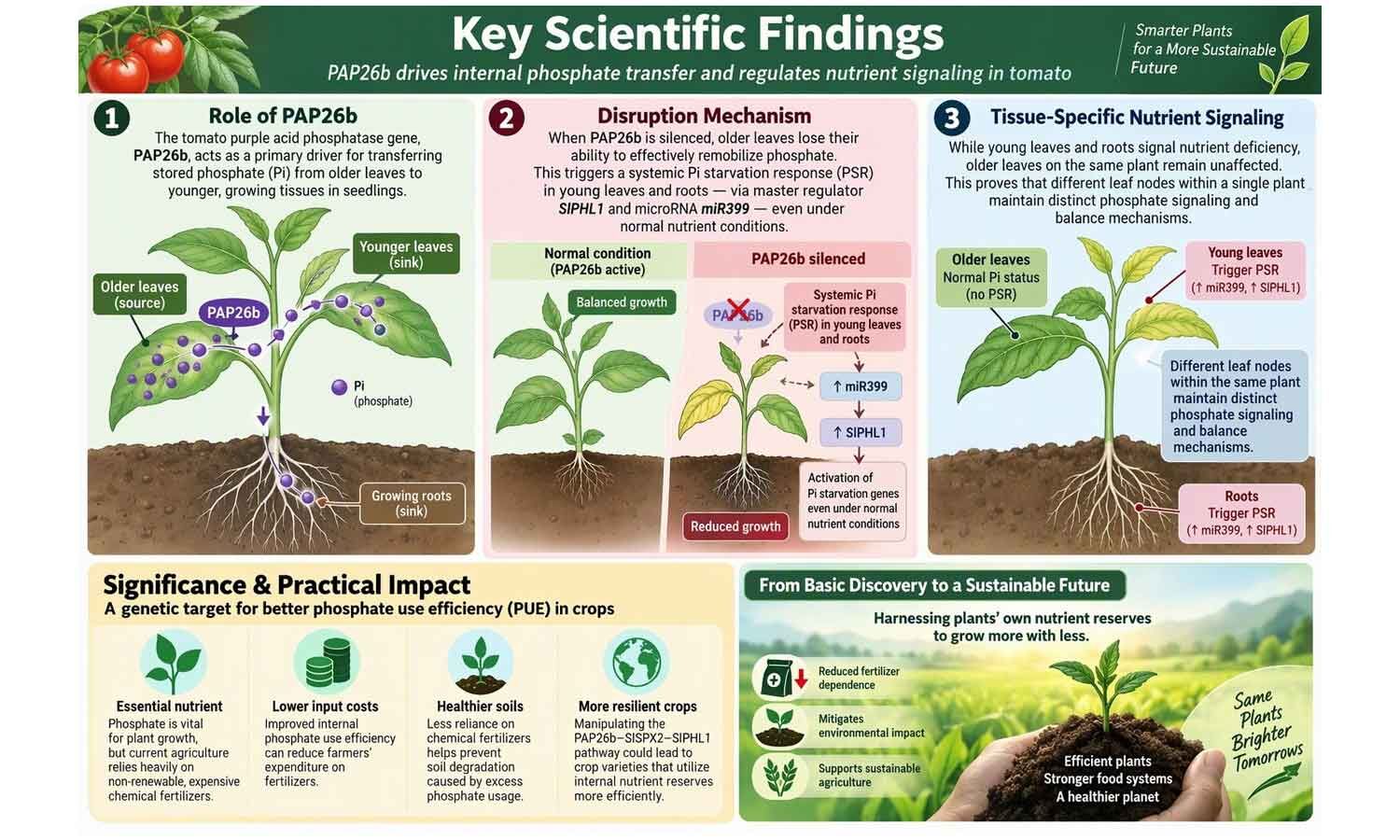
Plants need phosphate to grow.
Tomato plants can move phosphate stored in older leaves to parts that are still growing.
Researchers at the University of Hyderabad studied a gene called PAP26b that helps with this movement.
When they silenced the gene, older leaves moved less phosphate.
Younger leaves and roots then showed signs of not getting enough phosphate, even when the plants had normal amounts available.
The researchers also studied how phosphate signals are controlled in different parts of the plant.
Their findings may help scientists learn how crops can use phosphate more efficiently.
This matters because phosphate fertilisers are widely used and phosphate resources are finite.

University of Hyderabad researchers studied the tomato gene PAP26b and its role in moving phosphate from older leaves to growing tissues.
The study was conducted by Abhishek Roychowdhury and colleagues under Professor Rahul Kumar at UoH’s Tomato Lab.
The research was published in the Journal of Experimental Botany.
Silencing PAP26b reduced phosphate remobilisation from older leaves and was linked to phosphate-starvation responses in younger leaves and roots, even under normal phosphate conditions.
The findings highlight tissue-specific phosphate signalling and may guide future research into improving crop phosphate-use efficiency.
- Who
- Researchers from the University of Hyderabad, including Abhishek Roychowdhury and colleagues working under Professor Rahul Kumar.
- What
- A study examined how tomato PAP26b helps remobilise phosphate and how this relates to phosphate signalling across plant tissues.
- Where
- The Tomato Lab, Department of Plant Sciences, School of Life Sciences, University of Hyderabad.
- When
- The article does not state when the research was conducted; it says the study has been published in the Journal of Experimental Botany.
- Why
- To understand how plants store, move and signal phosphate, with potential relevance to research on improving crop nutrient-use efficiency.
Key facts
- Study title
- “Tomato purple acid phosphatase PAP26b mediates tissue-specific phosphate remobilization by modulating the SlSPX2–SlPHL1 regulatory module”
- Journal
- Journal of Experimental Botany
- Institution
- University of Hyderabad
- Gene studied
- Tomato PAP26b
- Main finding
- PAP26b contributes to transferring stored phosphate from older leaves to growing tissues.
- Effect of silencing PAP26b
- Reduced phosphate remobilisation from older leaves, alongside phosphate-starvation responses in younger leaves and roots under normal phosphate conditions.
- Potential relevance
- The findings may inform future research into crop phosphate-use efficiency and reducing reliance on external fertiliser inputs.
Sources
Related news

University of Hyderabad Patents Nanoparticle Platform for Reproductive Health

Bodangparthy Researcher Ravi Kumar Awarded PhD by JNTU

University of Hyderabad Patents Multi-Purpose Women’s Health Formulation
Gujarat Natural Farming Trial More Than Doubles Turmeric Output

Coffee Waste Helps Restore Costa Rican Forests In Two Years