1 hr ago
Coffee Waste Helps Restore Costa Rican Forests In Two Years
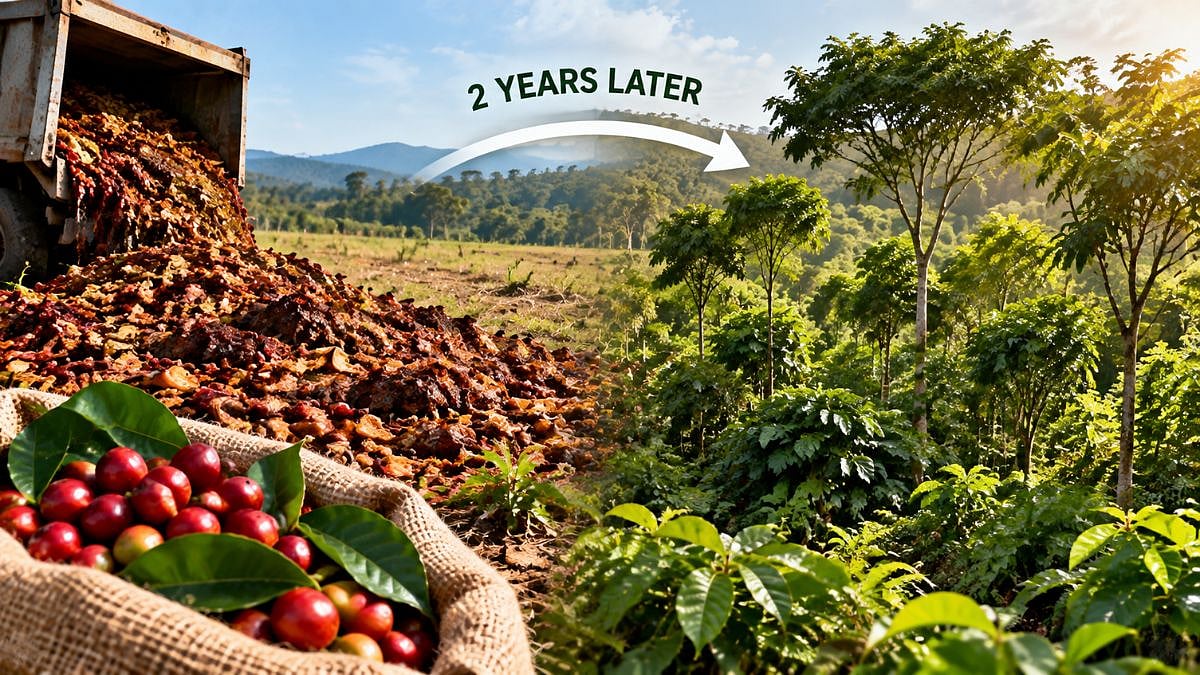
Scientists wanted to see whether coffee waste could help a damaged field become a forest.
They spread a thick layer of coffee pulp on an old pasture in Costa Rica.
The pulp covered the grass and helped it break down.
After two years, most of the grass was gone from the treated area.
Seeds carried by wind and animals then grew into many young trees and shrubs.
The treated area became much taller and greener than a nearby untreated area.
A similar experiment using orange waste also helped woody plants grow.
Scientists say more tests are needed before using this idea widely because transporting waste and controlling runoff could be difficult.

Scientists spread about 360 cubic metres of coffee pulp over an abandoned pasture in southern Costa Rica in March 2018.
After two years, the treated plot had about 83% canopy cover above two metres, compared with much less vegetation in the untreated plot.
Coffee pulp almost eliminated pasture grass and increased soil carbon, nitrogen and several other nutrients.
Woody-stem density was more than 20 times higher and mean basal area nearly 30 times greater in the treated plot than in the control.
Researchers said the method shows promise but requires longer-term, replicated studies because transport challenges and environmental risks remain.
- Who
- Researchers Rebecca J. Cole and Rakan A. Zahawi conducted the coffee-pulp experiment.
- What
- The experiment tested whether coffee-processing waste could suppress pasture grass and help naturally dispersed trees establish on degraded land.
- Where
- The experiment took place on an abandoned pasture in southern Costa Rica.
- When
- Coffee pulp was applied in March 2018, and the plot was monitored through March 2020; the findings were reported in a 2021 study.
- Why
- Researchers aimed to determine whether nutrient-rich coffee pulp could overcome barriers to natural forest recovery on degraded agricultural land.
Key facts
- Coffee pulp applied
- About 360 cubic metres, spread across a 35-by-40-metre plot.
- Application depth
- Approximately 0.4 to 0.5 metres.
- Monitoring period
- Two years, from March 2018 to March 2020.
- Canopy cover
- About 83% of the treated plot had canopy above two metres after two years.
- Woody-stem density
- More than 20 times higher in the treated plot than in the control plot after two years.
- Average canopy height
- About 4.3 metres in the treated plot versus about 1.4 metres in the control.
- Orange-waste comparison
- An earlier Costa Rican experiment found 176% higher above-ground woody biomass after 16 years.
Sources
Related news

Koraput’s Forest-Grown Coffee Reaches the 2026 BRICS Summit
Former Chandigarh Slum Colony Set to Become City Forest
Swiss Underwear Experiment Maps Soil Health Across Landscapes

Kerala Police Destroy 7,300 Cannabis Plants in Attappady Forest
15,000 Saplings Planted Across 100 Acres Near Tiruppur Dam
CBD Belapur Residents Treat Trees Allegedly Damaged by Chemicals

Seven Candidates Vie to Replace Guterres as UN Chief

UN Successor Race Intensifies Amid Wars and Financial Crisis

Chile’s Bachelet Withdraws From Race to Lead United Nations

India and Costa Rica Seek Deeper Bilateral Cooperation