3 hrs ago
Bengal Housing Complexes Turn to Rooftop Solar for Savings
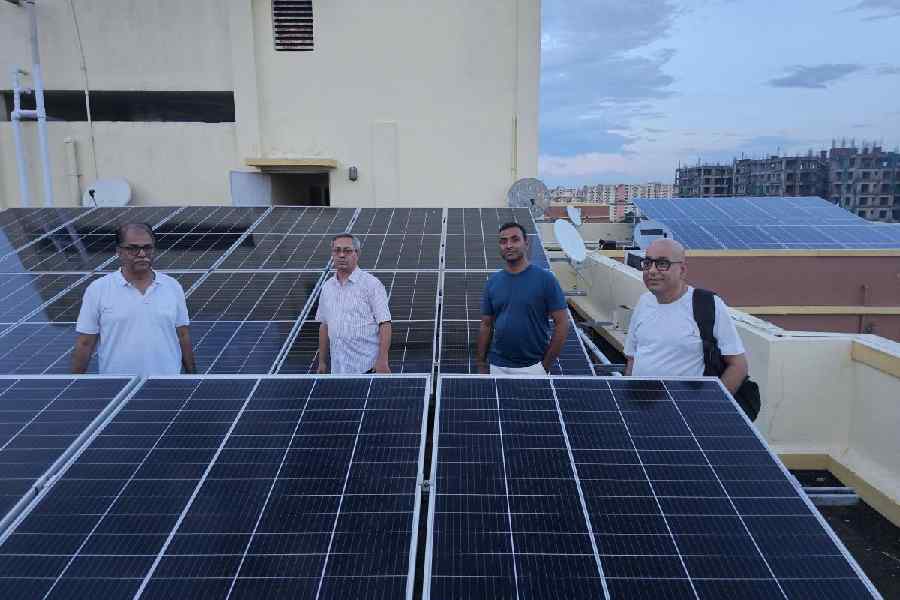
Some housing complexes in Bengal are putting solar panels on their roofs.
The panels use sunlight to make electricity and can reduce power bills.
Alaktika Housing Complex says its system has already paid back the money spent on installation.
Greenfield Ambition wants to build a much larger system for its lifts, lights, pumps, pool and club.
Government subsidies can reduce the cost for both housing associations and individual homeowners.
Net metering lets buildings receive credit for extra electricity sent to the power grid.
However, many housing associations struggle to qualify for bank loans because they have few assets or regular income.
One complex also found that solar heating panels did not reduce its electricity bill.
Residents are therefore interested in solar power but must carefully assess financing, equipment quality and vendors.

Alaktika Housing Complex says its 28-kilowatt rooftop system has already recovered its Rs 15.5 lakh cost through electricity savings.
Greenfield Ambition has invited bids for a 100-kilowatt solar system to reduce annual expenses of about Rs 18 lakh.
Other New Town complexes, including Sunrise Green, Greenwood Elements and Sunrise Point, are exploring rooftop solar installations.
West Bengal aims to provide rooftop solar to five lakh households by March 2027, compared with 1,810 households enrolled in the first phase.
Subsidies, net metering and loans are encouraging adoption, but housing complexes face difficulties obtaining bank financing and selecting reliable vendors.
- Who
- Housing complexes and individual homeowners in West Bengal, supported by government subsidy programs and solar vendors.
- What
- Residential communities are installing or considering rooftop solar systems to reduce electricity costs.
- Where
- West Bengal, particularly New Town, Salt Lake and North 24 Parganas.
- When
- Alaktika began installing panels in January 2022; the state’s first phase has 1,810 enrolled households, with a target for March 2027.
- Why
- To lower electricity bills and use government subsidies, net metering and financing support.
Solar Adoption Supporters
Solar Adoption Concerns
Lower electricity costs
Solar Adoption Supporters
Alaktika residents say rooftop solar savings have already recovered their installation cost, while Greenfield Ambition expects solar to offset part of its approximately Rs 18 lakh annual bill.
Solar Adoption Concerns
Savings depend on suitable equipment, correct metering and the ability to use or export electricity generated during the day.
Government incentives
Solar Adoption Supporters
Subsidies, net metering and bank financing can make rooftop solar more affordable for housing associations and individual users.
Solar Adoption Concerns
Housing complexes may lack assets or income needed for bank loans, and subsidy eligibility requires choosing vendors with India-made photovoltaic cells.
Technology performance
Solar Adoption Supporters
Solar photovoltaic systems can reduce grid consumption, especially when extra generation is credited through net metering.
Solar Adoption Concerns
Avenida residents said their preinstalled solar heating panels did not reduce electricity bills, and even some intended solar streetlights require conventional power.
Key facts
- Alaktika system
- The complex generates 28 kilowatts and spent Rs 15.5 lakh on installation.
- Alaktika expansion
- Residents estimate they need another 60 kilowatts to power common-area lights and elevators.
- Greenfield Ambition plan
- The complex is seeking bids for a 100-kilowatt rooftop system.
- State target
- West Bengal aims to cover five lakh households with rooftop solar by March 2027.
- First-phase enrollment
- The first phase includes 1,810 households.
- RWA subsidy
- The article says resident welfare associations can receive Rs 18,000 per kilowatt under the PM Surya Ghar scheme.
- Net metering range
- The article states that Bengal allows net metering for systems from 1 kilowatt to 500 kilowatts.
Quotes
Niladri Mukherjee
Secretary of Greenfield Ambition’s residents’ association
“The normal meter we use at home is a single-direction meter which measures the electricity we consume from the grid. But a net meter is a two-way one that measures the difference between the electricity you import from the grid and that you generate and export to the grid.”
 telegraphindia.com
“The yearly bill for our lifts, lights, pumps, swimming pool and club runs to Rs 18 lakh. We plan to offset that cost by installing solar panels on top of all eight of our towers.”
telegraphindia.com
Sources
Related news

Tata Power Launches Bihar Solar Initiative for Five Lakh Homes

Delhi Revises Solar Policy With Free Rooftop Systems

Uttar Pradesh Expands Rooftop Solar Under PM Surya Ghar Scheme
APSPDCL Fast-Tracks PM Surya Ghar Solar for SC/ST Homes
Delhi Approves Free Rooftop Solar Panels for 2.3 Lakh Homes
PM Surya Ghar May Tie Support to Solar Performance

West Bengal Industrial Power Tariff Hike Limited to DVC Area
North Bengal Hospital Opens Detox Centre, Adds Psychiatry Beds
Siliguri Orders 30-Day Hotel Fire Safety Audit After Fatal Fires

West Bengal to List Power Corporation on Stock Exchanges