

1 day ago
Civilian OROP Demands Take Center Stage Before 8th Pay Commission

The 8th Pay Commission is studying how government employees should be paid and how pensions should be calculated.
Some groups want civilian pensioners to receive similar pensions if they held the same rank and worked for a similar amount of time.
This idea is called One Rank One Pension, or OROP.
The concern is that people retiring in different years can receive very different pensions.
One proposal would adjust older pensions on paper so they match the position of newer retirees in the pay system.
Other groups want a higher increase factor, larger minimum pensions, and more frequent revisions.
The Commission has 18 months to prepare its report.
It has not yet announced a final decision on these demands.

The 8th Pay Commission was constituted on 3 November 2025 and has 18 months to submit recommendations.
The Justice Ranjana Prakash Desai-led panel is tentatively expected to submit its report in May-June 2027.
Civilian employee groups want comparable pensions for people retiring from the same rank with similar service.
Key proposals include notional fixation, pension parity, a 3.833 fitment factor, and five-yearly revisions.
Meetings in Chandigarh and Bengaluru may give unions and pensioner groups opportunities to press these demands.
- Who
- The 8th Pay Commission, civilian employee unions, and pensioner organizations including the Ministerial Staff Association, Bharat Pensioners Samaj, National Council-Joint Consultative Machinery, and Railway Senior Citizens' Welfare Society.
- What
- Employee and pensioner groups are seeking pension parity and possible One Rank One Pension for civilian employees, alongside other pension reforms.
- Where
- The upcoming consultations are scheduled in Chandigarh from 16-18 September and Bengaluru on 7-8 October.
- When
- The Commission was constituted on 3 November 2025, with its report tentatively expected in May-June 2027; meetings are scheduled for 16-18 September and 7-8 October.
- Why
- Groups say pension differences can arise when employees of the same rank and similar service retire under different Pay Commissions.
Pension-Parity Advocates
Higher-New-Retiree Benefits Without Automatic Parity
How to address retirement-date disparities
Pension-Parity Advocates
Unions and pensioner groups want older retirees' pensions revised through notional fixation or parity measures so comparable employees receive similar pensions.
Higher-New-Retiree Benefits Without Automatic Parity
The article describes the existing difference between pensions under different Pay Commissions but does not report any government commitment to extend new benefits to earlier retirees.
Main reform priority
Pension-Parity Advocates
The Railway Senior Citizens' Welfare Society and other groups emphasize civilian OROP and comparable pensions based on rank and qualifying service.
Higher-New-Retiree Benefits Without Automatic Parity
The National Council-Joint Consultative Machinery emphasizes a 3.833 fitment factor, extension of revised structures to pre-2026 pensioners, and five-yearly revisions; the final mix of proposals remains undecided.
Key facts
- Commission term
- The Union government has given the 8th Pay Commission 18 months to submit its report.
- Panel chair
- Justice Ranjana Prakash Desai leads the Commission.
- OROP proposal
- Civilian employees retiring from the same rank with similar qualifying service would receive comparable pensions regardless of retirement date.
- Fitment factor demand
- The National Council-Joint Consultative Machinery has proposed a 3.833 fitment factor.
- Illustrative pension gap
- A Level 6 employee retiring in 2016 is cited as receiving ₹24,500 basic pension and about ₹38,710 with 58% Dearness Relief.
- Projected 2026 pension
- Under the cited 3.833 factor proposal, a comparable Level 6 retiree in 2026 could receive about ₹93,900.
- Other demands
- Proposals include ₹45,000 minimum pension, family pension at 50%, and pay and pension revisions every five years.
Sources
Related news
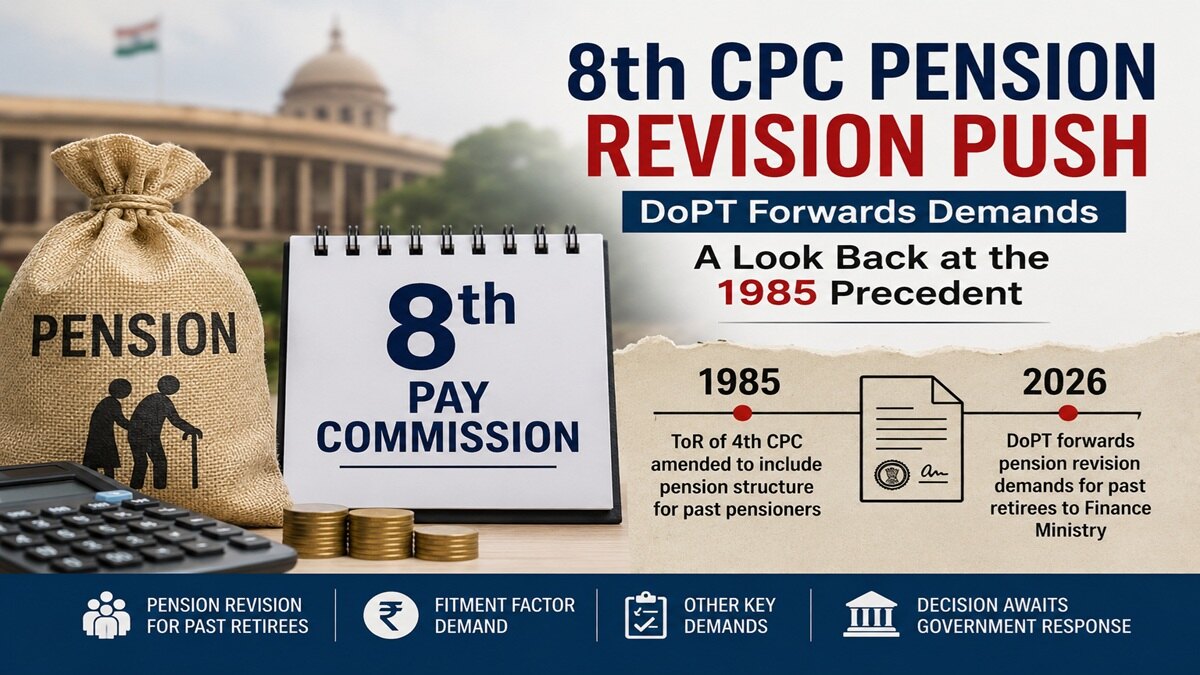
DoPT Forwards Pre-2026 Pension Demands to Expenditure Department

Government May Amend 8th Pay Commission Terms for Pensions

Pensioners Seek Rs 45,000 Minimum Pension, 3.83 Fitment Factor

8th Pay Commission Yet to Submit Report, Government Tells Parliament

Bharat Pensioners Samaj Seeks Quarterly DA, DR Revision
8th Pay Commission Pension Hike: What Central Govt Retirees Could Get

8th Pay Commission Enters Final Consultation Phase After Ten Months

July DA Hike and 8th Pay Commission: What Employees Know

8th Pay Commission Delay Could Cost Staff Lakhs
