

3 weeks ago
India's Data Centre Policy Push Aims to Protect Sovereign Data
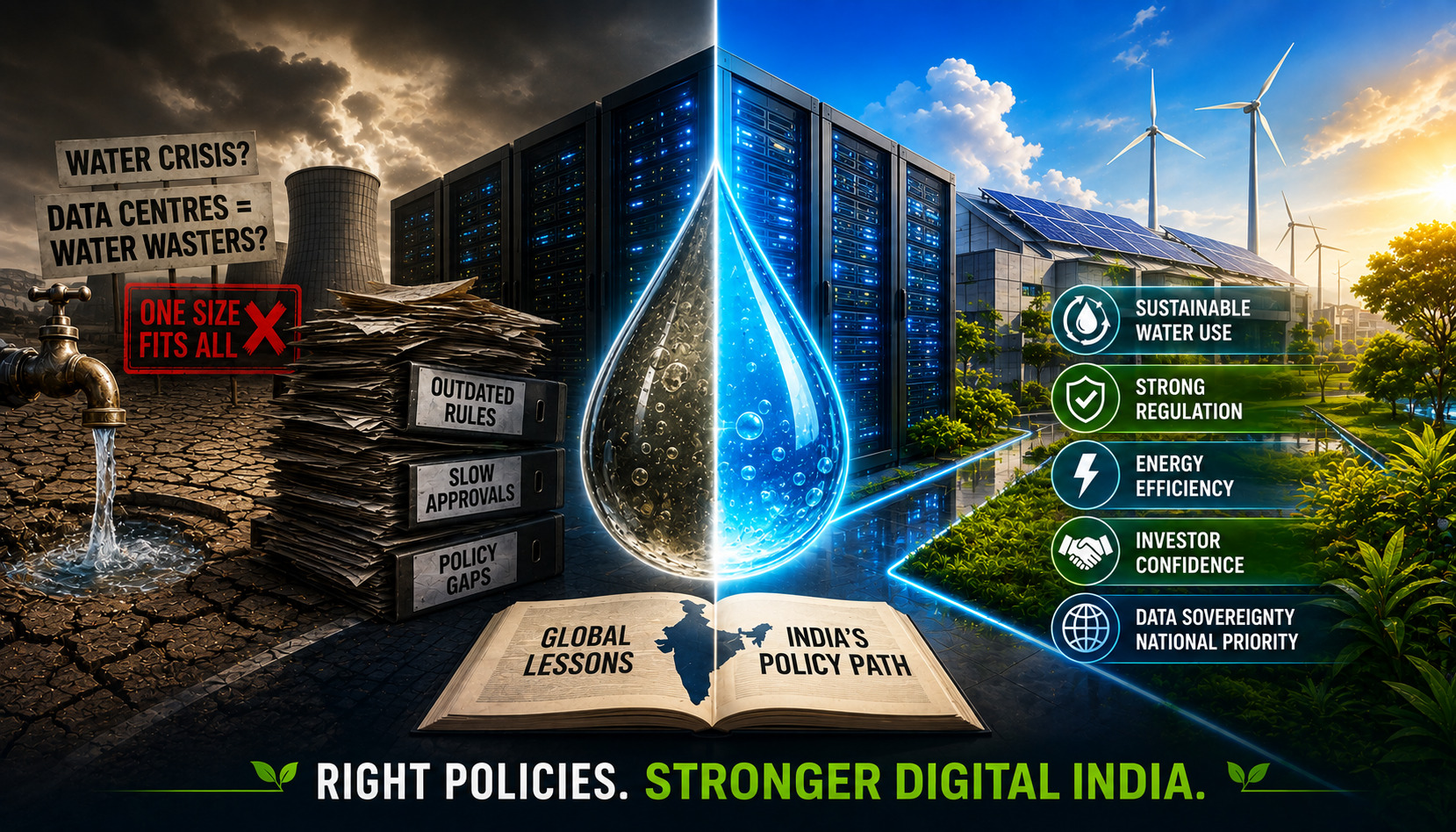
Data centres are big buildings full of computers that store information like photos, bank details, and government records.
India wants to build lots of them so that Indian data stays inside India, where Indian laws protect it.
India's data centre capacity has nearly tripled since 2020, and companies have pledged almost 95 billion US dollars to build more.
To help, the government gave data centres 'essential infrastructure' status, which makes it easier and cheaper to get loans.
In 2023, India passed a new law called the Digital Personal Data Protection Act to protect people's personal information.
The rules will be fully working by mid-2027.
Some countries, like Ireland and Singapore, built too many data centres too fast and ran out of electricity, so they had to pause new buildings.
India's leaders want to learn from these mistakes by setting energy and water standards for data centres.
They also want jobs and economic value from data centres to stay in India.
The goal is for India to be a world leader in safe, fair digital data.

India's data centre capacity has nearly tripled since 2020, with pledged investment reaching nearly USD 95 billion between 2019 and 2025.
Parliament passed the Digital Personal Data Protection Act (DPDP Act) in August 2023; rules were laid out in November 2025, with full implementation scheduled by mid-2027.
Data centres were designated essential infrastructure in 2022, and the Union Budget 2026-27 offers a tax holiday extending to 2047 for eligible foreign cloud providers using notified Indian data centres.
The article cites cautionary tales from Ireland, where data centres used about 14% of electricity by 2021, and New York Governor Kathy Hochul's temporary moratorium on new hyperscale data centres.
Indian states are competing for investment through policies such as Maharashtra's subsidies, Telangana's 15-day approvals, and Rajasthan's zero liquid discharge requirements.
- Who
- The Indian government, led by the Ministry of Electronics and Information Technology (MeitY), along with global technology companies, state governments, and regulators in countries like Ireland, Singapore, and the United States.
- What
- Development of a comprehensive policy framework for data centres to protect India's sovereign data, attract investment, and ensure sustainable growth.
- Where
- India, with major hubs in Mumbai, Bengaluru, Chennai, Hyderabad, and Visakhapatnam; the article also examines Europe, the United States, Singapore, the UAE, and China.
- When
- Ongoing; key milestones include the 2020 draft policy, essential infrastructure status in 2022, the DPDP Act in August 2023, and the Budget 2026-27 tax measures.
- Why
- To protect citizens' data from foreign access, prevent 'digital colonialism', secure digital sovereignty, and support the goals of Digital India, the IndiaAI Mission, and the Viksit Bharat 2047 vision.
Sovereignty-first view
Investment-first view
Data localisation
Sovereignty-first view
Citizen data generated through Aadhaar, UPI, and other digital public infrastructure is a sovereign asset that should be stored in India under Indian law, preventing 'digital colonialism' and access by foreign governments such as under the US CLOUD Act.
Investment-first view
Global tech companies and foreign investors criticised the strict layered data localisation in the 2019 Bill for raising costs and complexity; the DPDP Act's 'negative list' approach, allowing transfers to all nations except blacklisted ones, offered businesses more regulatory certainty.
Consent and government powers
Sovereignty-first view
Civil society organisations and privacy activists voiced concerns about clauses allowing government agencies broad powers to process citizen data without agreement, and wanted strong individual consent protections.
Investment-first view
The government favoured a simpler, consent-centric law that avoids excessive complexity; the 2019 Bill's drawn-out review and compliance costs were seen as harmful to startups and new market entrants.
National strategy vs. state competition
Sovereignty-first view
India lacks a complete national data centre strategy with clear targets and accountability; uniform minimum standards and a common reporting structure are needed to help investors making multi-state commitments.
Investment-first view
State-level policy competition, such as Telangana's fast approvals, Rajasthan's green norms, and Maharashtra's subsidies, drives innovation and better incentives; central coordination should not remove state discretion.
Key facts
- Data centre capacity growth
- Nearly tripled since 2020
- Pledged investment (2019-2025)
- Nearly USD 95 billion
- Core legislation
- Digital Personal Data Protection Act, 2023
- Full DPDP Act implementation
- Mid-2027; consent manager frameworks by late 2026
- Essential infrastructure status
- Granted in 2022
- Budget 2026-27 fiscal measure
- Tax holiday to 2047 for eligible foreign cloud providers using notified Indian data centres
- Ireland data centre electricity use (2021)
- About 14% of total electricity
- Northern Virginia share of global capacity
- Roughly 35% of the world's data centre capacity
Sources
Related news

India's data centre capacity surges four-fold to 1,575 MW

India's data centre boom builds foundations for digital future

Global Data Centre Growth Faces Rising Community Opposition

Gujarat targets 7.5 GW Green AI data centre capacity

India’s Data Centre Capacity Could Triple by 2030

Ikea cuts European prices as cost pressures weaken demand

Europe's Bond Selloff Deepens as Middle East Tensions Lift Oil

China’s Rapid Car Development Faces Growing Safety Scrutiny

CNG Prices Rise Rs 2 per Kilogram in Pune

China Challenges US Leadership in Escalating Global AI Contest
