

1 hr ago
The Deccan Hospital Unveils Advanced Robotic-Assisted Knee Replacement Technology
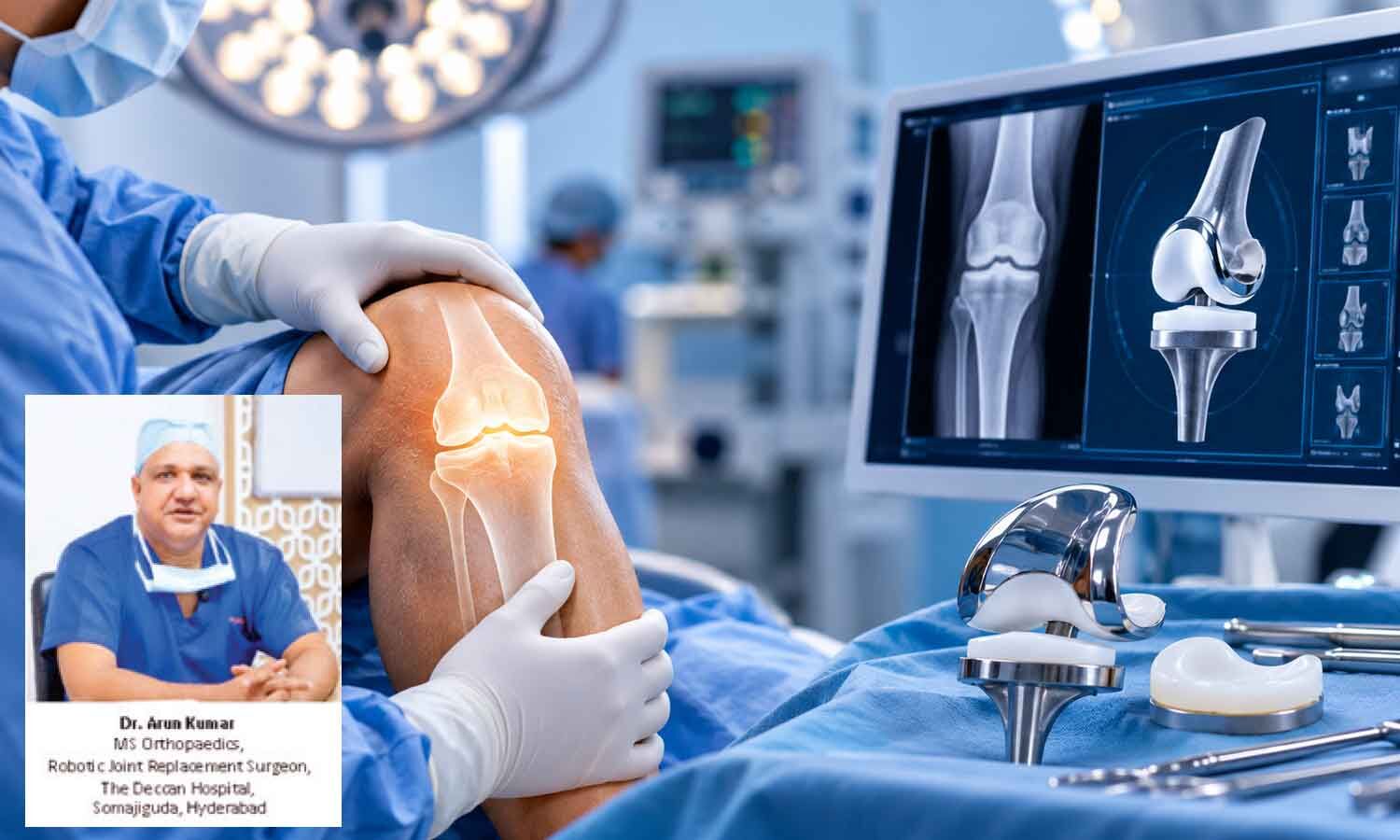
Knee arthritis can cause pain, stiffness and trouble walking.
Some people with severe arthritis may need knee replacement surgery.
A robotic system can help the surgeon plan and perform parts of the operation more precisely.
The robot does not operate by itself; the surgeon remains in control.
The system studies the patient’s knee and provides information about alignment and implant placement.
Not everyone with knee pain needs surgery or robotic assistance.
Exercise, physiotherapy and rehabilitation are important after the operation.
The Deccan Hospital says its team provides personalised orthopaedic care in Hyderabad.

The Deccan Hospital in Somajiguda, Hyderabad, has highlighted robotic-assisted knee replacement as an advanced treatment option.
The robotic system assists the orthopaedic surgeon with planning, navigation, alignment and selected surgical steps; it does not independently perform the operation.
The technology can provide real-time information to help with bone cuts, implant positioning and knee balance based on individual anatomy.
Robotic assistance is not suitable or necessary for every patient, and technical precision does not guarantee better outcomes for everyone.
Patient selection, surgeon expertise, implant choice, surgical technique and rehabilitation remain important to recovery after knee replacement.
- Who
- The Deccan Hospital’s orthopaedic team, including Dr. Arun Kumar, is presented as providing the care.
- What
- The hospital has highlighted advanced robotic-assisted knee replacement technology and personalised orthopaedic treatment.
- Where
- The Deccan Hospital, Somajiguda, Hyderabad.
- When
- Why
- The technology is intended to assist surgeons with planning, alignment, implant positioning and selected surgical steps for appropriate patients.
Technology’s Potential Benefits
Clinical Limitations and Considerations
Precision and outcomes
Technology’s Potential Benefits
Robotic assistance can provide detailed, real-time information that may help improve alignment accuracy, implant positioning and knee balance.
Clinical Limitations and Considerations
Greater technical precision does not automatically guarantee a superior outcome for every patient; surgeon expertise, patient selection, implants, technique and rehabilitation also matter.
Use of robotic assistance
Technology’s Potential Benefits
The system can help surgeons tailor planning and selected surgical steps to a patient’s individual knee anatomy.
Clinical Limitations and Considerations
Not every patient with knee pain needs knee replacement, and not every knee replacement requires robotic assistance.
Role of the technology
Technology’s Potential Benefits
Robotic systems can support modern joint-replacement surgery with planning, navigation and precise execution of selected steps.
Clinical Limitations and Considerations
The technology is a surgical tool and should support, rather than replace, the judgment and experience of an orthopaedic surgeon.
Key facts
- Technology
- Robotic-assisted knee replacement
- Surgeon’s role
- The orthopaedic surgeon remains in control throughout the procedure.
- Potential assistance
- Planning, navigation, alignment, bone cuts, implant positioning and knee balancing
- Patient selection
- The approach is not necessary or suitable for every person with knee pain or every knee replacement.
- Recovery factors
- Physiotherapy, exercises, muscle strengthening and rehabilitation are essential.
- Hospital location
- Somajiguda, Hyderabad
- Named specialist
- Dr. Arun Kumar, MS Orthopaedics, Robotic Joint Replacement Surgeon
Sources
Related news

Technology Brings Precision and Personalisation to Orthopaedic Surgery

SRV Hospitals Launches Robotic-Assisted Joint Replacement Centre In Chembur
Delhi Doctors Perform First Active Robotic Ceramic Knee Replacement
Experts Explain How Robotic Surgery Can Speed Recovery

Why Younger Patients Are Choosing Joint Replacement Surgery Earlier

Arthroplasty Summit Highlights Advances in Orthopaedic Care
Yadav, Yogi Review Uttar Pradesh Air Pollution Action Plan

Uttar Pradesh Opens 543 Stores for Rural Women’s Products

Constable Booked After Allegedly Concealing Marriage From Partner

Coal Cleaner’s Viral Smile Leads To Class X Success
