1 hr ago
India's Quick-Commerce Sector Hits Profit Wall During Market Recalibration

Quick-commerce companies deliver groceries and other products very quickly.
In India, these businesses have grown rapidly by opening many small warehouses and offering discounts.
Their sales are rising, but many companies still lose money.
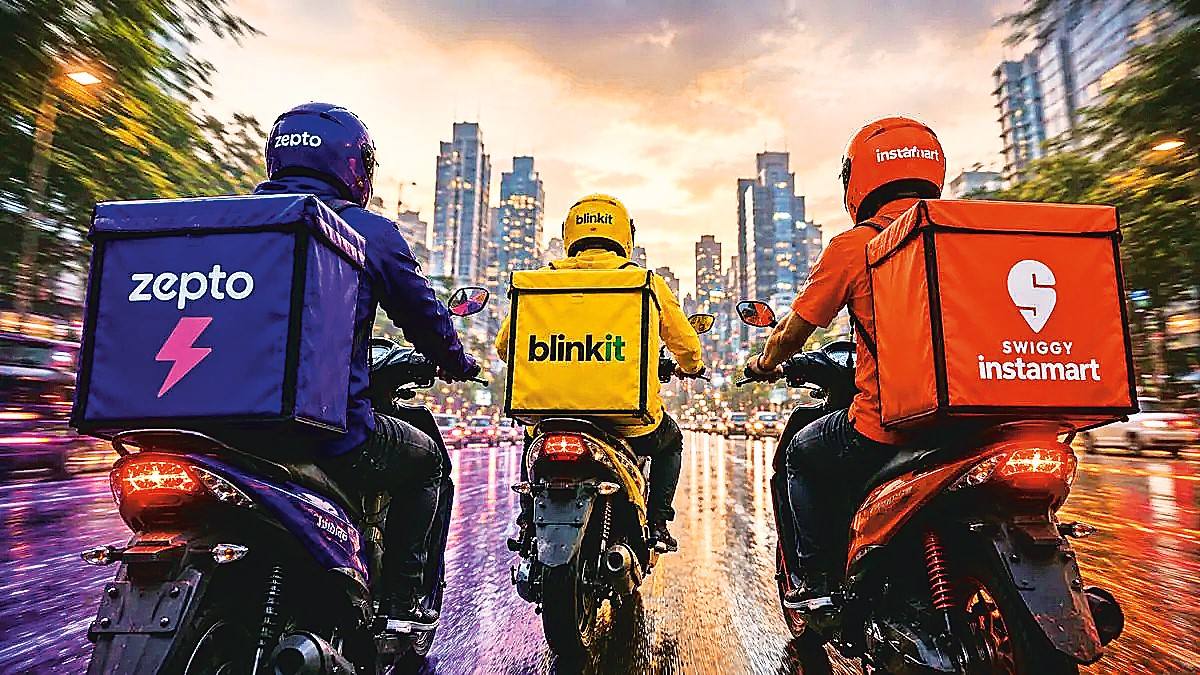
Blinkit has reached operating profitability, while Swiggy Instamart has reduced its losses.
Zepto and BigBasket’s consumer business reported much larger losses.
Companies say discounts are no longer enough to attract more customers in mature areas.
They are now trying to sell more items per order and make deliveries more efficient.
Regulators and traditional retailers are also questioning whether the industry competes fairly and protects workers.

India’s quick-commerce GMV is estimated at $10–11 billion in 2025 after doubling annually since 2023.
The sector has more than 7,000 dark stores across over 200 cities, with companies expanding into broader product categories.
Blinkit reported ₹102 crore in adjusted EBITDA in Q1FY27, while Swiggy Instamart reduced its adjusted EBITDA loss to ₹778 crore.
Zepto reported a ₹5,041.55-crore adjusted EBITDA loss for FY26, while Innovative Retail Concepts reportedly lost ₹3,073 crore.
Companies are reducing discounts and testing larger baskets, denser networks and new operating models to improve profitability.
- Who
- Indian quick-commerce companies including Blinkit, Swiggy Instamart, Zepto, Flipkart Minutes and BigBasket’s consumer business.
- What
- The sector is shifting from discount-led expansion toward profitability, operating efficiency and broader product assortments.
- Where
- India, including more than 200 cities and the country’s top 10 cities.
- When
- The figures and commentary cover 2025, FY26 and Q1FY27.
- Why
- Discounting has become less effective and costly, while companies face infrastructure, customer-acquisition, labour and regulatory pressures.
Growth and Scale Case
Profitability and Fairness Concerns
Expansion strategy
Growth and Scale Case
Industry analysts say greater order volumes, dark-store utilisation, delivery density, customer frequency and larger baskets can improve unit economics over time.
Profitability and Fairness Concerns
Companies are investing ahead of profitability, and the required infrastructure, technology, fulfilment capacity and customer acquisition remain costly.
Discounting and customer growth
Growth and Scale Case
Discounts helped quick commerce expand rapidly, while broader assortments and higher-value products could support larger, higher-margin baskets.
Profitability and Fairness Concerns
Eternal and Swiggy executives say aggressive pricing and discount-led expansion are no longer sustainable or effective in mature hubs.
Market regulation
Growth and Scale Case
Companies and policymakers can preserve innovation, consumer choice and disruption while establishing operating guardrails.
Profitability and Fairness Concerns
Traditional distributors and offline retail groups allege predatory pricing, preferred-seller arrangements and foreign-investment violations, while labour measures may increase delivery costs.
Key facts
- Estimated 2025 GMV
- $10–11 billion
- Projected GMV by decade-end
- $65–70 billion
- Physical footprint
- More than 7,000 dark stores across 200-plus cities
- Blinkit Q1FY27 adjusted EBITDA
- ₹102 crore, compared with a ₹162-crore loss a year earlier
- Swiggy quick-commerce Q1FY27 adjusted EBITDA loss
- ₹778 crore, down from ₹896 crore a year earlier
- Zepto FY26 adjusted EBITDA loss
- ₹5,041.55 crore
- Incremental e-retail GMV share by 2030
- Bain & Company estimates quick commerce will contribute 45–50%, up from around 17% in 2025
Quotes
Naveen Malpani
Partner and consumer and retail industry leader at Grant Thornton Bharat
“The current phase of intense competition should be viewed as a market-calibration exercise, where companies are testing the boundaries of where the model works, which consumer needs are most attractive, and under what operating conditions profitability can be achieved”
 telegraphindia.com
“The economics of quick commerce is linked to scale and network density”
telegraphindia.com
Sources
Related news

Flipkart Minutes Overtakes Instamart As Quick-Commerce Race Intensifies

India’s E-commerce Market Set to Nearly Triple by 2030
Flipkart Gains Early Quick-Commerce Edge Over Amazon as Networks Scale

Amazon Quick Delivery Reaches $1 Billion Milestone in India
Quick Commerce’s Inventory Shift Resets India’s FMCG Retail Playbook
Flipkart Minutes Surges Past 1.1 Million Daily Orders in India

Quick-Commerce Platforms Target India’s Longer, Localised Festival Season

Tata Sons Reappoints Chandrasekaran as Trusts Call Vote Illegal

GLP-1 Therapy Drives Demand for Convenient Protein Supplements