1 day ago
IBC Faces Prolonged Timelines and Steep Haircuts

India's insolvency law is meant to help troubled companies find solutions quickly.
But many cases are taking much longer than the law allows.
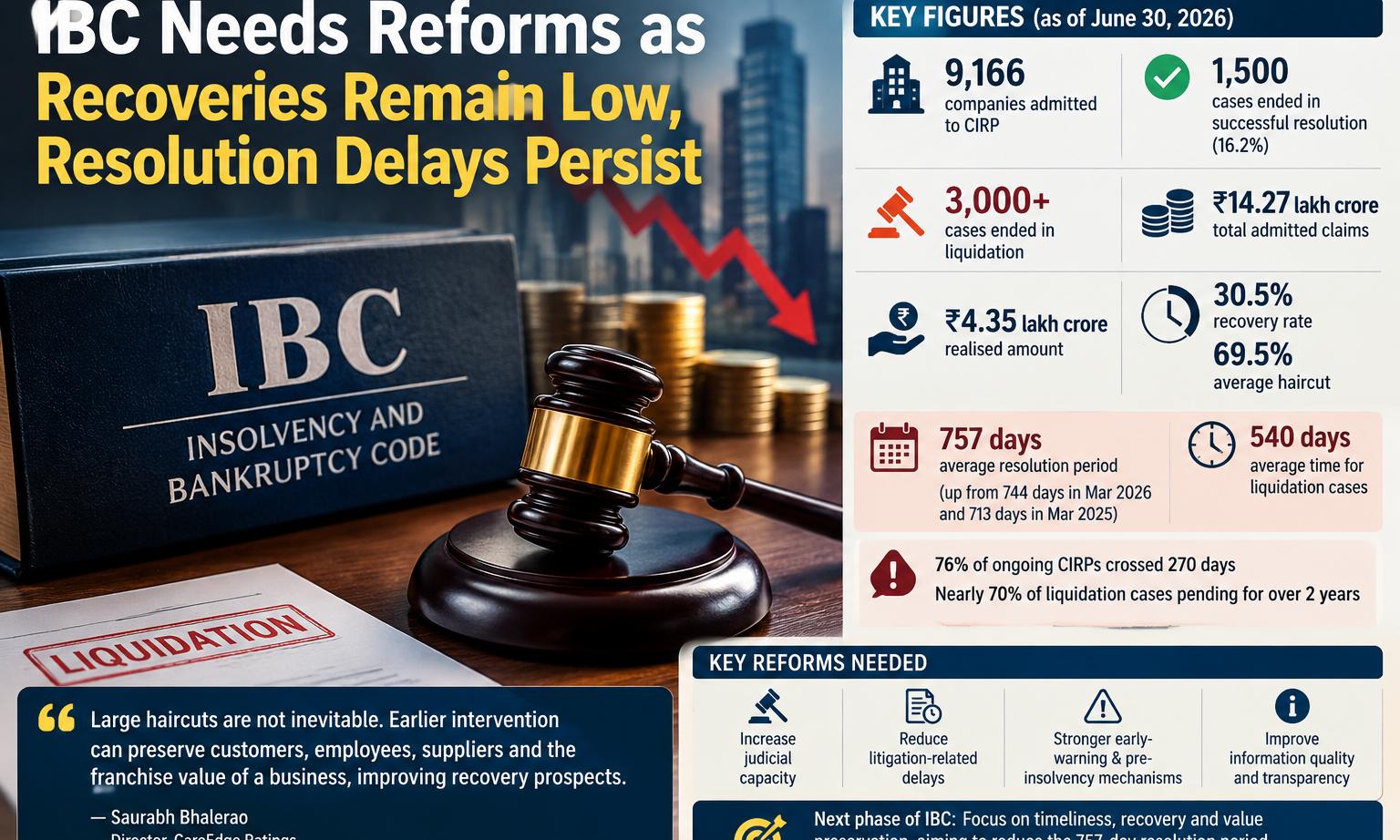
By June 2026, companies in the process had recovered about 30.5% of the money owed to creditors.
This means creditors accepted a large reduction in their claims.
However, recoveries were still much higher than what creditors would usually receive if the companies were simply liquidated.
Delays can reduce the value of a company and make it harder to save jobs, customers and businesses.
Many companies enter the process only after they have already become severely weakened.
Experts want earlier warnings, better information, faster courts and fewer legal delays.
They also say that companies that cannot survive should be liquidated quickly.

By June 30, 2026, 9,166 companies had entered the Corporate Insolvency Resolution Process, with about 16.2% reaching successful resolution.
Admitted claims totaled Rs 14.27 lakh crore, while Rs 4.35 lakh crore was recovered, representing a 30.5% recovery rate and approximately 69.5% haircut.
The average resolution process lasted 757 days, well above the statutory maximum of 330 days including litigation.
Manufacturing, real estate and construction accounted for nearly 70% of cumulative admissions, while 76% of ongoing cases had exceeded 270 days.
Suggested reforms include expanding judicial capacity, reducing litigation delays, improving early-warning systems, strengthening pre-insolvency restructuring and making liquidation time-bound.
- Who
- Companies, creditors and insolvency professionals involved in India's Corporate Insolvency Resolution Process; Saurabh Bhalerao of CareEdge Ratings provided the assessment.
- What
- An assessment found that India's insolvency framework faces lengthy proceedings, large haircuts and declining asset values, prompting calls for reform.
- Where
- India.
- When
- The figures cited are as of June 30, 2026, with comparisons including March 2026 and March 2025.
- Why
- Litigation, procedural delays, valuation disputes, difficulty attracting resolution applicants, complex stressed assets and late entry into insolvency are slowing cases and reducing recoveries.
Haircut Concern
Relative Recovery View
Scale of creditor losses
Haircut Concern
Creditors recovered only about 30.5% of admitted claims cumulatively, meaning the headline average haircut was approximately 69.5%.
Relative Recovery View
The recovery rate was about 166.6% of liquidation value, indicating that resolution plans produced substantially more than a straight liquidation.
Role of speed
Haircut Concern
A process averaging 757 days can destroy enterprise value and cause avoidable losses through delay.
Relative Recovery View
Some haircut is unavoidable once a company has substantially deteriorated; earlier intervention is the better way to preserve value.
Rescue versus liquidation
Haircut Concern
Prolonged insolvency proceedings may continue consuming resources even when a company is fundamentally unviable.
Relative Recovery View
Viable but temporarily illiquid companies need early restructuring opportunities, while genuinely unviable businesses should undergo rapid asset monetisation.
Key facts
- Companies admitted to CIRP
- 9,166 as of June 30, 2026
- Successful resolutions
- Approximately 1,500 cases, or 16.2% of admissions
- Total admitted claims
- Rs 14.27 lakh crore
- Total realised
- Approximately Rs 4.35 lakh crore
- Cumulative recovery rate
- 30.5% of admitted claims, equivalent to an average haircut of about 69.5%
- Average resolution time
- 757 days, compared with a statutory limit of up to 330 days including litigation
- Pending case age
- About 76% of ongoing CIRPs had exceeded 270 days
- Avoidance transaction applications
- More than 2,100 applications involving approximately Rs 4.65 lakh crore
Sources
Related news
IBC Reform Urged as Recoveries Fall and Delays Persist
Subhash Chandra Insolvency Deal Intensifies Debate Over India’s IBC
Subhash Chandra Settlement Highlights India’s Deep Insolvency Haircuts
Enforcement Directorate Targets Insolvency Frauds and Deep Haircuts
Subhash Chandra repayment case: why the massive haircut isn't scandal

Sources Clarify Subhash Chandra’s NCLT Claims, Reject ₹22,000 Crore Write-Off

ED Chief Rahul Navin Orders Crackdown on IBC Fraud

IBBI Proposes Stricter Safeguards for Personal Guarantor Insolvency