

2 hrs ago
India’s Auto PLI Drives Investment, Jobs and Green Mobility
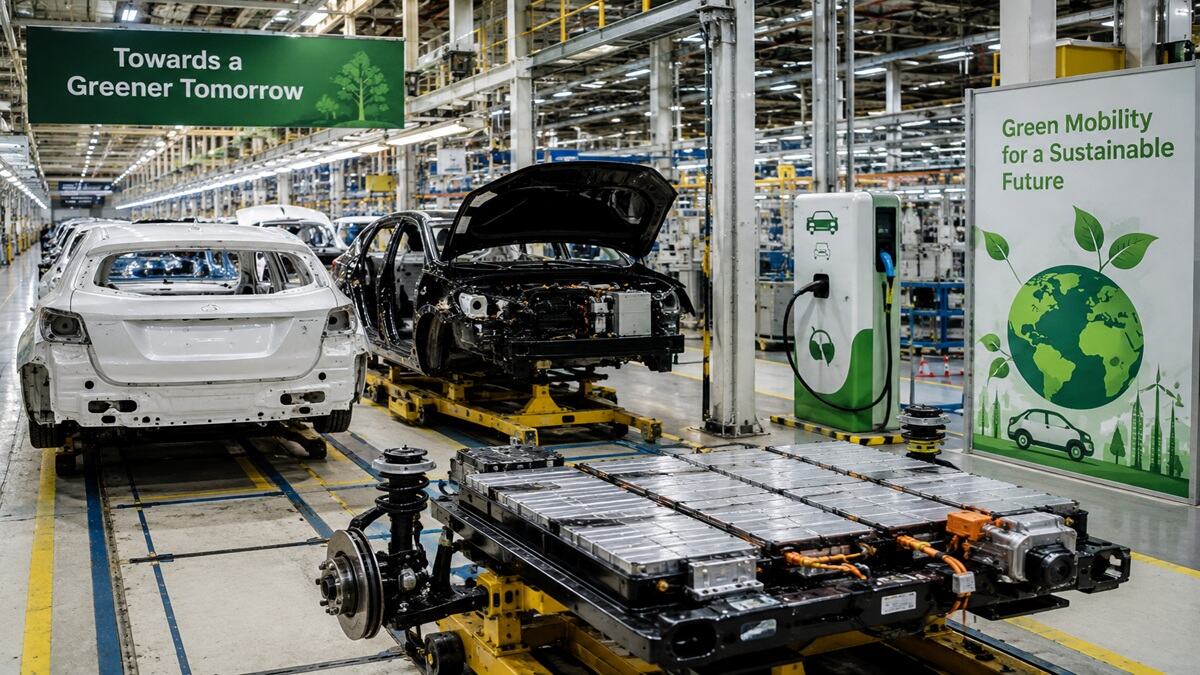
India is giving money to companies that make cars, vehicle parts, batteries and electric vehicles.
This programme has encouraged companies to invest Rs 45,477 crore and create more than 67,000 jobs.
Another scheme helps people and organisations use electric vehicles.
It has already supported millions of electric two-wheelers and many electric buses.
The government is also paying for more public charging stations.
A battery programme aims to help India make 50 gigawatt-hours of advanced batteries at home.
Officials say India should design and build more of the technology itself.
They also want smaller businesses to join the new supply chains.
The goal is to make India a strong global producer of cleaner and more advanced vehicles.

India’s auto PLI scheme has attracted Rs 45,477 crore in investment and created more than 67,000 jobs as of June 30, 2026.
PM E-DRIVE’s enhanced Rs 11,900 crore outlay supports electric vehicles, including 45.79 lakh e-two-wheelers.
The government has allocated Rs 4,391 crore for 14,028 electric buses and Rs 3,435 crore for a payment security mechanism supporting over 38,000 buses.
A Rs 2,000 crore charging programme has approved proposals covering 7,254 public chargers, while battery PLI targets 50 GW of capacity.
India’s auto component industry reported Rs 7.6 lakh crore in FY2025–26 turnover, 12.7% growth and USD 24 billion in exports.
- Who
- The Government of India, Union Minister H. D. Kumaraswamy, auto manufacturers, component makers and other industry participants.
- What
- Government-backed auto, electric-vehicle, battery and charging programmes have attracted investment, created jobs and expanded green-mobility infrastructure.
- Where
- New Delhi, India, at the 66th Annual Session of the Automotive Component Manufacturers Association of India and a separate Federation of Automobile Dealers Association address.
- When
- Investment and job figures are reported as of June 30, 2026; the announcements were discussed on September 2, 2026.
- Why
- To increase domestic manufacturing and value addition, support electric mobility, reduce import dependence and make India competitive in advanced mobility technologies.
Broader Industrial Development
EV-Centered Expansion
How success should be measured
Broader Industrial Development
H. D. Kumaraswamy said success should include technology designed in India, domestic value addition, MSME participation and global competitiveness, rather than EV sales alone.
EV-Centered Expansion
The government’s EV-focused measures emphasize electric-vehicle adoption, including support for two-wheelers, three-wheelers, trucks, buses and charging infrastructure.
Industry’s next priority
Broader Industrial Development
ACMA President Vikrampati Singhania called for stronger collaboration and more activity to create, engineer and innovate in India for domestic and global markets.
EV-Centered Expansion
The policy programme directs substantial resources toward scaling electric mobility, battery production and charging networks as central parts of the sector’s future.
Benefits of manufacturing
Broader Industrial Development
Kumaraswamy said manufacturing should translate into household prosperity, remain broad-based and keep customers at the centre.
EV-Centered Expansion
The programmes primarily channel support through manufacturers, vehicle buyers, bus deployment, charging projects and battery producers to build the wider mobility ecosystem.
Key facts
- Auto PLI outlay
- Rs 25,038 crore
- Auto PLI results
- Rs 45,477 crore in reported investment and more than 67,000 jobs
- PM E-DRIVE outlay
- Enhanced to Rs 11,900 crore
- Electric vehicles supported
- More than 25.66 lakh e-two-wheelers, 2.75 lakh e-three-wheelers and 53 electric trucks
- Electric buses
- Rs 4,391 crore allocated for 14,028 buses; 13,800 already allocated
- Public charging
- Rs 2,000 crore earmarked; proposals covering 7,254 chargers approved
- Battery PLI target
- Rs 18,100 crore scheme targeting 50 GW of domestic advanced-chemistry-cell capacity
Quotes

H. D. Kumaraswamy
Union Minister for Heavy Industries and Steel
“The real measure of success must include how much technology is designed in India, how much value is added domestically, how many Ministry of Micro, Small and Medium Enterprises of India (MSMEs) participate in emerging supply chains and how effectively Indian products compete in global markets”
 financialexpress.com
“The next phase must be about leadership—building scale, deepening localisation, accelerating innovation and establishing India as a globally competitive hub for advanced and green mobility technologies”
financialexpress.com
Vikrampati Singhania
President of the Automotive Component Manufacturers Association of India
“The next phase must increasingly be about Create in India, Engineer in India and Innovate in India for India and for the world”
financialexpress.com
Sources
Related news
Make in India Transforms India Into Technology Manufacturing Powerhouse
Ola Electric Secures ₹95.81 Crore Auto PLI Incentive

Over 88,000 EVs Subsidised in Madhya Pradesh Under PM E-DRIVE
Gadkari Projects India’s EV Market at Rs 20 Lakh Crore

India's EV sales likely to grow 55% annually through 2034
Modi’s Make in India Gains Face Rahul Gandhi’s Criticism
Jefferies Favors Kaynes as India Advances Electronics Component Manufacturing
Indian Chief Ministers Turn Marketers to Win Manufacturing

India’s Capex Push Must Build Capability, Not Just Assets
