3 weeks ago
Outcome-based IT services no longer optional, says Nasscom's Rajesh Nambiar

India's information technology (IT) companies build and look after software for businesses all over the world.
This industry is enormous — it is worth about 315 billion dollars.
New artificial intelligence (AI) tools can now do many tasks that people used to do.
Because of this, IT companies are changing how they get paid: instead of charging for hours worked, they are moving toward being paid for results.
Some jobs are changing too, and companies may need fewer people for certain tasks.
The leader of India's IT industry group, Rajesh Nambiar, says about one in four companies may struggle to make this change.
He also notes that India spends much less money on research than many other countries.
Schools are being asked to teach students AI skills so they can get the new kinds of jobs.
Most of India's IT business comes from the United States, so leaders want to protect that relationship.
Nambiar hopes the government will make rules clearer and easier for companies to follow.

Nasscom President Rajesh Nambiar said AI is making outcome-based IT services delivery inevitable, replacing traditional FTE-based billing.
India's IT industry revenue grew 6.1 percent while employee headcount grew only 2.3 percent, breaking the historic link between hiring and growth.
He estimated that 20-25 percent of IT companies, especially those tied to the FTE model, may be left behind in the transition.
Nasscom is working with the government on an AI curriculum through AICTE and UGC to address declining core engineering and coding skills.
With 63 percent of industry revenue dependent on the U.S., Nambiar urged policy certainty, better centre-state coordination, and improved ease of doing business.
- Who
- Rajesh Nambiar, President of IT industry body Nasscom, in an interview with businessline.
- What
- Discussed how AI is forcing India's IT services industry to shift from headcount-based FTE/time-and-materials models to outcome-based delivery.
- Where
- India, with the industry's revenue heavily dependent on the U.S. (63 percent); the interview was published by businessline.
- When
- The article does not state a specific date; it references trends over the past 1.5 years and the last four quarters.
- Why
- AI adoption is reshaping business models, hiring patterns, and client expectations, making outcome-based delivery inevitable.
Market pessimists
Industry leadership (Nasscom)
IT industry outlook
Market pessimists
Investors and markets are pessimistic: services companies, both Indian and global, have been punished with significant stock-market headwinds amid slowing headcount growth and AI disruption.
Industry leadership (Nasscom)
Rajesh Nambiar says the underlying picture is strong — order books and deal pipelines have gone up for every player — and predicts the industry will return with more growth within two years.
GCCs versus IT services firms
Market pessimists
Global Capability Centres (GCCs) were once seen as complementary to IT services firms but are increasingly viewed as competitors that could overtake them in scale and employment.
Industry leadership (Nasscom)
Nambiar argues GCCs and IT services firms are complementary and will coexist, noting that services companies have built GCC practices that have become a revenue stream.
Key facts
- Interviewee
- Rajesh Nambiar, President, Nasscom
- India IT industry size
- About $315 billion
- Industry revenue growth
- 6.1 percent
- Employee headcount growth
- 2.3 percent
- Companies expected to be left behind
- 20-25 percent
- India's R&D spending
- 0.65 percent of GDP (advanced nations: upwards of 2.8 percent)
- Revenue dependence on U.S.
- 63 percent
- Nasscom U.S. CEO forum
- Launched 1.5 years ago; three meetings held so far
Sources
Related news

Indian IT sector bucks AI stock sell-off as investor sentiment shifts

AI Expands Indian IT Opportunities, Demanding New Business Models

AI Reprices Indian IT as Smaller Firms Challenge Giants

AI not an existential threat, says PPFAS CIO Rajeev Thakkar
AI Reshapes India’s IT Contracts as Clients Demand More

Can India's 1,700 GCCs Move Services Up the Value Chain?
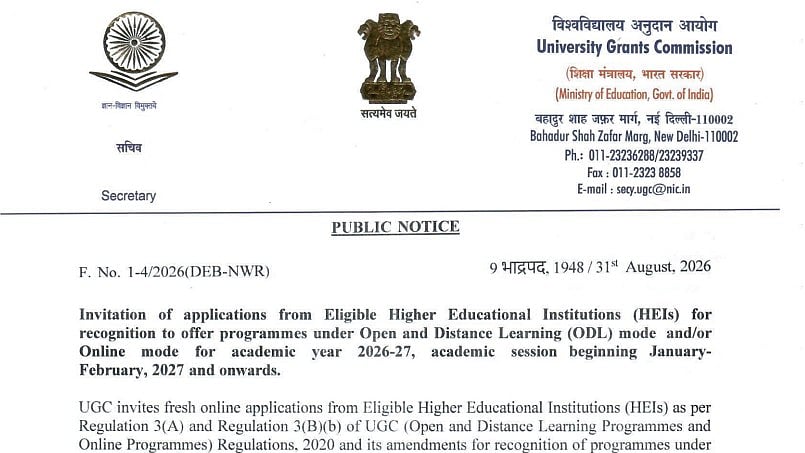
UGC Invites Applications for 2026-27 ODL, Online Programme Recognition

India Compresses Professional Training Across Law, Science, and Medicine
UGC Opens Applications for Distance and Online Courses

NTA Releases UGC-NET June 2026 Re-Exam City Intimation Slip

Allahabad University Opens PhD Admissions For 2026-27 Session