

2 hrs ago
Anna University Student’s Death Highlights Serious Scrub Typhus Warning Signs

Scrub typhus is an infection spread by tiny infected mites.
It can start like an ordinary fever.
Some people also have headaches, chills, body aches or weakness.
A dark scab from a mite bite may appear, but it is not always seen.
The illness can look like dengue, malaria or leptospirosis.
If it is not recognized early, it can harm the lungs, brain, kidneys and other organs.
Confusion, trouble breathing, low blood pressure or very little urine are danger signs.
Doctors can test for the infection and may start antibiotics when suspicion is high.
Anyone with worsening unexplained fever should be assessed urgently, especially after time around grass, bushes or other vegetation.

A 20-year-old Anna University hostel resident died after developing severe scrub typhus following about four days of high fever.
Doctors said he arrived with altered sensorium, respiratory distress and multi-organ failure after testing negative for dengue and positive for scrub typhus.
Scrub typhus is caused by Orientia tsutsugamushi and spreads through bites from infected larval mites, or chiggers.
Fever, headache, chills, body aches, weakness, rash and swollen lymph nodes may occur, but the characteristic dark eschar is not always present.
Doctors may use IgM ELISA, ELISA or PCR for diagnosis, while suspected complicated cases may require prompt doxycycline and referral.
- Who
- A 20-year-old Anna University student who lived in a campus hostel; doctors at Government Kilpauk Medical College Hospital treated him.
- What
- He died from severe scrub typhus after developing high fever, altered sensorium, respiratory distress and multi-organ failure.
- Where
- At Anna University’s campus hostel and subsequently at hospitals including Government Kilpauk Medical College Hospital.
- When
- After about four days of illness, when he was admitted and later referred to another hospital.
- Why
- The infection progressed to serious complications; the case highlights that scrub typhus can resemble other fever illnesses and requires early recognition and treatment.
Key facts
- Cause
- The bacterium Orientia tsutsugamushi.
- Transmission
- Bites from infected larval mites, commonly called chiggers.
- Common exposure
- Scrub vegetation, grass, bushes and other ground cover.
- Key diagnostic clue
- An eschar, or dark scab-like lesion, may appear but is not present in every patient.
- Diagnostic tests
- IgM ELISA is a mainstay; ELISA and PCR may also be used.
- Serious complications
- Acute respiratory distress syndrome, meningo-encephalitis, shock, kidney failure and multi-organ dysfunction.
- Treatment guidance
- When suspicion is sufficiently high, antibiotic treatment, including doxycycline in suspected complicated cases, may begin before laboratory confirmation.
Quotes
Dr Jatin Ahuja
Consultant in infectious disease at Indraprastha Apollo Hospital, Delhi
“Scrub typhus is treatable if diagnosed early but complications can become serious.”
 indianexpress.com
Sources
Related news

Manipur Sees Rise in Dengue, Typhoid and Scrub Typhus
Chennai Fever Cases Rise: When to Seek Dengue Care
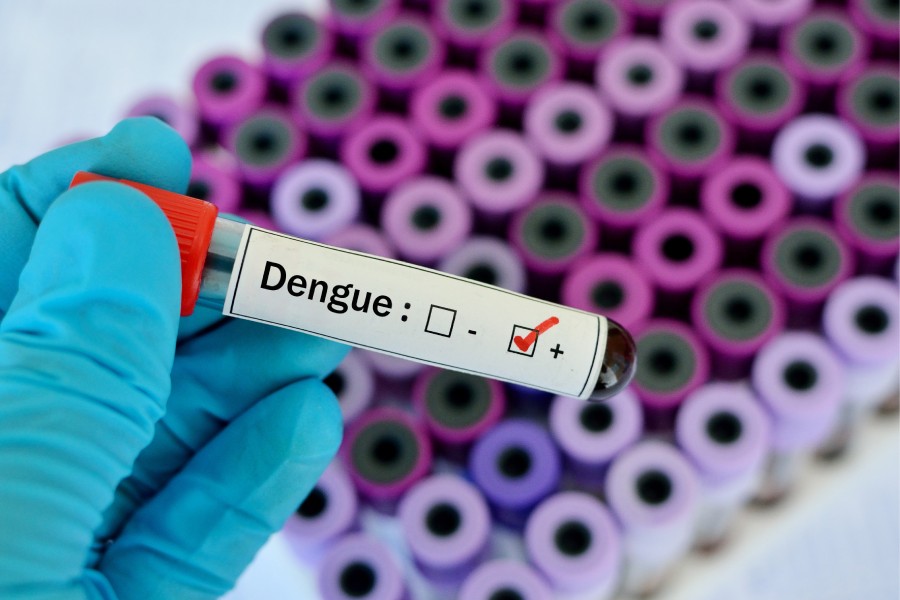
Kolkata Doctors Detail Dengue Symptoms, Testing And Warning Signs

Odisha Urges Calm Over Scrub Typhus Reports in Angul

Manipur District Faces Triple Outbreak as Hospitals Overcrowd
Chennai Fever And Dengue Cases Surge, Doctors Urge Caution

Engineering Education Links Theory With Hands-On Systems Learning

Readers Raise Concerns Over Dementia, Liquor, Climate, Campuses and Reading

Experts Urge Clean, Diverse Data for More Reliable AI

Tamil Nadu Unveils 2026-27 AI and Digital Technology Roadmap
