

3 weeks ago
Second Solar Eclipse of 2026 Tonight, Not Visible in India
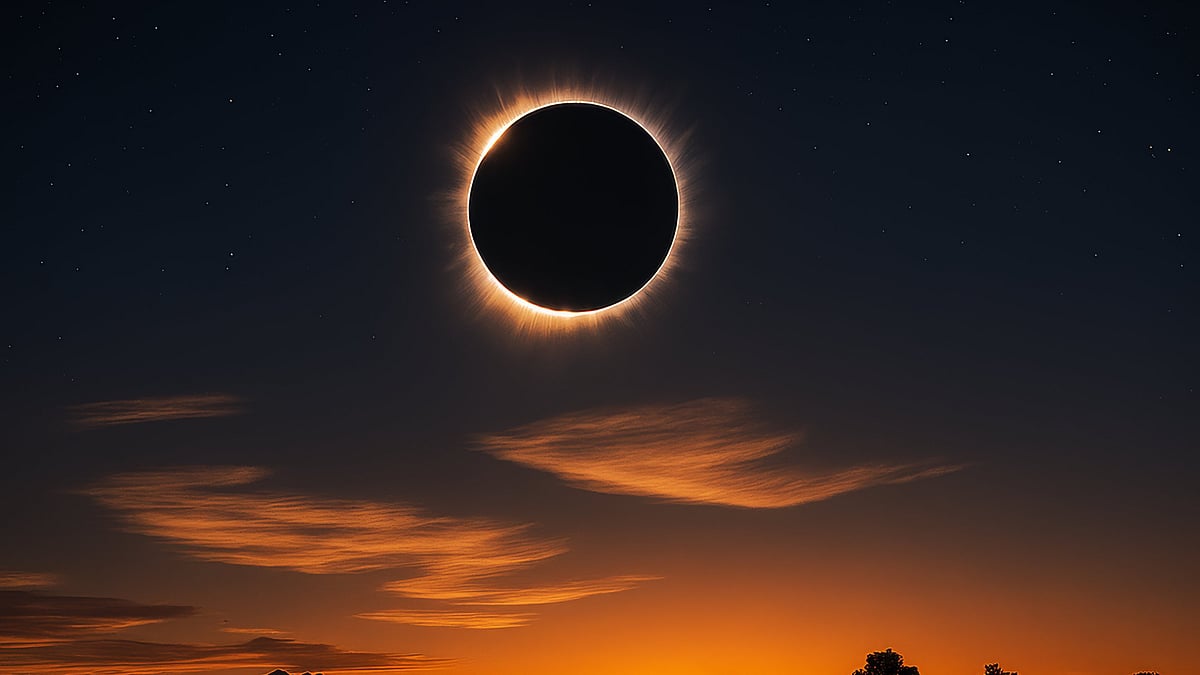
A solar eclipse happens when the Moon moves in front of the Sun and blocks its light.
On the night of August 12, 2026, a total solar eclipse, also called Surya Grahan, will take place.
In a total solar eclipse, the Sun can be completely covered by the Moon.
This is the second and last solar eclipse of 2026, and it will last about six minutes and 23 seconds, longer than usual.
People in Greenland, Iceland, and northern Spain will see the total eclipse, while parts of Europe, North Africa, and northern America will see a partial one.
People in India will not be able to see it, but they can watch it online through NASA's website or other live streams.
In Hindu tradition, eclipses are linked to Sutak Kaal, a time when some activities are avoided.
Because this eclipse is not visible in India, Sutak Kaal will not apply, so temples will stay open and pilgrimages can go on.
Many people also find the eclipse special because the Sun matters to communities and belief systems everywhere.
Astrologers say the eclipse happens in the zodiac sign Cancer and the Shatabhisha nakshatra.

The second and last total solar eclipse (Surya Grahan) of 2026 occurs from the night of August 12 into the early hours of August 13.
The eclipse will last six minutes and 23 seconds, nearly double a typical solar eclipse's three-minute duration.
It will not be visible in India; viewers there can watch it online via NASA's official website or other live streaming platforms.
The total eclipse is visible in Greenland, Iceland, and northern Spain, with a partial eclipse in Europe, North Africa, and northern America.
Sutak Kaal will not apply in India, allowing temples and pilgrimages to continue; astrologically the eclipse falls in Cancer and the Shatabhisha nakshatra.
- Who
- Sky lovers, astrologers, and those interested in astronomy who are watching the eclipse, including via live stream.
- What
- A total solar eclipse (Surya Grahan), the second and last solar eclipse of 2026.
- Where
- The total eclipse is visible in Greenland, Iceland, and northern Spain; a partial eclipse is visible in Europe, North Africa, and northern America. It is not visible in India.
- When
- From the night of August 12 into the early hours of August 13, 2026, beginning around 09:04 PM.
- Why
- The Sun plays a major role in every community and belief system, and the eclipse is considered significant through both science and astrology.
Scientific View
Astrological/Traditional View
Significance of the eclipse
Scientific View
The eclipse is a natural celestial event of scientific interest, notable mainly for its long duration of six minutes and 23 seconds and its visibility across specific regions.
Astrological/Traditional View
The eclipse is significant because the Sun plays a major role in every community and belief system, and the event falls in Cancer and the Shatabhisha nakshatra, giving it astrological meaning.
Sutak Kaal and rituals in India
Scientific View
Because the eclipse is not visible in India, the inauspicious Sutak Kaal period does not apply, so normal activities, temple worship, and pilgrimages can continue as usual.
Astrological/Traditional View
During any eclipse, Sutak Kaal marks a ritually impure time of heightened negative energy when sleeping, grooming, and physical intimacy should be avoided.
Key facts
- Event
- Total solar eclipse (Surya Grahan)
- Date
- August 12-13, 2026
- Occurrence
- Second and last solar eclipse of 2026
- Duration
- Six minutes and 23 seconds (starts around 09:04 PM)
- Total eclipse visibility
- Greenland, Iceland, northern Spain
- Partial eclipse visibility
- Europe, North Africa, northern America
- India impact
- Not visible; Sutak Kaal not applicable; temples remain open
- Astrological position
- Cancer and Shatabhisha nakshatra
Sources

Related news

Total Solar Eclipse August 2026: India Out, Greenland, Spain In

Total Solar Eclipse 2026: Greenland, Iceland Covered; India Misses
Solar Eclipse 2026: rare total eclipse sweeps Europe, Spain, Iceland
August 12: Solar Eclipse, Six-Planet Alignment and Perseid Meteor Shower

August 2026 Partial Lunar Eclipse Nears Totality, Misses India

Solar Eclipse 2026: Global Superstitions From India to Korea

Ikea cuts European prices as cost pressures weaken demand

Europe's Bond Selloff Deepens as Middle East Tensions Lift Oil

China’s Rapid Car Development Faces Growing Safety Scrutiny

CNG Prices Rise Rs 2 per Kilogram in Pune

China Challenges US Leadership in Escalating Global AI Contest
