

3 weeks ago
Indian Express RDI fund report draws criticism over conflict-of-interest claims
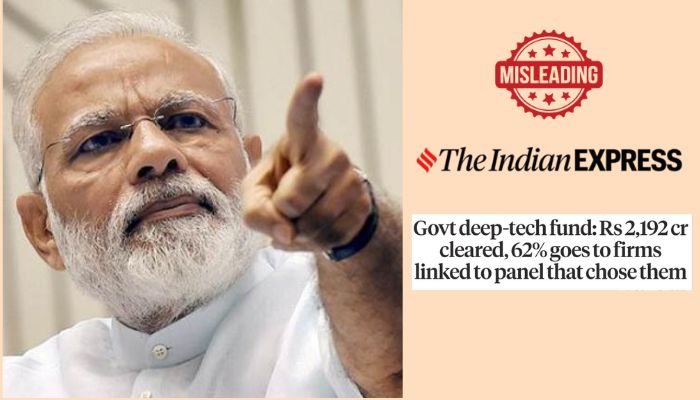
The government of India started a big fund to help smart new companies grow.
It is called the Research, Development and Innovation Fund, and it keeps aside ₹1 lakh crore to give low-cost loans.
A group of twelve people decides which companies get the loans.
Eleven of them are business and technology experts, and one is a government worker who cannot vote.
A newspaper called The Indian Express wrote a story saying some companies that got loans were connected to the people deciding the loans.
Some people read the story and worried that this might not be fair.
But the newspaper's own reporters said the experts stepped away from deciding about companies they were connected to.
People who do not agree with the story say there was no cheating and the headline was just meant to scare readers.
Indian leaders say the fund is important because India is now spending more on research than it has in years.

The Indian Express published an investigative report on 7 August headlined 'Rs 2,192 crore cleared, 62% for firms linked to government tech fund panel'.
The report flagged that 15 companies with sanctioned loans and 7 other companies benefiting from the scheme had links to members of the RDI Fund's investment committee.
The RDI Fund is a ₹1 lakh crore government corpus providing long-term, low-cost loans to private Indian companies in emerging sectors.
Critics of the report say the newspaper's own journalists acknowledged committee members recused themselves and that no wrongdoing was proven.
Congress MP Praveen Chakraborty said additional safeguards should have been in place, while report critics argue existing guardrails were followed.
- Who
- The Indian Express journalists Amitabh Sinha and Sandeep Singh, members of the RDI Fund's 12-member investment committee, and Congress MP Praveen Chakraborty.
- What
- A dispute over The Indian Express's report alleging a large share of RDI Fund loans went to firms linked to investment committee members; critics say no conflict of interest was proven.
- Where
- India.
- When
- The report was published on Friday, 7 August.
- Why
- Concerns about potential conflict of interest in the sanctioning of long-term, low-cost government R&D loans to private companies.
Reporters and skeptics
Critics of the report
Conflict of interest in loan sanctions
Reporters and skeptics
Firms receiving RDI Fund loans included companies whose investors sat on the investment committee, raising questions about conflicts of interest.
Critics of the report
Committee members recused themselves from evaluating companies they had interests in, and no single instance of conflict of interest was proven.
Sufficiency of existing safeguards
Reporters and skeptics
Congress MP Praveen Chakraborty argued additional safeguards should have been in place when public money is loaned to private individuals.
Critics of the report
Mandatory disclosure, mandatory recusal, supermajority approval and Technology Development Board approval already provided adequate protection.
Framing of the investigation
Reporters and skeptics
The headline drew attention to the share of cleared funds going to firms linked to committee members, which warranted public scrutiny.
Critics of the report
Critics call the headline clickbait and propaganda because the report itself led to no conclusion of wrongdoing.
Key facts
- Fund
- Research, Development and Innovation (RDI) Fund
- Fund corpus
- ₹1 lakh crore
- Loans covered in report
- Rs 2,192 crore cleared
- Report headline
- Rs 2,192 crore cleared, 62% for firms linked to government tech fund panel
- Investment committee
- 12 members: 11 voting private-sector experts and 1 non-voting government representative
- Companies flagged
- 15 with sanctioned loans plus 7 others linked to committee members
- India's R&D spending
- 0.8% of GDP, highest since 2010
- Final approval authority
- Technology Development Board
Quotes
Amitabh Sinha
Journalist at The Indian Express
“Now, the situation was very well foreseen, and adequate steps had been taken to mitigate the conflict of interest situation. The members from the selection panel had to recuse themselves from the evaluation process of the companies that they had interest in and this process was followed for all the members and for all the companies. So there has been no wrongdoing as such.”
 opindia.com
Sources
Related news
Investigation finds tech fund conflicts: 62% lent to panel-linked firms

Government says checks in place after RDI Fund conflict report
Minister Welcomes More Safeguards Amid RDI Fund Concerns

India's Chief Economic Advisor Defends Deep-Tech Fund Against Conflict Claims

Government says RDI Fund safeguards robust, no committee member conflicted
Rajya Sabha MP flags deep-tech grants worth Rs 1,377 crore

UP Government Releases ₹101.49 Crore to Upgrade Kasturba Schools
Uttar Pradesh Selects 61 Teachers for State Education Awards

Uttar Pradesh Transfers Aid to Parents of 7.83 Lakh Students

Uttar Pradesh DIKSHA Users Reach 27 Lakh, 12% National Total

Karnataka, Haryana, Jharkhand Win Again at Women's Jr Hockey Nationals
