1 week ago
Study Finds Lead May Worsen Nerve Cell Damage
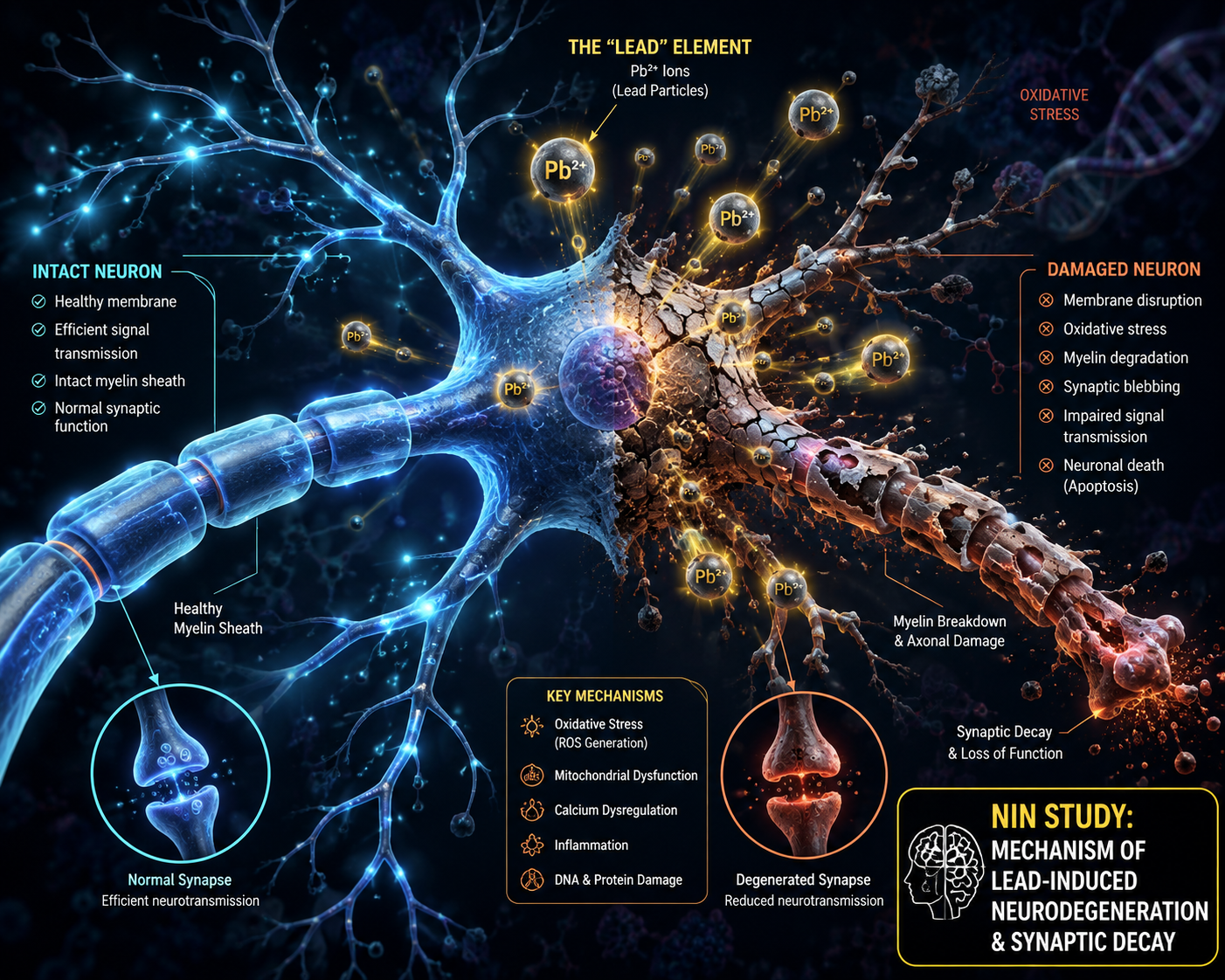
Scientists studied how lead affects nerve cells in a laboratory.
They also studied amyloid-β, a substance linked to changes seen in some brain diseases.
Lead and amyloid-β each caused some problems in the cells.
When the cells were exposed to both, the damage was stronger.
The main problem involved lysosomes, which act like tiny recycling and garbage-processing centers inside cells.
The lysosomes became less effective, changed shape and sometimes leaked harmful enzymes.
This could make nerve cells more vulnerable to damage.
However, the experiment used cells in a laboratory, so it does not prove that lead causes brain disease in people.

Researchers at ICMR-NIN studied lead and two forms of amyloid-β in human neuronal cells.
Lead and amyloid-β each disrupted cells, but their combination caused substantially greater damage.
Combined exposure reduced cell survival and impaired lysosomes, which dispose of cellular waste.
The exposure altered lysosomal acidity, structure, related proteins and genes, including TFEB and LAMP1.
The laboratory findings do not establish that lead directly causes neurodegenerative disease in people.
- Who
- Researchers led by Dr Suresh Challa at the ICMR-National Institute of Nutrition studied human neuronal cells.
- What
- The study found that lead exposure worsened amyloid-β-related lysosomal dysfunction and nerve-cell damage.
- Where
- The research was conducted by the ICMR-National Institute of Nutrition in Hyderabad using laboratory-grown human neuronal cells.
- When
- The findings were reported in a study published in the Journal of Applied Toxicology; no publication date was provided.
- Why
- The researchers examined how environmental lead exposure may interact with amyloid-β and affect cellular waste-processing systems important to nerve-cell health.
Key facts
- Research institution
- ICMR-National Institute of Nutrition (ICMR-NIN)
- Study publication
- Journal of Applied Toxicology
- Experimental model
- Human neuronal cells studied under laboratory conditions
- Combined exposure
- Lead plus two forms of amyloid-β caused more disruption than either exposure alone
- Affected structures
- Lysosomes, which break down damaged proteins and unwanted cellular material
- Observed effects
- Reduced cell survival, impaired lysosomal acidity, structural changes and unstable lysosomal membranes
- Study limitation
- The findings do not establish that lead directly causes neurodegenerative disease in people
Quotes
Dr Bharati Kulkarni
Director of ICMR-NIN
“Understanding these cellular changes can help us better understand how environmental exposures may influence neuronal health”
 deccanchronicle.com
“Our findings show that lead exposure can significantly worsen lysosomal dysfunction in the presence of amyloid‑β”
deccanchronicle.com
Sources
Related news

Delhi’s Air Pollution Linked to Brain Changes Beyond Lungs

NGT Takes Cognisance of Unsafe E-Waste Disposal in Bhopal

DNA damage may drive Huntington's disease, opening new treatment path

Pollution Threatens Breast Milk and Infants Across India

Liver-Brain Axis Links Liver Health To Brain Function

Can everyday plastics affect blood sugar? What experts say

Uttarakhand Journalists Visit Hyderabad Development and Heritage Sites

Mancherial Centralized Kitchen Begins Breakfast for 49,104 Students

Why Post-Meal Pineapple May Support Protein Digestion

Centralized Kitchen Opens for Telangana Government School Breakfasts