7 months ago
Indian Scientists Develop Non-Invasive Quantum Atom Density Measurement
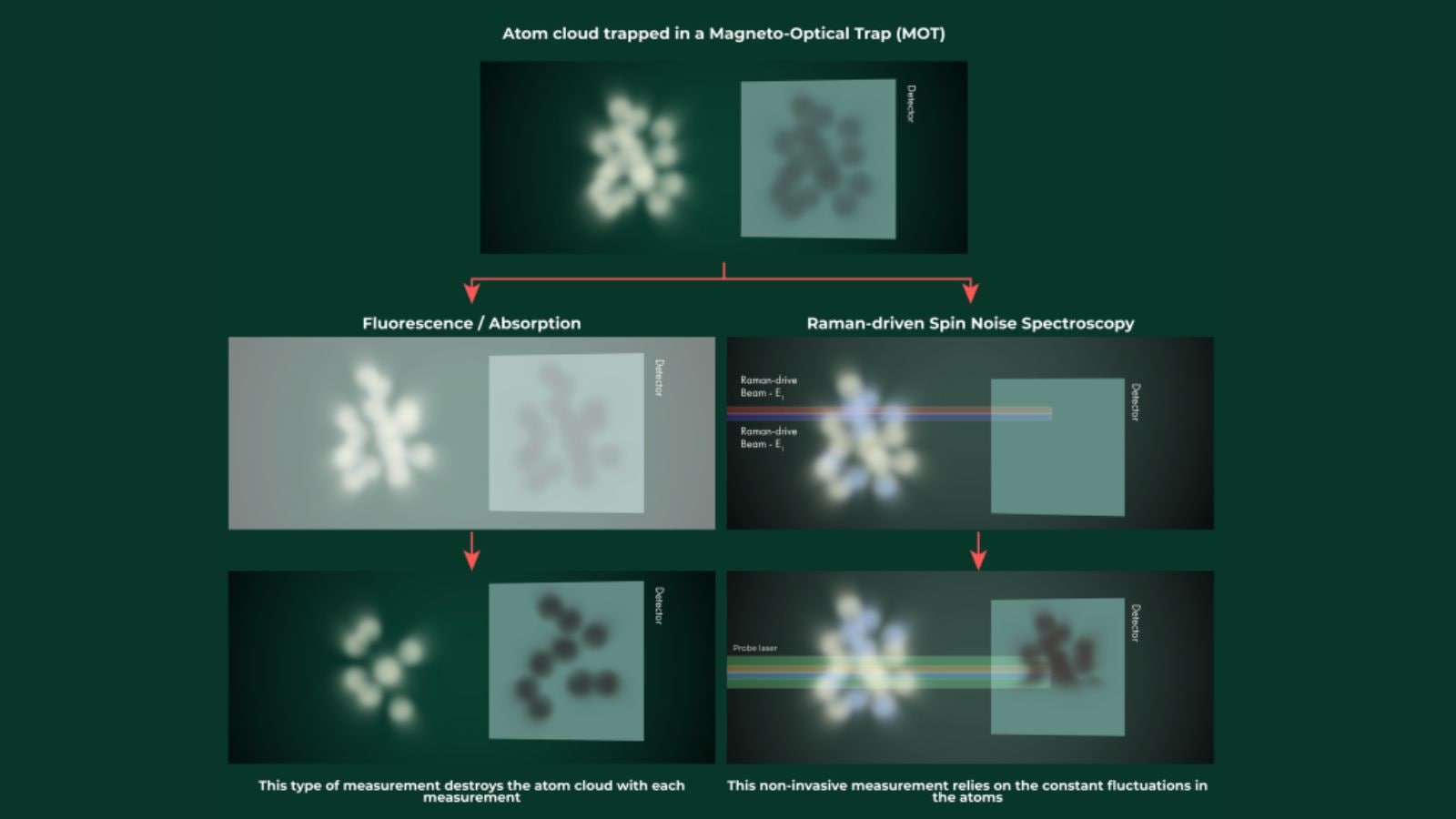
Indian scientists have found a gentle way to measure how tightly atoms are packed together in quantum experiments.
Normally, looking at these atoms can mess up their special quantum states, but this new method listens to the atoms instead of forcing them to react.
It uses a weak laser to detect tiny changes in the atoms' spins, which tells scientists about the density without disturbing the atoms.
This could help in making better quantum computers and sensors.
The method is very precise and can even track quick changes inside the atom cloud, making it useful for studying quantum materials in detail.

Indian researchers at Raman Research Institute developed a non-invasive method called Raman Driven Spin Noise Spectroscopy (RDSNS) to measure quantum atom density.
The method detects natural fluctuations in atomic spins using a weak laser, allowing scientists to infer atom density without disturbing the quantum states.
RDSNS can focus on a small region of the atom cloud, providing local density information with high accuracy and real-time measurement.
The technique was successfully applied to potassium atoms, revealing faster local dynamics compared to traditional fluorescence imaging.
Supported by India’s National Quantum Mission, this method could advance quantum computing, sensing, and the study of quantum matter.
- Who
- Researchers at Raman Research Institute (RRI)
- What
- Developed a non-invasive method to measure quantum atom density
- Where
- Raman Research Institute, India
- When
- Not specified
- Why
- To study quantum properties without disturbing the atoms' delicate states
Key facts
- Research Institute
- Raman Research Institute (RRI)
- Method
- Raman Driven Spin Noise Spectroscopy (RDSNS)
- Key Advantage
- Non-invasive, high accuracy, real-time measurement
- Atom Cloud Size
- 0.01 cubic millimetres
- Atom Count
- 10,000 atoms
- Probe Beam Width
- 38 micrometres
- Research Support
- India’s National Quantum Mission
Sources
Related news

Andhra Pradesh Approves Quantum-AI University Campus in Amaravati

SEBI chief launches two portals to strengthen cyber defence

India to be key player in AI, biotechnology-led industrial revolution
India hits half its quantum communications target in 3 years