1 week ago
Why Political Power May Be Holding Back India’s Investment

The article asks why Indian companies with plenty of money are not building more factories and businesses in India.
Some people say weak demand and global uncertainty are the main reasons.
The author thinks politics may also be important.
Political power and money are described as becoming more concentrated.
A few very large companies, called national champions, are said to have gained more influence.
Smaller companies may worry that rules could change or that they could be pushed out.
Because of these fears, businesses may prefer financial investments instead of building factories.
The author says India may need more competition and confidence in stable rules before companies invest heavily.
However, spreading economic power could also weaken the concentration of political power.

India’s private corporate investment remains below its mid-2000s peak despite government efforts to encourage investment.
The article argues that political and fiscal centralisation, alongside market concentration, may be discouraging companies from investing.
It says businesses fear policy changes, entry barriers, an uneven playing field and being forced out by dominant national champions.
The author contends that relying on a few large companies may limit competition and make investors uncertain about their long-term prospects.
The article argues that greater economic competition would disperse economic power but could also increase political competition.
- Who
- The article discusses India’s government, private companies, national champions, domestic investors and foreign investors.
- What
- It examines why private corporate investment in India remains weak and argues that political centralisation and market concentration may be key factors.
- Where
- India.
- When
- The article focuses on developments after 2014 and the current investment environment; it also compares investment with the mid-2000s peak.
- Why
- The author argues that companies may hesitate because of policy uncertainty, barriers to entry, an uneven playing field and fears of being displaced by dominant companies.
Conventional Explanations
Political-Economy Argument
Why investment is weak
Conventional Explanations
Weak domestic demand and global uncertainty may be discouraging companies from making major investments.
Political-Economy Argument
The deeper issue may be political and fiscal centralisation combined with market concentration and uncertain policy conditions.
Role of large companies
Conventional Explanations
Large national champions may help advance investment and economic development through their scale and policy support.
Political-Economy Argument
Reliance on a few dominant companies may deter smaller and foreign investors who fear an uneven playing field or being pushed out.
Economic and political effects
Conventional Explanations
Concentrating resources in large companies can support a coordinated economic strategy.
Political-Economy Argument
Dispersing economic power through greater competition could encourage investment but might also increase funding opportunities for Opposition parties and political competition.
Key facts
- Investment trend
- Private corporate investment remains considerably below its peak in the mid-2000s.
- Companies’ preference
- India Inc is described as deploying more funds in financial assets than in physical assets such as factories.
- Conventional explanations
- Subdued domestic demand and global uncertainty are cited as explanations for weak investment.
- Political shift
- The article says political centralisation and fiscal centralisation have increased since 2014.
- Market structure
- A handful of large companies, often called national champions, are described as gaining greater economic influence.
- Investor concerns
- The article identifies policy uncertainty, entry barriers, uneven competition and possible hostile takeovers as deterrents.
- Potential consequence
- The author warns that weak competition could contribute to an uncompetitive, high-cost economy.
Sources
Related news
India Corporate Investments Rise But Consumer Demand Remains Weak
NITI Aayog vice-chairman urges easing land acquisition to attract investments

India's Reform Test: Balancing Business Ease and Governance
India Needs Deeper Reforms to Reach 8% Growth, Ahluwalia Says

India’s Fourth BRICS Chair Faces a Much Larger Summit

Nepal Families Seek Missing Loved Ones After Deadly Flash Floods

Putin Faces Western Isolation While Russia Builds Non-Western Ties
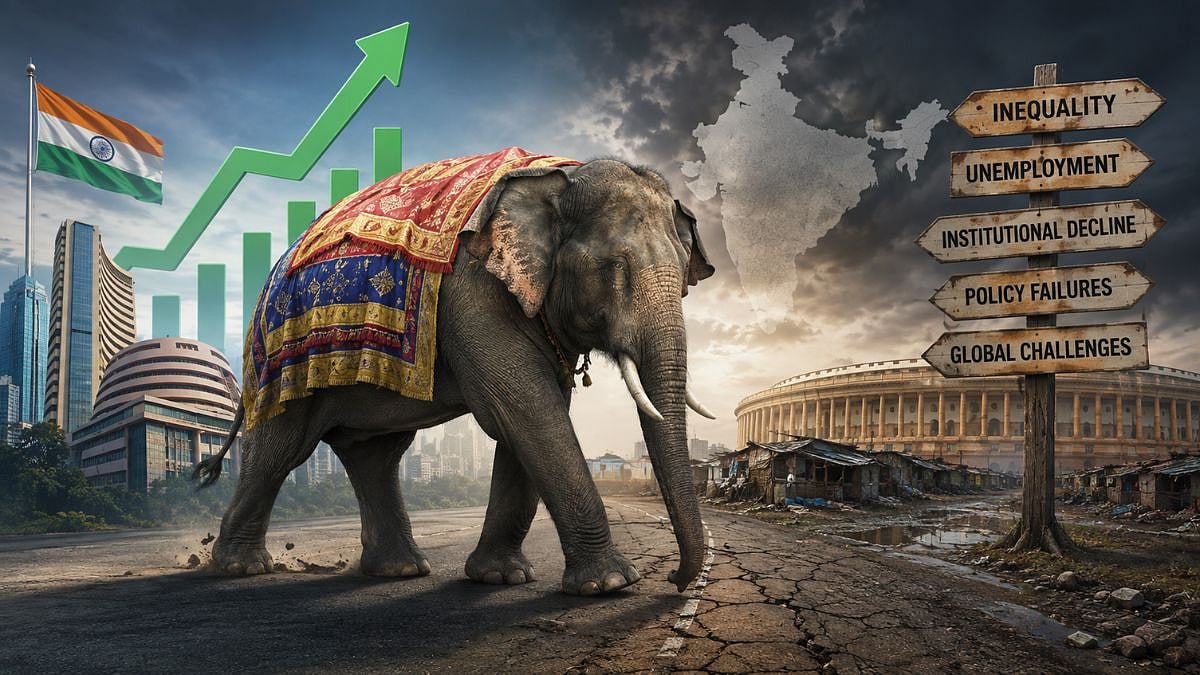
India’s Global Power Ambitions Face Economic and Democratic Setbacks
India’s 7.8% Growth Broad-Based, but Jobs Remain Challenge