1 hr ago
Nobel Honors Scientists Behind Optogenetics and Deeper Brain Mapping
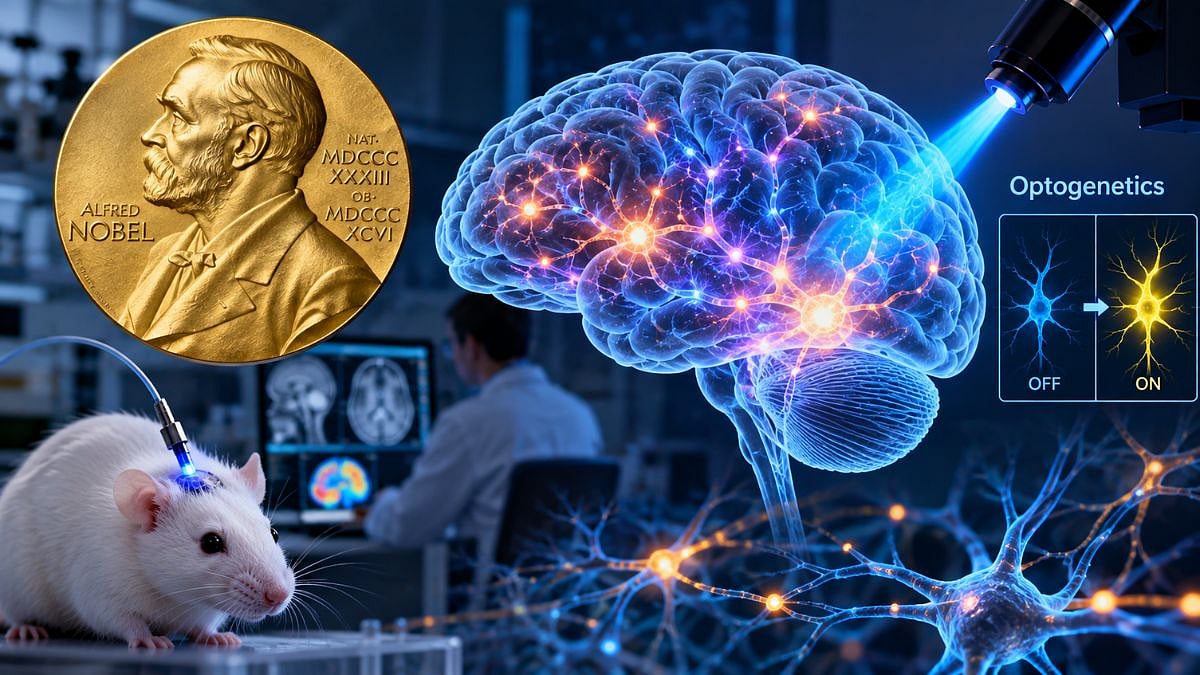
Three scientists received the Nobel Prize in Physiology or Medicine for discoveries that help researchers study the brain.
Their work helped create optogenetics, a way to use light to switch certain cells on or off.
Scientists first studied a tiny alga that moves toward light.
They found a light-sensitive protein called channelrhodopsin.
Karl Deisseroth later engineered rats to make this protein and used light to activate particular nerves.
This lets researchers investigate how different brain pathways work.
The method has helped studies of several brain and neurological conditions.
Researchers are also exploring whether it could help restore some vision for people with retinitis pigmentosa.

Karl Deisseroth, Peter Hegemann and Georg Nagel received the Nobel Prize in Physiology or Medicine for work on light-sensitive proteins and optogenetics.
Optogenetics uses light to activate or deactivate cells, allowing researchers to study specific neurons and neural pathways.
Hegemann and Nagel’s research on the alga Chlamydomonas helped identify channelrhodopsin, a light-sensitive protein.
Deisseroth later genetically engineered rats to produce the protein and used light to activate specific nerves.
The approach has informed research into brain functions and conditions including Parkinson’s, epilepsy, depression, schizophrenia and Alzheimer’s; researchers are also exploring its potential for retinitis pigmentosa.
- Who
- Karl Deisseroth, Peter Hegemann and Georg Nagel.
- What
- They received the Nobel Prize in Physiology or Medicine for pioneering work that enabled optogenetics and more precise studies of neurons.
- Where
- The research was conducted at Stanford University and German institutions, including Humboldt and Würzburg universities and the Max Planck Institutes of Biochemistry and Biophysics.
- When
- The article does not specify when the prize was announced.
- Why
- Their discoveries about light-sensitive proteins enabled researchers to activate specific nerve cells with light and study brain pathways.
Key facts
- Prize
- Nobel Prize in Physiology or Medicine
- Recipients
- Karl Deisseroth, Peter Hegemann and Georg Nagel
- Research field
- Optogenetics
- Key protein
- Channelrhodopsin
- Early research organism
- The single-celled alga Chlamydomonas
- Research applications mentioned
- Studies of neural pathways and conditions including Parkinson’s, epilepsy, depression, schizophrenia and Alzheimer’s
- Potential vision application
- Experimental optogenetic work for retinitis pigmentosa
Sources
Related news

Three Scientists Win 2026 Nobel Medicine Prize for Optogenetics
Nobel Winner Karl Deisseroth Began as a Literature Lover

UPSC GS 3 Practice Explores Optogenetics and Oil Prices

Nitin Gupta: From JEE 2000 Topper to Mosquito Brain Researcher
Scientists Grow Brainstem Cells in Petri Dishes for First Time

Human Brain Organoids Integrated Into Mouse Brains, Enabling Disease Research
CERN Experiment Recreates Cosmic Ray Collisions in Earth’s Atmosphere

AfD Turns East Germany’s Vespa Into Election Vehicle