15 hrs ago
Trump's Moon Claim Collides With International Space Law
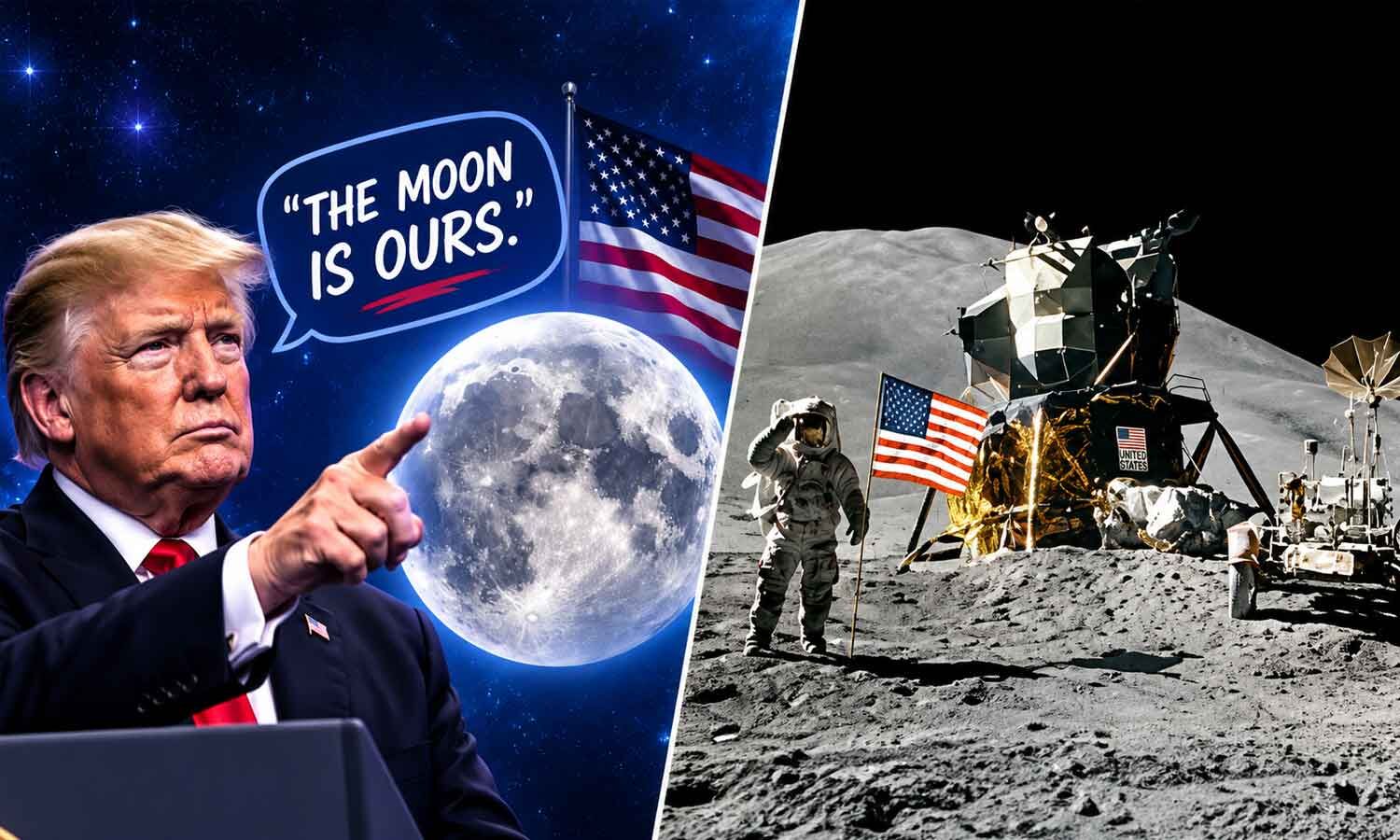
Donald Trump recently said that the Moon belongs to the United States.
International rules do not allow any country to own the Moon.
These rules say that countries may explore and use space equally.
They also say that planting a flag or building a base does not create ownership.
The United States has a law allowing its citizens to collect and use materials from space.
The Artemis Accords support this kind of activity while banning territorial claims.
Another agreement says lunar resources should belong to everyone and be managed internationally.
The United States has not accepted that agreement.
Because countries interpret the rules differently, the legal status of lunar mining remains unsettled.

Donald Trump wrote that “The Moon is ours” in a recent Truth Social post.
The 1967 Outer Space Treaty bars countries from claiming sovereignty over the Moon.
U.S. law allows Americans to recover and use space resources without owning lunar territory.
The Artemis Accords support lunar resource use while requiring coordination and safety zones.
The 1979 Moon Agreement would require international management and equitable sharing of lunar mining benefits.
- Who
- U.S. President Donald Trump, the United States, and countries involved in space-law agreements.
- What
- Trump claimed that “The Moon is ours,” prompting consideration of international rules governing lunar ownership and resource extraction.
- Where
- The issue concerns the Moon and activities governed by international space law.
- When
- Trump made the statement recently; the key Outer Space Treaty dates to 1967, the U.S. resource law to 2015, and the Moon Agreement to 1979.
- Why
- The claim conflicts with the prohibition on national ownership of celestial bodies, while future lunar mining raises unresolved questions about resource ownership.
Treaty-Based Limits
Commercial Resource Rights
Ownership of lunar territory
Treaty-Based Limits
The Outer Space Treaty says no country can own the Moon; flags, bases, or operations do not create sovereignty.
Commercial Resource Rights
The U.S. position accepts that territory cannot be owned but distinguishes territorial ownership from the use of extracted resources.
Commercial mining
Treaty-Based Limits
The Moon Agreement’s approach says unextracted lunar resources cannot be owned and that mining should be managed internationally with benefits shared equitably.
Commercial Resource Rights
The U.S. law and Artemis Accords support commercial recovery and use of space resources, arguing this does not amount to owning the Moon.
Interpretation of international law
Treaty-Based Limits
Some experts argue commercial appropriation could undermine the principle that space activities should serve all countries.
Commercial Resource Rights
Other experts argue that extracting and possessing lunar material is lawful if it does not involve claiming sovereignty and complies with international law.
Key facts
- Key treaty
- The Outer Space Treaty of 1967 prohibits national appropriation of the Moon and other celestial bodies.
- U.S. legislation
- The 2015 Commercial Space Launch Competitiveness Act recognizes Americans’ right to commercially recover and use space resources.
- Artemis Accords
- Launched by NASA in 2020, the U.S.-led guidelines support peaceful lunar exploration and resource use without territorial claims.
- Safety zones
- The Artemis Accords allow operational safety zones intended to prevent interference, not establish ownership.
- Alternative agreement
- The 1979 Moon Agreement describes the Moon and its resources as the common heritage of mankind.
- U.S. position
- The United States has not accepted the Moon Agreement.
- Participation detail
- NASA said Turkiye became the 71st Artemis Accords signatory on August 31, 2026, according to the article.
Quotes

Donald Trump
President of the United States who made the declaration in a Truth Social post
“The Moon is ours”
 thehansindia.com
Sources
Related news
Trump’s Moon Claim Collides With Outer Space Treaty
India Weighs Lunar Ambitions Amid Rising Space Competition
US Invites ISRO Into Moon Base Cooperation, Ambassador Says
United States Admits Deploying Weapons in Space, Sparking Legal Debate

US Confirms Orbital Weapons, Raising Legal and Security Questions