1 week ago
Semen Bacteria Linked to Pregnancy Loss, but Causation Remains Unproven
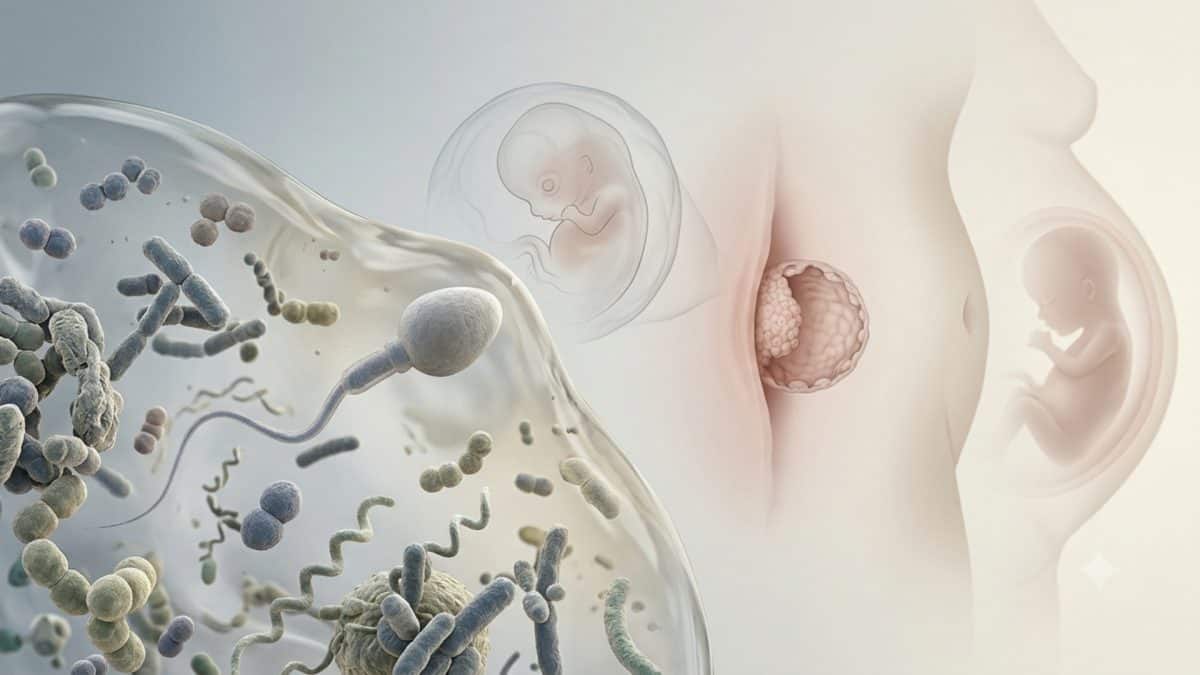
Scientists studied the tiny organisms that live in semen.
They found that some men had a bacterial pattern linked with fewer live births and more pregnancy losses.
This pattern was called seminal vaginal-dysbiosis.
In one group, 57% of couples with the pattern had a live birth, compared with 85% without it.
However, the study did not prove that the bacteria caused the losses.
The bacteria might affect sperm or cause inflammation, but researchers are still investigating.
Doctors say fertility problems should be evaluated in both partners.
Couples should continue standard medical care rather than seek unproven treatments for semen bacteria.

A Danish study linked a semen bacterial pattern called seminal vaginal-dysbiosis with poorer reproductive outcomes.
Among IVF or ICSI couples, live birth occurred in 57% with the pattern versus 85% without it.
The pattern was also associated with higher pregnancy-loss risk in IVF and recurrent-loss groups.
Researchers found an association, not proof that semen bacteria cause miscarriage or infertility.
Doctors do not currently recommend routine microbiome testing, antibiotics, probiotics, or supplements for this purpose.
- Who
- Researchers studied 353 women and 191 male partners undergoing fertility treatment or evaluation for recurrent pregnancy loss.
- What
- The study found that seminal vaginal-dysbiosis was associated with lower live birth rates and higher pregnancy-loss risk.
- Where
- The prospective study was conducted in Denmark.
- When
- The article does not specify when the study was conducted or published.
- Why
- Researchers aimed to examine whether microbial communities in semen, alongside gut and vaginal microbiomes, were associated with reproductive outcomes.
Study Findings Suggest a Potential Risk Factor
Doctors Urge Caution Before Changing Treatment
Meaning of the bacterial pattern
Study Findings Suggest a Potential Risk Factor
Researchers identified seminal vaginal-dysbiosis as a microbial pattern associated with poorer reproductive outcomes.
Doctors Urge Caution Before Changing Treatment
Doctors emphasize that the finding shows correlation, not that the bacterial pattern directly causes miscarriage or infertility.
Clinical testing
Study Findings Suggest a Potential Risk Factor
The findings suggest that semen microbiomes may provide an additional area for future fertility assessment beyond sperm count, movement, and shape.
Doctors Urge Caution Before Changing Treatment
Doctors do not recommend routine semen microbiome testing because testing is not yet standardized and its clinical benefit is unproven.
Treatment implications
Study Findings Suggest a Potential Risk Factor
The researchers describe microbial profiles as potentially modifiable risk factors and call for intervention trials.
Doctors Urge Caution Before Changing Treatment
Doctors say couples should not start antibiotics, probiotics, or supplements specifically to alter semen bacteria without evidence that doing so improves live birth rates.
Key facts
- Study journal
- The Lancet Obstetrics, Gynaecology & Women’s Health
- Study location
- Denmark
- Participants
- 353 women and 191 male partners
- Methods
- Deep shotgun metagenomic sequencing of semen, gut, and vaginal samples
- Live birth with seminal V-dysbiosis
- 57% among couples undergoing IVF or ICSI
- Live birth without seminal V-dysbiosis
- 85% among couples undergoing IVF or ICSI
- Current clinical advice
- Routine microbiome testing and treatment are not recommended based on this study alone
Quotes
Dr Meghana Reddy
Senior Consultant in obstetrics, gynecology, laparoscopy and aesthetic gynecology at Aster Women & Children, Bengaluru
“The message is valuable: fertility is a couple-level issue. When evaluating infertility or recurrent pregnancy loss, we should not look exclusively at the woman.”
 firstpost.com
“the results show a correlation between miscarriage and the presence of certain bacteria in the sample rather than direct causality.”
firstpost.com
Sources
Related news
New study links gut bacteria, not just hormones, to fertility

Study Highlights Men’s Preconception Health and Children’s Outcomes
India’s Fertility Crisis Highlights Delayed Parenthood and Reproductive Awareness

AI Enters IVF Labs as Decision-Support, Not Embryologist Replacement

30 Children Feared Caught Up in Northern Cyprus IVF Scandal

Denmark Sends Conscripts to Greenland as Arctic Tensions Rise

Denmark Delegation Discusses Future Power Grid Development in Amaravati

India and Denmark Deepen MSME Innovation, IP Cooperation

UK Student Dependent Ban Reshapes Family Study-Abroad Choices

Denmark Tops Global Women’s Peace and Security Index