

3 hrs ago
Pulse Field Ablation Used in Complex Atrial Fibrillation Case
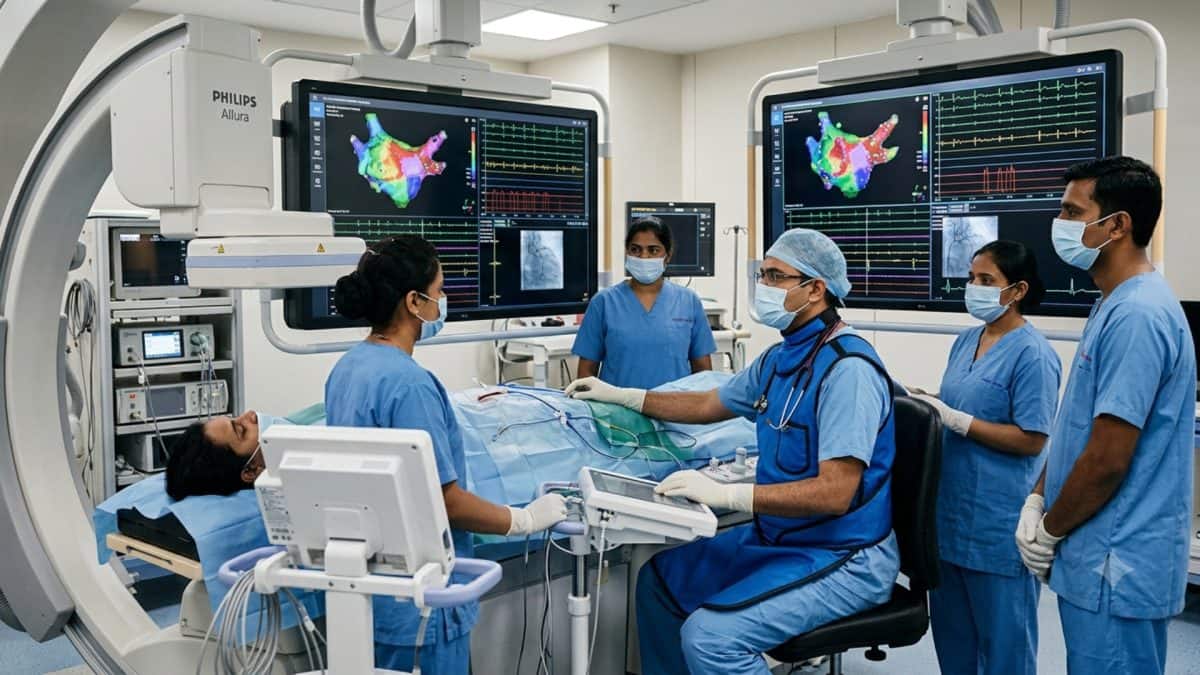
A woman had an irregular heartbeat that kept coming back.
She also had a condition that made her heart muscle unusually thick.
Her medicines and a heart device had not stopped the problem or repeated hospital stays.
Doctors used a treatment called pulse field ablation to target areas linked to the irregular heartbeat.
It uses short electrical pulses rather than heat or extreme cold.
The hospital said her atrial fibrillation was not documented during the first 30 days after treatment.
That is an early result, and doctors need to watch her for longer to know how well it lasts.
This one case does not show whether the treatment will work for everyone.

A 62-year-old woman with recurrent atrial fibrillation and hypertrophic obstructive cardiomyopathy underwent pulse field ablation.
The procedure was performed at BM Birla Heart Hospital in Kolkata.
She had experienced repeated heart-failure hospitalisations despite treatment and an implantable cardioverter-defibrillator.
Doctors used pulse field ablation for pulmonary vein isolation and to treat the left atrial posterior wall.
The hospital reported no clinically documented atrial fibrillation during the first 30 days; longer follow-up is needed to assess durability.
- Who
- A 62-year-old woman with recurrent atrial fibrillation and hypertrophic obstructive cardiomyopathy.
- What
- She underwent catheter ablation using pulse field technology, including pulmonary vein isolation and treatment of the left atrial posterior wall.
- Where
- BM Birla Heart Hospital in Kolkata, India.
- When
- The article does not specify when the procedure took place; the reported follow-up covered the first 30 days afterward.
- Why
- She continued to have symptomatic atrial fibrillation and repeated heart-failure hospitalisations despite treatment.
Key facts
- Patient
- 62-year-old woman from North 24 Parganas
- Conditions
- Recurrent atrial fibrillation and hypertrophic obstructive cardiomyopathy
- Hospital
- BM Birla Heart Hospital, Kolkata
- Treatment
- Pulse field catheter ablation
- Areas treated
- Pulmonary veins and left atrial posterior wall
- Early follow-up
- No clinically documented atrial fibrillation during the first 30 days, according to the hospital
- Long-term outcome
- Further follow-up is needed to assess sustained rhythm control and clinical outcomes
Quotes
Dr Rakesh Sarkar
Senior Consultant in Cardiology and Cardiac Electrophysiology at BM Birla Heart Hospital.
“We therefore looked at her overall condition, previous treatment and the pattern of her arrhythmia before deciding on the procedure. We used pulse field ablation to target the areas triggering the abnormal rhythm, intending to give her better and more lasting rhythm control.”
 firstpost.com
“Atrial fibrillation may be harder to treat in hypertrophic obstructive cardiomyopathy, a condition in which the heart muscle is abnormally thick. In this case, the patient continued to have AF despite treatment and was repeatedly admitted with heart failure.”
firstpost.com
Sources
Related news

Navi Mumbai Woman Survives Stroke and Repeated Cardiac Emergencies

Doctors Highlight Prosthetic Valves and AI Cardiac Monitoring Research

Major Heart Surgery Succeeds for 77-Year-Old with Rare Blood Group

Bihar Patient Receives Minimally Invasive Heart Surgery in Raipur
Robotic Surgery Repairs Heart Defect in Merchant Navy Aspirant

First-in-Country Tricuspid TEER Treats Rare Barlow’s Disease Without Surgery

Kolkata Metro Announces Overnight Services for Peak Durga Puja Days

Eight Kolkata Restaurants Offer Puja Menus and Café Breaks

Tipsy Night School Brings Serious Lectures to Kolkata Bars
IEM Rally Brings Mental Health Awareness Into Kolkata Community

East Bengal and Mohun Bagan Set for IFA Shield Final Derby
