

2 days ago
H-1B Fee Extension Deepens Uncertainty for Indian Professionals and Students
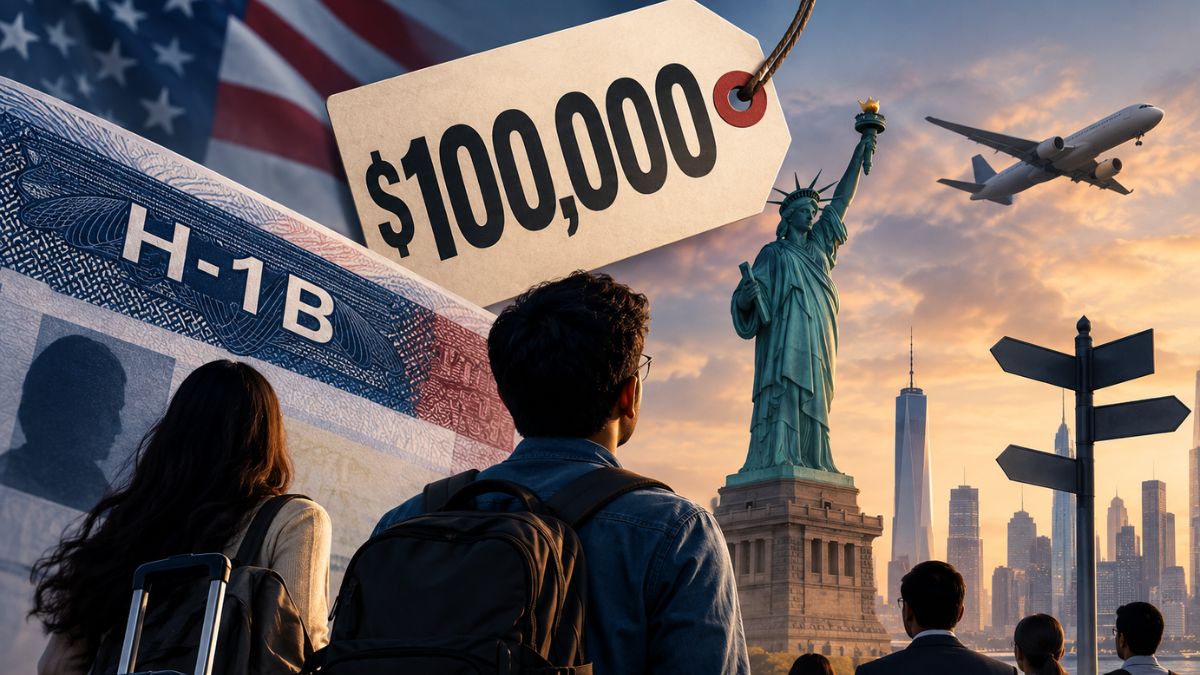
The US government requires some employers to pay $100,000 when bringing certain new H-1B workers from abroad.
President Donald Trump extended this rule for another year.
The administration says the fee discourages companies from using foreign workers for lower-paid jobs.
Some companies have sharply reduced their H-1B applications.
Critics say the rule is legally uncertain and makes it hard for businesses to plan.
A US judge said the fee was unlawful, but the government is appealing.
Indian students are now asking earlier whether they can stay and work in the US after graduation.
Some are also considering countries such as Germany.
Workers already in the US may think twice before changing jobs because future sponsorship is less predictable.

President Donald Trump extended the $100,000 H-1B fee restriction through September 21, 2027.
A Massachusetts federal judge ruled the charge unlawful, but the administration has appealed and separate litigation continues.
The White House says the policy reduced outsourcing companies’ H-1B registrations and encouraged higher-paid, higher-skilled hiring.
Employers and immigration lawyers say shifting legal rules are making overseas recruitment and workforce planning more difficult.
Indian students and professionals are considering Germany and other destinations while becoming more cautious about US education, sponsorship, and job changes.
- Who
- The Trump administration, US employers, immigration lawyers, Indian students, and Indian professionals are central to the issue.
- What
- The United States extended a $100,000 payment requirement for certain H-1B applications while courts review its legality.
- Where
- The policy affects H-1B recruitment into the United States and is influencing education and career decisions in India.
- When
- The extension was announced on September 18 and keeps the restriction in place until September 21, 2027; the original policy began in September 2025.
- Why
- The administration says the measure counters H-1B abuse and shifts hiring toward higher-skilled, higher-paid workers; critics say it creates costly legal and planning uncertainty.
Trump Administration
Employers, Lawyers, and Critics
Purpose of the fee
Trump Administration
The administration says the fee curbs abuse by outsourcing and staffing companies, reduces lower-paid foreign recruitment, and encourages higher-skilled and higher-paid hiring.
Employers, Lawyers, and Critics
Critics say the fee acts mainly as a near-total deterrent, discouraging overseas recruitment and encouraging companies to hire within the US or locate work elsewhere.
Effect on H-1B applications
Trump Administration
The White House points to a 92% decline in registrations from the largest IT outsourcing companies and more than 700 paid petitions as evidence that the policy is working.
Employers, Lawyers, and Critics
Lawyers note that the decline also occurred alongside a separate wage-weighted selection rule, so the fee alone cannot explain the changes.
Legality
Trump Administration
The administration is defending the charge in court and argues that the restriction can remain in place while appeals proceed.
Employers, Lawyers, and Critics
A Massachusetts judge ruled that the charge functioned as an unauthorized tax, while the US Chamber of Commerce and universities are pursuing a separate challenge in Washington.
Key facts
- Fee
- $100,000 for certain H-1B applications involving new workers entering from outside the United States.
- Extension
- The restriction was extended through September 21, 2027.
- Petitions paying fee
- The White House says more than 700 petitions paid the fee during its first year.
- Outsourcing registrations
- The administration says registrations from the largest IT outsourcing companies fell 92% after the 2025 proclamation.
- Court ruling
- A Massachusetts federal judge ruled in June that the charge was unlawful; the administration appealed.
- Proposed additional fee
- The Department of Homeland Security proposed a separate $103,265 fee for H-1B cap-subject petitions.
- Alternative destinations
- Immigration consultants report increased interest in Germany and continued interest in the United Kingdom.
Quotes
Kevin J Andrews
Founder and principal attorney at Kevin J. Andrews Law, LLC
“The fee’s legal status has moved four times in about a year. It was struck down, briefly and administratively kept in force pending appeal, struck down again when the First Circuit refused to pause that ruling, and now extended by the President for another year regardless. The uncertainty alone is enough to drive employers away from the H-1B program.”
 financialexpress.com
“One noticeable difference is that earlier, Plan B was something we discussed when Plan A didn’t work out. Today, we are discussing Plan B before the student even leaves India.”
financialexpress.com
An unidentified H-1B visa holder
An H-1B worker in the United States who requested anonymity
“People can plan around a known process, even if it is difficult. It becomes much harder when you don’t know what the process or cost might look like a year from now.”
financialexpress.com
Sources
Related news
Trump Extends $100,000 H-1B Fee Through September 2027
Trump Extends $100,000 H-1B Fee Order Amid Legal Challenges
Trump H-1B Fee Proposals Could Hit Indian Workers Hard
Trump Administration Tightens US Visa Rules for Indians

Trump Extends $100,000 H-1B Fee, Tightens Visa Scrutiny

Nine 2026 H-1B Rule Changes Affecting U.S. Visa Workers
H-1B Visa System Faces Intensifying Trump Administration Investigation

Visakhapatnam IT Hub Faces Water Stress, Firms Urged To Conserve
US Labor Department Expands H-1B Fraud Investigation Beyond Tech

Cognizant Launches Axis Bank’s Five-Year AMS 2.0 Partnership
