1 hr ago
India Seeks Ownership as Artificial Intelligence Reshapes Global Power
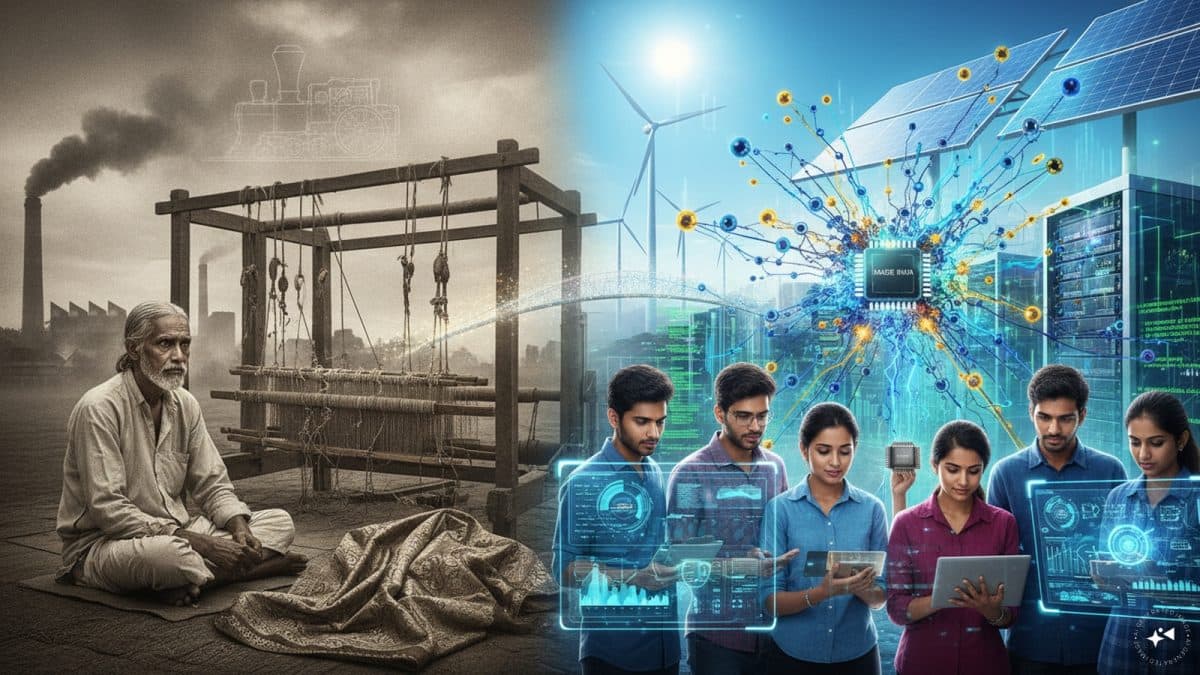
The article says India missed out when steam-powered machines changed the world.
Many Indian weavers lost their livelihoods because factories were built elsewhere.
Now a new kind of machine, artificial intelligence, is becoming powerful.
The author says India has many computer experts, a large market and many languages that can help it compete.
India has also begun supporting chips, GPUs and local AI models.
But using AI is not the same as owning the machines that run it.
The author wants India to make computing cheaper, preserve and share its language data, buy from Indian AI companies and use renewable energy.
These steps could help India gain power instead of repeating its earlier industrial experience.
The article says the opportunity is urgent because AI is developing quickly.

India’s share of global manufacturing fell from about 25% in 1750 to under 2% by 1900 as industrialization advanced elsewhere.
The article argues that artificial intelligence will redistribute power quickly, rewarding those who own computing infrastructure rather than merely use it.
Compute, energy and data are identified as the three essential resources in the emerging AI competition.
India is described as having major advantages in AI talent, market size, semiconductor design and access to subsidized computing.
The author proposes public GPU infrastructure, open Indian-language data, government procurement of domestic models and solar-powered AI parks.
- Who
- Dr Manish Ranjan, an Indian Administrative Service officer and AI author, presents the argument; Indian policymakers, researchers and companies are the intended actors.
- What
- An opinion article argues that India should turn its talent, market, data, computing and energy resources into ownership of the emerging AI economy.
- Where
- The discussion focuses on India’s role in the global artificial-intelligence economy, with historical references to Bengal, Manchester and other countries.
- When
- The article discusses the current AI race, 2026, and projections through 2030.
- Why
- To prevent India from again being left behind by a major machine-driven economic transformation and to convert its current advantages into lasting power.
Key facts
- India’s manufacturing share in 1750
- About 25% of global manufactured goods
- India’s manufacturing share by 1900
- Under 2% of global manufacturing
- AI labor-market estimate
- MIT researchers estimate current AI can perform work equal to 11.7% of the American labor market, worth about $1.2 trillion in wages.
- Projected AI economic impact
- PwC projects AI could add $15.7 trillion to global GDP by 2030.
- Advanced-chip production
- The article says a single company in Taiwan fabricates roughly nine in ten of the world’s most advanced chips.
- IndiaAI computing support
- The IndiaAI Mission provides tens of thousands of subsidized GPUs to startups and researchers at under a dollar an hour.
- Policy proposals
- The author recommends public computing infrastructure, Indian-language data, government purchasing of domestic models and solar-linked AI parks.
Sources
Related news

India’s AI Race Gains Momentum, But Jobs Remain Uncertain
Satya Nadella Calls for Broad, Sovereign AI Access in India
India Should Avoid China’s AI Price War, Pursue Value

India Poised to Build AI-Native Semiconductor Ecosystem Advantage

Cloud and AI Could Propel India's Economic Growth
UK Institute Warns Humans Could Lose Control of Superintelligent AI
UN AI Panel Urges Facts Over Apocalyptic Risk Rhetoric
AI by 2030: Work, Economy, Energy, Rules and Geopolitics

Pritzker Urges Federal AI Regulation Amid Slowdown Debate