

1 week ago
India’s Research System Faces Funding, Bureaucracy and Academic Power Barriers
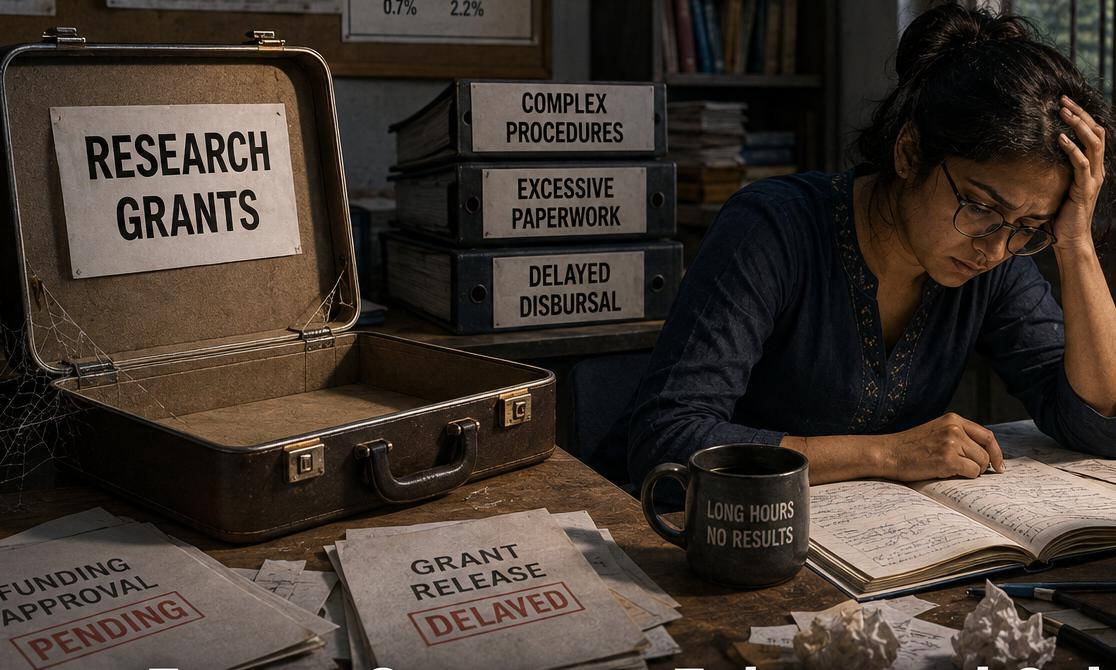
India wants to make it easier for scientists to do research.
Researchers say the problem is not only the amount of money available.
Grants can take a long time to arrive, and scientists may have to pay expenses themselves before being reimbursed.
Buying equipment and chemicals can also involve many forms and approvals.
Some research students wait months for project salaries.
Scientists may spend weeks writing grant applications that are not approved.
Researchers also say funding often favors better-known institutions.
Young scholars can face pressure from supervisors who control their academic progress.
These problems can make research slower, discourage talented people and reduce the quality of scientific work.

NITI Aayog’s two reports seek to make India’s research ecosystem more efficient and innovation-driven.
Researchers say grants are often insufficient, delayed or difficult to access because of procurement and reimbursement rules.
Administrative work, repeated forms and lengthy proposal processes reduce the time researchers can spend on experiments and analysis.
Researchers report that funding and infrastructure challenges can delay student salaries and make scientific careers less attractive.
Scholars also describe power imbalances with supervisors, including delayed reviews, inadequate feedback and alleged misuse of student work.
- Who
- Indian researchers, academics, research scholars, universities and funding agencies, including experts cited by the article.
- What
- The article examines obstacles in India’s research system, including delayed grants, procurement burdens, unequal funding, insecure careers and supervisor power imbalances.
- Where
- India, including central universities, BML Munjal University, Atria University and the University of Hyderabad.
- When
- Why
- NITI Aayog aims to create a more efficient research and development ecosystem, while researchers want funding, administration and academic relationships to better support actual research.
Key facts
- NITI Aayog reports
- The agency released “Ease of Doing Research & Development in India” and the “Survey Report on Ease of Doing R&D in India”.
- Anonymous professor’s funding
- A central university associate professor has secured about seven projects totaling approximately ₹2 crore since 2012.
- Chemical costs
- The professor estimates that chemical purchases for molecular-level biological research can cost around ₹15 lakh annually.
- Proposal success rate
- The professor says seven or eight proposals may produce only one approved project, with each proposal taking two to three weeks to prepare.
- Payment difficulties
- Researchers may need to pay contingency or travel expenses themselves and wait for reimbursement.
- Administrative burden
- Researchers report spending substantial time on procurement, utilization requirements, approvals and repetitive forms.
- Long research timelines
- Dr Sadaf Kalam said outcomes such as drug patents may take five, 10 or even 20 years.
Quotes
Anonymous associate professor at a central university
A central university associate professor discussing contingency expenses and reimbursement delays
“Researchers still spend a considerable amount of time navigating procurement processes, utilisation requirements and multiple layers of institutional approvals rather than focusing on the research itself.”
 deccanchronicle.com
“I have to shell out ₹50,000 from my pocket, submit the bills and then wait for the funding agency to send the money.”
deccanchronicle.com
Dr Sadaf Kalam
Researcher and academic from Hyderabad
“Research is not something where you put in an input and get an output immediately. If you file a patent for a particular drug, it might take five, 10 or even 20 years. The government should understand that research is not a one-time process.”
deccanchronicle.com
Sources
Related news

NITI Aayog Report Flags Funding and Transparency Gaps in India

India's R&D Ecosystem Faces Hurdles On Path To Knowledge Economy

Why Undergraduate Research Matters for India’s Innovation Future

NSUI complaint puts JNTU research grant under scanner
Dalit Scholar Alleges Caste Bias at Kerala University
Six IIT Madras Professors Granted ANRF JC Bose Research Award

Women Students Build Generative AI Solutions at Delhi-NCR Hackathon

New optimisation trick speeds boundary-layer mathematics, with trade-offs
From Partition Loss to Hero MotoCorp’s Two-Wheeler Empire
BMU's 5th Moot Court Competition Hosted by Future Foundation School
