

1 day ago
British Policeman Turned Indian Postings Into Colonial Crime Fiction
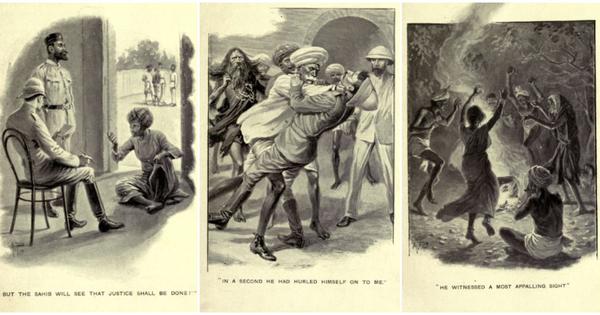
Edmund Cox was a British officer who worked as a policeman in India for many years.
He later used things he had seen at work to write books.
Some books told stories about a clever police detective, while another featured a daring robber who sometimes helped poor farmers.
Cox also wrote about the places he visited, including mountains and wide-open landscapes.
But he often described Indian people using unfair labels that matched the ideas of the colonial government.
That government treated some travelling communities as suspicious under a law called the Criminal Tribes Act.
Cox believed British rule in India was necessary.
His books show both his interest in India and his belief in the empire that governed it.

Edmund Cox served in the British Indian police for 30 years, drawing on his postings and cases for books.
His writing included memoirs and police histories, as well as detective stories featuring John Carruthers and the outlaw Kesho Naik.
Cox portrayed policing as part of a colonial effort to order Indian society and accepted the criminal classifications imposed on communities under the Criminal Tribes Act of 1871.
His books also described Indian landscapes, while often depicting people through categories such as thieves, dacoits and suspected members of mobile communities.
Cox supported British rule and clashed with Bal Gangadhar Tilak over the Kolhapur controversy involving Shivaji IV.
- Who
- Edmund Cox, a British officer who served in the British Indian police.
- What
- Cox turned experiences from his Indian postings into memoirs, police histories and crime fiction.
- Where
- His work drew on postings across the Bombay Presidency and other parts of India, including Kolhapur, Belgaum, Poona, Dharwad, Ahmednagar, Sindh and Thana.
- When
- His books appeared from 1887 to 1912, with most of the police-focused books published between 1905 and 1912.
- Why
- His police work and observations of colonial India supplied material for his writing, which also reflected his belief in British rule and social control.
Colonial Order
Colonial Critique
Policing and social control
Colonial Order
Cox presented policing and the regulation of communities as part of ordering Indian society, and defended the necessity of British rule.
Colonial Critique
The article explains that colonial classifications treated some mobile communities as inherently suspect and subjected them to surveillance.
Cox's portrayal of India
Colonial Order
Cox wrote admiringly of India's landscapes and portrayed some fictional outlaws as honourable or generous.
Colonial Critique
His writing often reduced people to criminal categories and expressed belief in British superiority; writer Manohar Malgonkar called him jingoistic.
The Kolhapur controversy
Colonial Order
Cox recalled Shivaji IV as erratic and described accusations against himself as lies.
Colonial Critique
Reformers including Bal Gangadhar Tilak and Gopal Ganesh Agarkar accused Cox and others responsible for Shivaji's care of isolating and abusing the ruler.
Key facts
- Police career
- Cox formally joined the police in February 1883 and served for 30 years.
- First book mentioned
- A Short History of the Bombay Presidency and Tales of Ancient India appeared in 1887.
- Police memoir
- My Thirty Years in India was published in 1905.
- Police history
- Police and Crime in India was published in 1911.
- Fictional detective
- John Carruthers is the police officer featured in two collections of detective stories.
- Final book
- The Exploits of Kesho Naik, Dacoit was published in 1912 and was Cox's last book.
- Criminal Tribes Act
- The 1871 law placed numerous itinerant communities under colonial surveillance and was finally repealed in 1952.
Quotes
Edmund Cox
British police officer and author who served in India.
“Tilak’s only idea of laws was to break them, and of regulations to defy them… To allow Tilak to have a seat on the Legislative Council was equivalent to selecting a highwayman to draw up a Police Code.”
 scroll.in
“Our rule in India is one of the greatest achievements in the world’s history.”
scroll.in
Sources
Related news
How Two Bengali Cyclists Challenged the British Empire

How Phoolan Devi Became India’s Enduring Bandit Queen Legend

Six Indian Fiction Titles to Watch This September

Kerala Conman Arrested After Three Decades, Five Identities, 17 Cases
Nimit Goyal Leads Mumbai West Zone With Technology-Driven Policing

Pratik Gandhi Discusses Breaking Cop Stereotypes In Ghamasaan
Bank of India Kolhapur Zone Holds Vigilance Awareness Activities

Mumbai Rain Alerts Extend Across Region as Thunderstorms Loom

Four-Kilogram Hydroponic Weed Seized At Kochi Airport, Two Arrested

Central Railway Announces 418 Festival Special Trains From Mumbai
