

2 weeks ago
Government sent social media blocking orders every 68 seconds

The government in India told social media companies to remove some posts from the internet.
Between March and July, it sent almost two lakh such requests.
That is about one request every minute!
Most of the requests went to Instagram and Facebook.
This happened around the time students were protesting about exam leaks in Delhi.
The companies now use computers to remove the posts automatically.
That means no person at the company checks the request first.
Some people who care about internet freedom say this is not fair.
They think a human should check each request before content is removed.
A leader named Arvind Kejriwal said some of his posts were blocked, and leaders of Congress called the removals an attack on free speech.

The government sent nearly 1.95 lakh blocking orders to Instagram, Facebook and YouTube between March and July, averaging one order every 68 seconds.
Instagram received nearly 1 lakh orders, Facebook around 80,000, and YouTube nearly 15,000, with Meta-owned platforms getting roughly nine of every 10 orders.
The surge coincided with student protests against exam leaks at Delhi's Jantar Mantar that began on June 6 and were called off on July 25 after Dharmendra Pradhan resigned as Union Education Minister.
Meta has integrated its API with the Home Ministry's Sahyog portal, enabling content flagged by government directions to be taken down automatically without separate human review.
Digital rights activists and the Opposition criticised the moves: Apar Gupta said automation bypasses the legal 'actual knowledge' requirement, while Congress chief Mallikarjun Kharge called it a 'calculated attack' on democratic rights.
- Who
- The Indian government, which issued blocking orders through the Home Ministry's Sahyog portal to Instagram, Facebook and YouTube; critics include advocate Apar Gupta of the Internet Freedom Foundation and Congress chief Mallikarjun Kharge. Data was accessed by The Indian Express.
- What
- Nearly 1.95 lakh blocking orders were sent to the three platforms in five months, averaging one every 68 seconds, with Meta automating takedowns through API integration with the Sahyog portal.
- Where
- India, including Delhi's Jantar Mantar, where the student protests took place.
- When
- Between March and July this year, coinciding with student protests that began in Delhi on June 6 and were called off on July 25.
- Why
- To restrict online content deemed unlawful, including posts supporting the student protests, criticism of the government's ethanol fuel blending policy, and content related to West Bengal Assembly elections.
Government and platform compliance
Digital rights activists and Opposition
Automated takedowns
Government and platform compliance
Meta integrated its API with the Sahyog portal to comply with the government-mandated three-hour takedown timeline, removing flagged content automatically.
Digital rights activists and Opposition
Apar Gupta says machine-to-machine execution converts a conditional legal duty into unconditional compliance, with no human at Meta reading or reviewing the orders.
Takedown speed
Government and platform compliance
The IT Ministry amended the IT Rules in February, requiring unlawful content to be removed within 2-3 hours instead of the previous 24-36 hours.
Digital rights activists and Opposition
Activists say companies are legally required to remove content only upon receiving 'actual knowledge' of a lawful order, which an automated API lacks.
Impact on free speech
Government and platform compliance
Government agencies say the blocking targets content deemed unlawful and helps platforms retain legal immunity from user-generated content under Section 79(3)(b) of the IT Act.
Digital rights activists and Opposition
Congress chief Mallikarjun Kharge called the crackdown the 'most brazen and calculated attack' on the democratic right to speak, question and dissent, while Arvind Kejriwal said some of his Instagram posts were blocked.
Key facts
- Blocking orders (March-July)
- Nearly 1.95 lakh
- Average frequency
- One order every 68 seconds
- Daily average
- Around 1,275 orders
- Instagram orders
- Nearly 1 lakh (just over half of total)
- Facebook orders
- Around 80,000
- YouTube orders
- Nearly 15,000
- Legal basis
- Section 79(3)(b) of the IT Act, 2000
- Takedown timeline
- Within 2-3 hours under amended IT Rules 2021
Quotes
The Indian Express
News organization reporting on government blocking orders
“The Indian Express has learned that, in order to comply with the government-mandated three-hour takedown timeline, Meta has integrated its API with the Sahyog portal, allowing content flagged through government directions uploaded on the system to be automatically taken down from its platforms, without a separate human review by the company.”
 indianexpress.com
“An API that executes takedowns automatically has no knowledge at all. Nobody at Meta reads the order. Nobody checks whether it comes from an officer of the prescribed rank or states the reasons the amended rule now requires… Machine-to-machine execution converts a conditional legal duty into an unconditional compliance”
indianexpress.com
Unknown Speaker
Data from The Indian Express
“Nearly 1.95 lakh blocking orders were issued to Instagram, Facebook and YouTube between March and July of this year, averaging one order every 68 seconds.”
indianexpress.com
Sources

Related news

India Requests 2.44 Lakh Social Media Takedowns During March-July

India’s Digital Blocking Orders Raise Fresh Free Expression Concerns
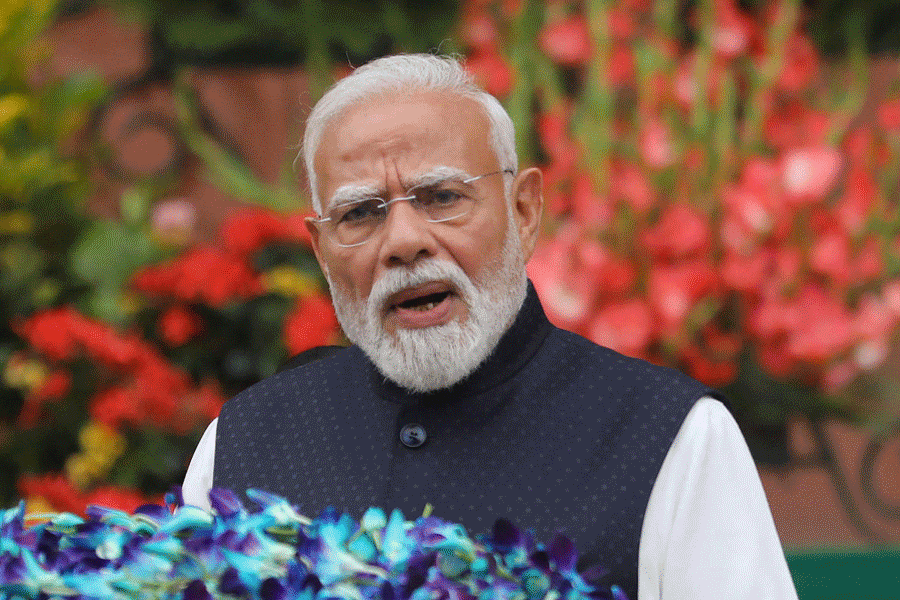
Modi Government Faces Questions Over Social Media Content Crackdown

India Flags Nearly 300,000 URLs Amid Takedown Debate

Kharge accuses Modi government of brazen attack on democratic rights
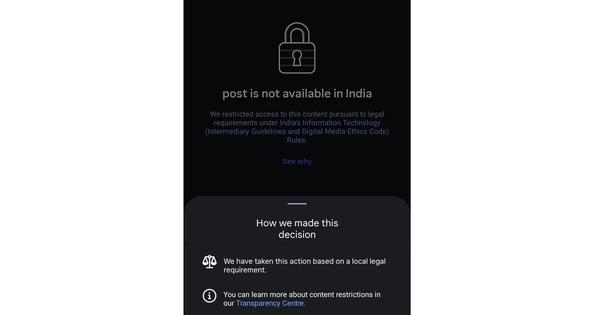
Instagram blocks four Scroll posts citing India's IT rules
BJP Alleges Punjab Cash-for-Transfer Network, Seeks Mann Resignation
Delhi Approves Free Rooftop Solar Panels for 2.3 Lakh Homes
Ranka’s Gavi, AAP and Pakistan Links Raise Transparency Questions
Rahul Gandhi Challenges Maharashtra Roll After 2.07 Crore Exclusions
Delhi SIR Draft Roll Leaves 47.6 Lakh Voters Unlisted
