

1 hr ago
Supreme Court Asks Centre to Reconsider Metro Closures

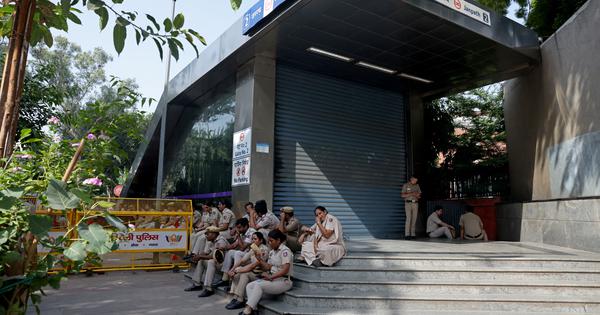
The Supreme Court discussed plans to close 57 Metro stations and cancel some trains before a protest.
The protest was planned for Saturday and called for the Chief Election Commissioner to resign.
The judges said the government can take steps to keep people safe.
But they said those steps should not stop public transport completely if that is not needed.
They noted that commuters, including children, older people and patients, rely on trains.
The government’s lawyer said officials needed room to respond to an uncertain security situation.
He said the restrictions followed violence after an earlier attempt to march to Parliament.
The court also asked officials to consider another suitable place for peaceful protests.

The Supreme Court asked the Centre to reconsider closing 57 Metro stations and cancelling trains ahead of a Saturday protest.
The bench said public transport restrictions must be proportionate and should not bring services to a complete halt.
Solicitor General Tushar Mehta said he would discuss the court’s concerns with the authorities and argued security agencies needed some leeway.
The Centre said restrictions followed violence after protesters attempted to march to Parliament on July 20; an internet shutdown was limited to sensitive areas within four kilometres of the President’s House.
The court asked authorities to consider an alternative venue with basic amenities for peaceful protests after police denied permission to demonstrate at Jantar Mantar.
- Who
- The Supreme Court, the Centre, and organizers of the Cockroach Janta Party and Opposition protest.
- What
- The court asked the Centre to reconsider closing 57 Metro stations and cancelling trains, and to consider an alternative protest venue.
- Where
- New Delhi, with commuters travelling from Gurugram, Greater Noida, East Delhi and South Delhi also affected.
- When
- The hearing took place on Friday, ahead of a protest planned for Saturday; the Metro closures were due to begin at 9 pm on Friday.
- Why
- Authorities cited security and law-and-order concerns ahead of a protest demanding the Chief Election Commissioner’s resignation.
Court’s concerns
Government’s security position
Metro and train restrictions
Court’s concerns
The bench said restrictions should be proportionate, commuters must not be unduly inconvenienced, and services should not be stopped altogether.
Government’s security position
Solicitor General Tushar Mehta said a complete stoppage could be proportionate in some circumstances and law enforcement needed leeway because the situation could not be fully anticipated.
Security measures
Court’s concerns
The court said authorities must protect people as well as state property and questioned whether closing stations until further orders was merely regulation.
Government’s security position
Mehta said authorities had taken proportionate steps in view of violence following the July 20 attempted march to Parliament.
Key facts
- Metro stations affected
- 57 stations were scheduled to close from 9 pm Friday until further orders.
- Protest timing
- The protest was planned for Saturday.
- Protest demand
- Resignation of Chief Election Commissioner Gyanesh Kumar.
- Protest venue
- Police denied the Cockroach Janta Party and Indian Youth Congress permission to demonstrate at Jantar Mantar.
- Internet restrictions
- The government said an internet shutdown was limited to sensitive areas within a four-kilometre radius of the President’s House and would be reviewed.
- Earlier incident cited
- The Centre said measures followed violence after protesters attempted to march to Parliament on July 20.
Quotes
Chief Justice Surya Kant
Chief Justice of India and presiding judge of the three-judge bench
“One very important principle that we follow for every citizen is the principle of proportionality. You have to prevent certain things. Take measures only to the extent necessary to prevent them. But that does not mean you use a hammer to kill a fly. That principle must be kept in mind.”
 deccanchronicle.com
“Exercise caution in abundance. There is nothing wrong with that. You are responsible for maintaining law and order. But that responsibility is not merely about protecting the State property; it is about protecting people. That is your sovereign duty.”
deccanchronicle.com
Sources
Related news
Supreme Court Bars Blanket Delhi Metro Shutdown Ahead of Protest
Supreme Court Seeks Regulated Delhi Metro Services Ahead of Protests

Supreme Court Seeks Answers Over 17 Metro Station Closures

Supreme Court Told Closures Could Restrict Delhi Protest Rights
Supreme Court to Hear Challenge to Delhi Protest Curbs

Supreme Court Asks Centre to Consider Alternative Protest Venue
Supreme Court Challenges Delhi Protest Transport Restrictions
