1 day ago
Europe’s Gas Storage Faces Pressure as Middle East Conflict Escalates
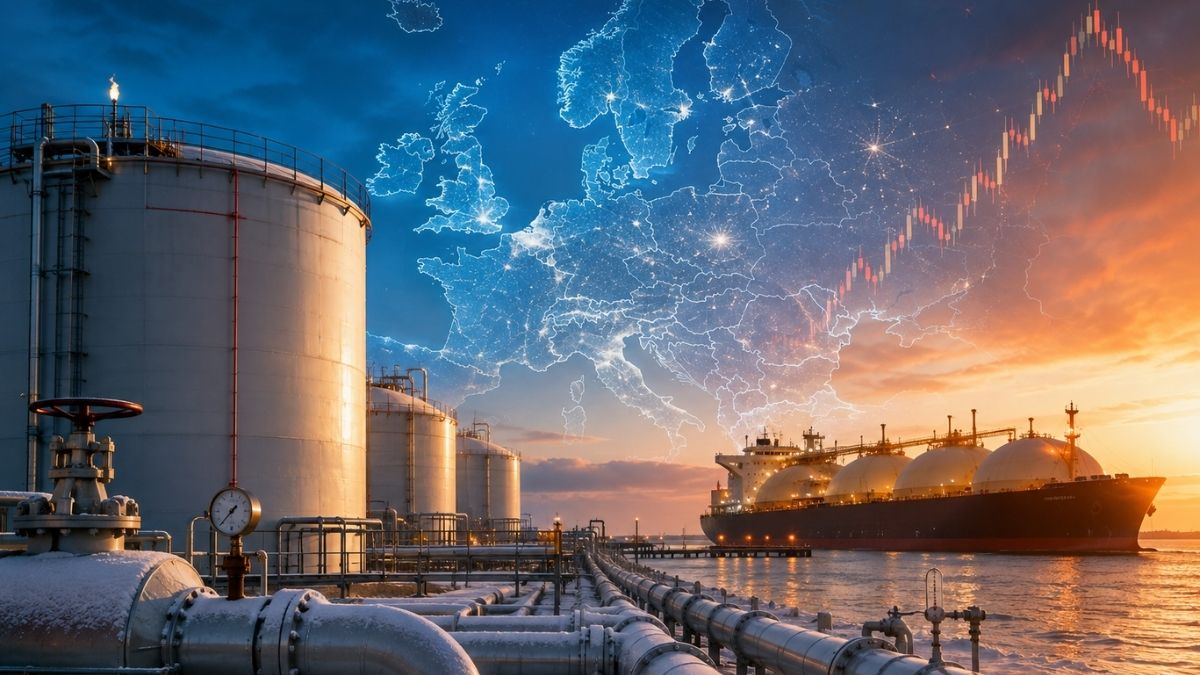
Europe needs to store enough gas before winter, when people use more energy.
Gas prices have risen because the conflict involving Iran has disrupted some Middle Eastern supplies.
Qatar’s disrupted shipments have made gas for immediate delivery more expensive than gas for later delivery.
That gives companies less reason to buy gas now and put it into storage.
The European Union still has gas reserves, storage rules, and spare capacity to import liquefied natural gas.
Officials say there is no immediate danger of running out of gas.
However, filling storage may cost more, especially if winter is cold.
Higher energy prices are also raising inflation and making decisions harder for the European Central Bank.

European benchmark gas prices reached their highest level in about three and a half years.
Disrupted Qatari supplies have pushed the market into backwardation, reducing incentives to store gas now.
EU gas storage rules require facilities to reach 90%, with flexibility between October 1 and December 1.
The European Commission says there is no immediate supply concern and that spare LNG capacity provides flexibility.
The energy shock has contributed to euro zone inflation above 3% and increased pressure on the European Central Bank.
- Who
- The European Union, European Commission, European Central Bank, gas buyers, and energy suppliers are involved.
- What
- Europe is trying to refill gas storage before winter while conflict-related supply disruptions drive prices higher.
- Where
- Across the European Union and the wider European gas market, with supply disruption linked to the Middle East.
- When
- The pressure was reported in July and September; EU storage targets for 2025-27 can be met between October 1 and December 1.
- Why
- Disrupted Middle Eastern energy supplies, especially from Qatar, have raised prices and reduced incentives to store gas before winter.
Official reassurance
Market and economic concerns
Immediate supply risk
Official reassurance
The European Commission and the Energy Union Task Force said there was no immediate security-of-supply concern and that storage targets remained achievable.
Market and economic concerns
Higher prices, disrupted Qatari supplies, and uncertainty over winter storage could make it harder and more expensive to replenish reserves.
Available safeguards
Official reassurance
The EU has spare LNG import capacity, storage rules, coordination mechanisms, and flexibility to respond if pipeline supplies weaken.
Market and economic concerns
These safeguards provide a buffer but do not remove the economic consequences of a prolonged energy disruption.
Monetary-policy response
Official reassurance
The European Central Bank must assess whether energy-driven inflation is temporary or persistent.
Market and economic concerns
Higher energy prices may require tighter monetary policy while also weakening households, businesses, and already-soft euro zone growth.
Key facts
- Gas price movement
- European benchmark gas prices reached their highest level in about three and a half years.
- EU storage target
- EU rules require gas storage facilities to reach 90% annually.
- Storage flexibility
- For 2025-27, countries have a two-month window from October 1 to December 1 to meet the target.
- Winter storage role
- Underground storage normally supplies about 25% to 30% of EU winter gas consumption.
- Fossil-fuel import costs
- The European Commission said the EU spent about €53 billion more on fossil-fuel imports since the conflict began in February.
- Reported storage level
- EU storage reached 83% on October 1, 2025, with about 85 billion cubic metres in stock.
- Inflation impact
- Euro zone inflation rose above 3%, with ECB research attributing the increase almost entirely to energy supply shocks through the end of May 2026.
Sources
Related news

Iran Conflict Adds Nearly £10bn to Britain’s Energy Costs
War-Driven Gas Costs Set UK Energy Bills Higher
West Asia Disruptions Keep Oil Prices Firm, $100 Risk Looms
Bangladesh curbs power use amid gas shortages and Iran crisis

India Faces $22.5 Billion Fossil Fuel Import Shock

Oil Prices Surge Past $93 as US-Iran Conflict Intensifies

Sitharaman Pursues Economic Cooperation with Russia and South Korea

EU Regulators Quiz Publishers on Google AI Opt-Out Proposal

Trump Administration Plans $4 Million For Right-Wing Media Europe

EU Places ChatGPT, Reddit and Roblox Under Stricter DSA Rules