

1 week ago
India’s AI Education Push Exposes Readiness and Governance Gap
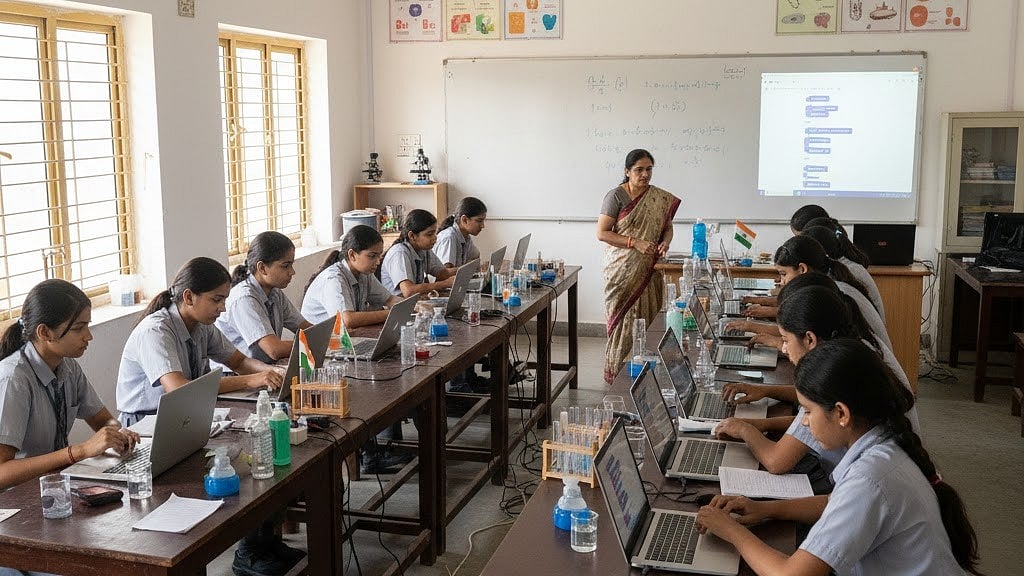
Many schools and colleges in India are trying to decide how to use artificial intelligence in education.
Only a small share of schools, 13%, said AI is fully built into their systems.
Teachers said schools need clear rules about when students can use AI for schoolwork.
They also want protections for privacy, online safety and academic honesty.
College teachers see benefits, such as faster administrative work and better academic performance.
However, 78% worry that too much AI could make students less able to think and solve problems on their own.
Faculty members want practical training and access to advanced AI tools.
The reports suggest that India needs to use AI responsibly, while keeping human judgment and honest learning important.

Only 13% of surveyed Indian schools reported advanced, system-wide AI integration.
Ninety-one percent of schoolteachers said clear rules are needed for students’ academic use of AI.
School readiness was fragmented, with 25% in structured implementation and 25% still exploring AI.
Four in five higher-education faculty members said their institutions were ready to adopt AI, but 78% feared excessive use could weaken independent thinking.
Faculty identified hands-on training, premium AI tools, academic dishonesty and student dependence as major adoption priorities and concerns.
- Who
- QS I-GAUGE surveyed 1,209 K-12 teachers and 1,118 higher-education faculty members; QS India chair Ashwin Fernandes commented on the findings.
- What
- The reports examined AI readiness, classroom use, teacher capacity, governance, privacy, academic integrity and concerns about overdependence.
- Where
- The surveys covered schools and higher-education institutions across Indian states and Union Territories.
- When
- The findings were presented as new QS I-GAUGE reports; the survey dates were not stated.
- Why
- The reports assess how India’s education institutions can adopt AI while addressing integrity, privacy, training and independent-learning concerns.
AI’s Educational Benefits
AI’s Educational Risks
Academic and administrative performance
AI’s Educational Benefits
Faculty members said AI could make administrative work more efficient, with 83% selecting this benefit, while 76% expected improved academic performance.
AI’s Educational Risks
Faculty members warned that excessive reliance on AI could reduce students’ independent thinking and problem-solving skills.
Student use of AI
AI’s Educational Benefits
Supporters see AI as a tool that can contribute to a more productive learning experience when used appropriately.
AI’s Educational Risks
Teachers and faculty identified academic dishonesty and excessive dependence on AI as major concerns, while parents were especially concerned about privacy and cognitive dependence.
Adoption priorities
AI’s Educational Benefits
Faculty said successful adoption requires hands-on training and access to premium, enterprise-level AI tools.
AI’s Educational Risks
Teachers emphasized clear usage boundaries, faculty protocols, cyber safety and academic-integrity frameworks before wider adoption.
Key facts
- School survey
- 1,209 teachers from 71 K-12 institutions across 21 states and Union Territories.
- Higher-education survey
- 1,118 faculty members from 146 institutions across 27 states and Union Territories.
- Advanced school integration
- 13% of schools reported advanced, system-wide AI integration.
- School rules
- 91% of schoolteachers said clear boundaries for students’ academic use of AI were necessary.
- Faculty concern
- 78% of higher-education faculty feared excessive AI reliance could weaken independent thinking and problem-solving.
- Requested training
- Hands-on workshops were requested by 71% of faculty members.
- Student risks
- Faculty most frequently cited academic dishonesty at 72% and excessive student dependence at 63%.
Quotes
QS I-GAUGE school education report
Report on artificial intelligence adoption and readiness in Indian school education
“Seventy-eight of the faculty are concerned that relying too heavily on AI tools will reduce students' independent thinking and problem-solving skills. Seventy-six per cent of the faculty believe that using AI will boost students' overall academic performance and create a more productive learning experience.”
 freepressjournal.in
“Assessment of institutional readiness reveals a fragmented landscape with only 25 per cent schools having initiated structured AI implementation, 25 per cent remaining in an exploratory phase and only 13 per cent achieving advanced system wide-integration.”
freepressjournal.in
Dr Ashwin Fernandes
Chair of QS India and vice president for Strategic and International Engagement at QS Quacquarelli Symonds
“India's emerging AI vision reflects a broader ambition to become not simply a consumer of AI, but a creator of technology, talent and solutions that can contribute globally. The goal should not simply be greater AI adoption, but responsible AI capability. The institutions that lead will be those that combine innovation with inclusion, academic integrity and human judgement.”
freepressjournal.in
Sources
Related news

India’s Education System Faces an Uneasy AI Reckoning

OpenAI Urges Responsible AI Use While Preserving Student Learning
CJI Urges Law Universities to Lead Legal Tech Integration
India’s AI Ambition Faces Questions About School Foundations

India’s AI Use Surges, but Building Skills Lags

SC, ST MPs Demand Action Over Kharge Purification Ritual

Centre Rejects 2.6% GDP Claim, Defends 7.8% Growth

Supreme Court Questions BCI Chairman’s Proposed Five-Year Tenure

Revanth Reddy Seeks Stern Action Against Minister Konda Surekha

NITI Aayog Member Calls for Green Finance for Nuclear Energy
