1 hr ago
Experts Challenge British-Interpolation Claims About Manusmriti Bias
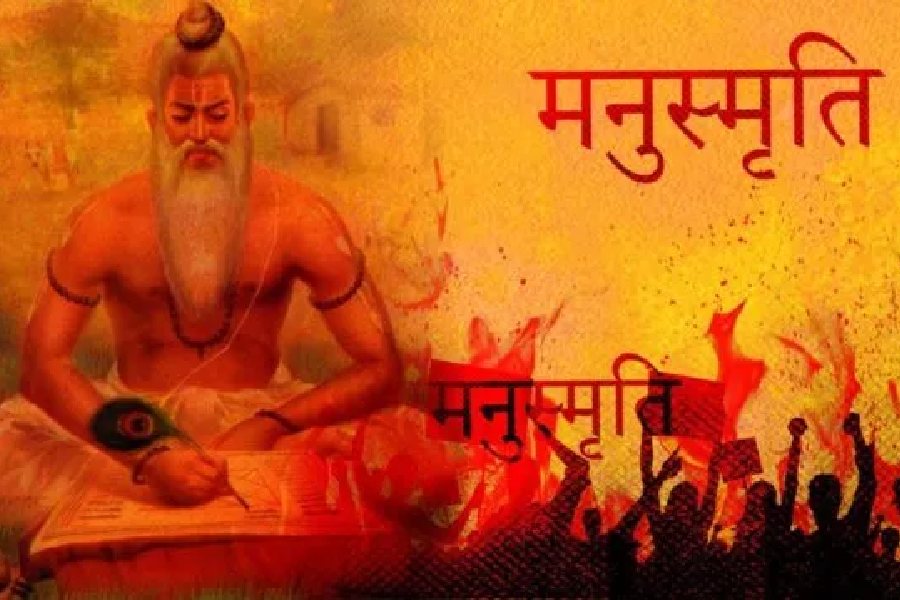
The Manusmriti is an ancient text about social rules and duties.
Some government and BJP leaders say the harsh parts people quote may have been added or changed during British translations.
Several academics disagree and say the different versions all contain rules that treat women and lower-caste groups unequally.
One scholar said there is no version where women and Shudras receive equal status.
Another scholar cited historian P.V. Kane’s view that mistakes and later additions affected the text.
B.R. Ambedkar strongly criticized the Manusmriti for supporting caste inequality.
He and his associates burned a copy at a protest in 1927.
The argument is about whether the text’s discriminatory passages are original, altered, or present across its versions.

Several academics say all circulating Manusmriti versions deny educational and economic rights to Shudras and Ati-Shudras.
Government and BJP leaders have argued that controversial passages may result from British-era translations or interpolations.
The dispute arose in the Rajya Sabha after Mallikarjun Kharge cited passages from the Manusmriti.
Other scholars say William Jones translated the version available in his time rather than creating an altered text.
Ambedkarite scholars say B.R. Ambedkar opposed the Manusmriti and burned a copy during the 1927 Mahad Conference.
- Who
- Government and BJP leaders, Opposition politicians, and academics including Y.S. Alone, Pradeep Aglave, and Sadashiv Dwivedi.
- What
- They are disputing whether the Manusmriti’s controversial caste- and gender-based rules were part of its original text or resulted from later changes.
- Where
- The parliamentary discussion took place in the Rajya Sabha, while Rahul Gandhi addressed the issue at a Chhatron Ki Goonj gathering in Pune.
- When
- The debate was raised in the Rajya Sabha on July 30 and discussed by Rahul Gandhi on August 22; Ambedkar and associates burned a copy in 1927.
- Why
- The dispute concerns the authenticity of Manusmriti versions and their alleged role in justifying caste hierarchy, untouchability, and gender inequality.
Scholars Challenging Interpolation Claims
Government and Supporters of Interpolation Claims
Whether discriminatory passages are original
Scholars Challenging Interpolation Claims
Academics such as Y.S. Alone argue that all versions contain rules denying women and Shudras equal status and rights.
Government and Supporters of Interpolation Claims
J.P. Nadda and Sudhanshu Trivedi say the cited versions may not represent an original pre-British text.
Role of British scholars
Scholars Challenging Interpolation Claims
Critics of the government’s position say William Jones translated the Manusmriti that was available and that those alleging changes must produce evidence of an alternative original.
Government and Supporters of Interpolation Claims
Sadashiv Dwivedi, citing P.V. Kane, says transmission mistakes and British interpolations contributed to controversial material in circulated versions.
B.R. Ambedkar’s interpretation
Scholars Challenging Interpolation Claims
Pradeep Aglave says Ambedkar opposed the Manusmriti, burned it in 1927, and viewed it as a source of caste inequality and untouchability.
Government and Supporters of Interpolation Claims
Sudhanshu Trivedi cited Ambedkar’s writings to argue that modern Scheduled Castes were not connected to Vedic-age Shudras and that untouchability did not exist in Manu’s era.
Key facts
- Text under discussion
- Manusmriti, an ancient dharmashastra addressing social, legal, and ethical norms.
- Government position
- J.P. Nadda and Sudhanshu Trivedi argued that the cited copy was not necessarily the original and may reflect British-era changes.
- Academic challenge
- Y.S. Alone said all versions contain similar restrictions on women and Shudras.
- Historical translator
- William Jones translated a version of the Manusmriti in 1790, according to Sudhanshu Trivedi.
- Ambedkar’s response
- B.R. Ambedkar and associates publicly burned a copy of the Manusmriti at the Mahad Conference on December 25, 1927.
- Alternative scholarly view
- Sadashiv Dwivedi cited P.V. Kane’s argument that transmission errors and British interpolations affected controversial passages.
Quotes

J.P. Nadda
House leader and Union health minister
“The speech made by LoP Kharge creates disharmony in society. This is not the original text. He should authenticate from the original text. I want the original text of the Manusmriti, the original text before British time.”
 telegraphindia.com
Y.S. Alone
Jawaharlal Nehru University professor specializing in caste studies
“There is no version of the Manusmriti where women and Sudras have been given an equal position as caste Hindus. William Jones had translated the Manusmriti that was available.”
telegraphindia.com
Sadashiv Dwivedi
Head of Sanskrit at Banaras Hindu University
“It is difficult to find the original manuscript of the Manusmriti. Initially, different scribes wrote down Manusmriti texts dictated to them from manuscripts.”
telegraphindia.com
Sources
Related news
Why the Manusmriti Still Shapes India’s Social Discourse

Swami Challenges Rahul Gandhi’s Manusmriti Remarks Over Women’s Rights
Rahul Gandhi’s Manusmriti Speech Draws Criticism Over Selective Scripture

Manusmriti’s Contradictions Offer a Weapon Against Sanatan Defenders

Hindu Leader Demands Rahul Gandhi Apologise Over Manusmriti Remarks
Bikers Hurt As Owaisi Convoy Vehicles Collide In Bhopal

Gen Z Candidates Make Limited Breakthrough in Rajasthan Civic Polls
Karnataka Vande Mataram Row Escalates Over Two-Stanza Limit
Congress Denies TMC Nandigram Bypoll Offer Amid Political Tensions