Science & Tech · Science & Environment · 6 hrs ago
Study finds fine-tuning varies across dark matter theories
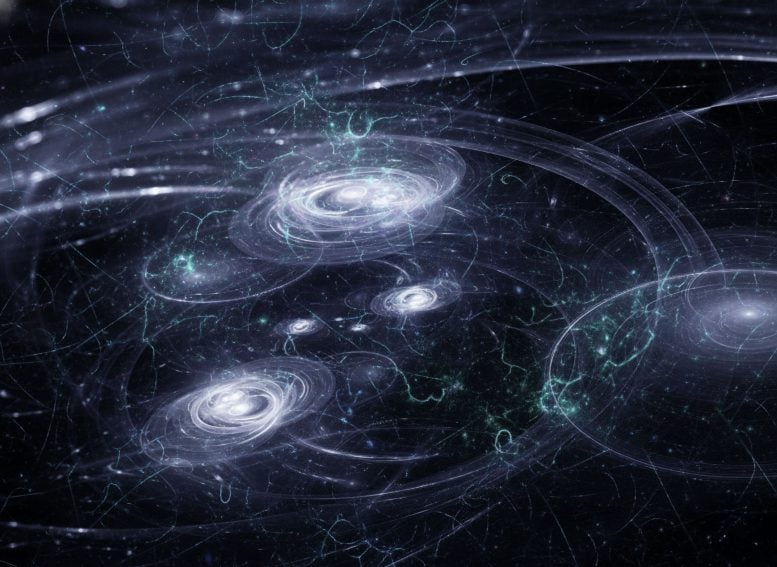
Dark matter makes up most of the matter in the universe and helps shape how galaxies form and move, but it has not been directly detected.
Physicists have proposed different explanations, including unknown particles and primordial black holes that may have formed shortly after the Big Bang.
Stefano Profumo, a physics professor at the University of California, Santa Cruz, tested 12 established scenarios using the same measure of how sensitive each model is to changes in its assumptions.
In this context, a theory is called natural if it can explain the observed amount of dark matter without requiring very precise parameter values.
The study found natural and highly fine-tuned models in both the particle and black-hole groups, suggesting that the details of how dark matter forms matter more than which broad category it belongs to.
The results, published in Physical Review D, challenge the idea that particle theories are generally natural while primordial-black-hole theories are generally fine-tuned.

A study compared 12 dark matter scenarios using the same quantitative measure of fine-tuning.
The analysis found both particle dark matter and primordial black hole models across the range from relatively natural to highly fine-tuned.
The findings suggest that fine-tuning depends more on a model’s production mechanism than on whether dark matter consists of particles or black holes.
The study was conducted by Stefano Profumo of the University of California, Santa Cruz, and appeared in Physical Review D.
- Who
- Stefano Profumo, a physics professor at the University of California, Santa Cruz, conducted the analysis.
- What
- The study compared the fine-tuning of 12 dark matter scenarios using one quantitative method.
- When
- The article was published on 2026-10-11. The study date is not stated.
- Where
- The study appeared in Physical Review D. Where the research was conducted is not stated.
- Why
- To compare how sensitive different dark matter models are to changes in their underlying parameters.
This story does not have two clearly opposing sides.
When you actually run the numbers side by side, that story doesn’t hold up.
This story does not have a timeline yet.
- Scenarios compared
- 12
- Measure used
- Barbieri-Giudice measure
- Researcher
- Stefano Profumo
- Institution
- University of California, Santa Cruz
- Journal
- Physical Review D
Sources
Related news
Researchers map hair-like sensory cells across squid bodies

Bellbird and Seriema Among the Loudest Birds Measured

Survey finds only 83 mature cheetahs across a vast area of South Africa
British Columbia rogue wave was nearly three times taller than nearby waves

Detached sea cucumber tissue remained active for more than three years
New book examines the survival skills of 75 fierce forms of nature

Air pollution reaches ‘very poor’ levels in towns near Manaus

Young Puerto Rican parrot rescued from invasive boa

Warm, mostly sunny weather forecast across the Netherlands this week

Researchers confirm a new giant waterlily species in Colombia

Amazonas fires rise 271% in the first 10 days of October