Science & Tech · Science & Environment · 22 hrs ago
Scans show famous fossil was not an early reptile ancestor

Westlothiana, nicknamed “Lizzie,” is a 345-million-year-old fossil found in Scotland.
For decades, its five-toed feet and claw-like tips led scientists to treat it as an early amniote, the group that later gave rise to reptiles, birds and mammals.
The fossil was crushed between two slabs of rock, hiding much of its anatomy.
Researchers used X-rays to examine parts of it that could not be seen from the surface.
They found internal gills, a primitive skull and a fish-like mouth with thousands of tiny teeth, evidence that Lizzie belonged to a much older tetrapod lineage and lived in water or partly on land.
Its feet suggest that features associated with later land animals existed before vertebrates had fully adapted to life on land.
The findings challenge how scientists interpret early stages of vertebrate evolution; no further steps are described.

X-ray scans show that the 345-million-year-old fossil known as “Lizzie” was not an early reptile ancestor.
The fossil, Westlothiana lizziae, was long treated as an important reference point for the evolution of land-adapted vertebrates.
Researchers found internal gills and a fish-like mouth with thousands of tiny teeth, indicating an aquatic or amphibious lifestyle.
The findings also suggest that five-toed feet and claw-like tips evolved before some animals had fully left the water.
The study was published in Nature.
- Who
- Researchers from the American Museum of Natural History and the University of Oxford, working with the European Synchrotron Radiation Facility.
- What
- Scans revealed that Westlothiana lizziae was on an older tetrapod lineage, not an early reptile ancestor.
- When
- The fossil is 345 million years old; the study’s publication date is not stated in the article text.
- Where
- The fossil was discovered in Scotland. The scans were carried out using a facility in Grenoble, France.
- Why
- Researchers used X-rays to reveal anatomy hidden inside the badly crushed fossil.
This story does not have two clearly opposing sides.
But when we were finally able to see inside the fossil, we found an animal that looked very different from what we expected.
The surprisingly primitive features of the skull show us that Lizzie was not only not a reptile but belonged to a much more ancient lineage.
This is a big surprise.
Westlothiana was discovered in Scotland.
The fossil was formally described.
SciTechDaily reported on research published in Nature that used scans to reveal hidden features of the fossil.
- Fossil age
- 345 million years
- Scientific name
- Westlothiana lizziae
- Discovery place
- Scotland
- Newly revealed features
- Internal gills and a fish-like mouth packed with thousands of tiny teeth
- Scan facility
- European Synchrotron Radiation Facility, Grenoble, France
Sources
Related news
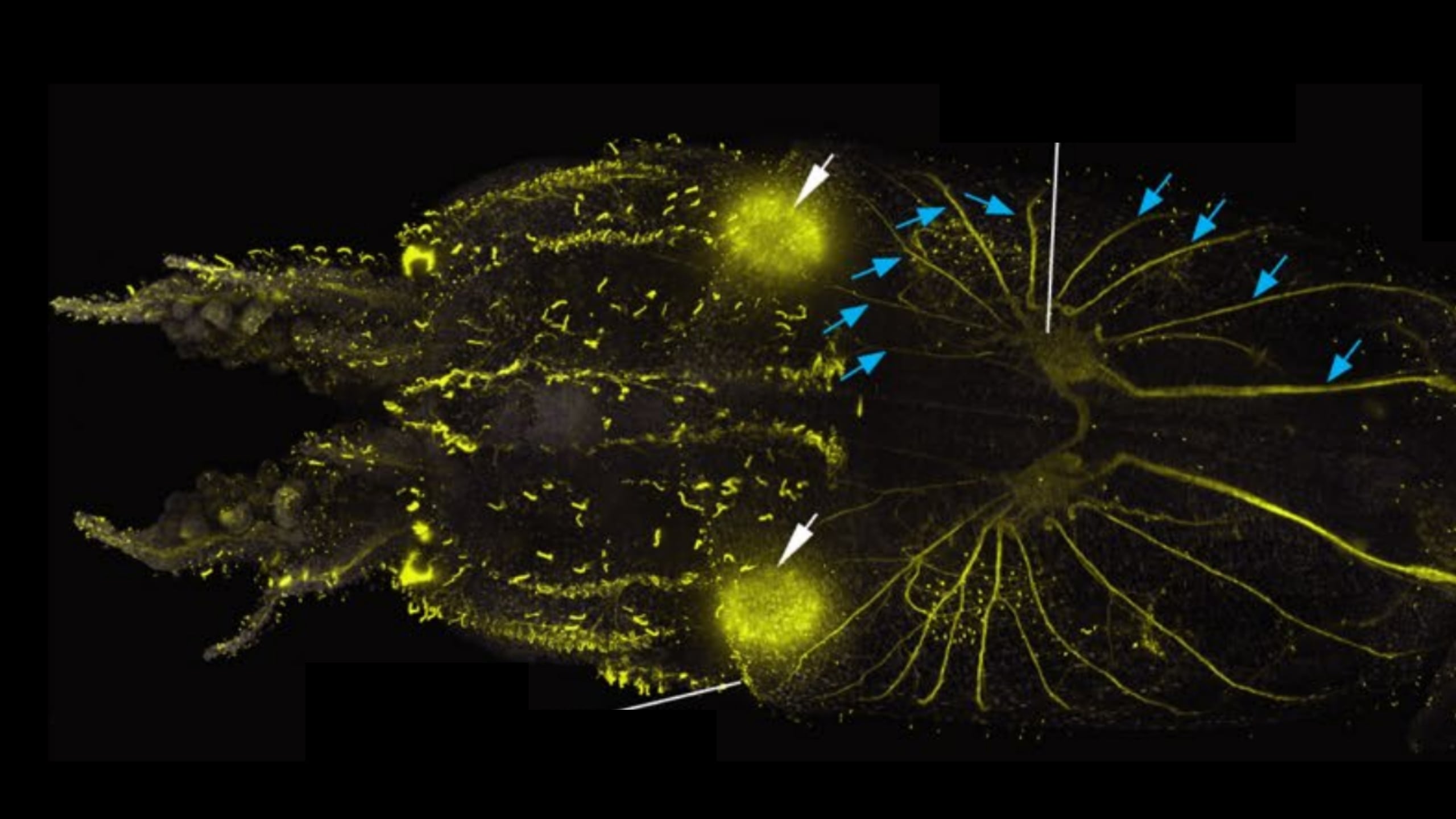
Researchers map hair-like sensory cells across squid bodies
Bellbird and Seriema Among the Loudest Birds Measured
Survey finds only 83 mature cheetahs across a vast area of South Africa

British Columbia rogue wave was nearly three times taller than nearby waves

Detached sea cucumber tissue remained active for more than three years
New book examines the survival skills of 75 fierce forms of nature
Researchers confirm a new giant waterlily species in Colombia

Air pollution reaches ‘very poor’ levels in towns near Manaus
Young Puerto Rican parrot rescued from invasive boa
Warm, mostly sunny weather forecast across the Netherlands this week

Showers and morning fog forecast in parts of Türkiye