

Science & Tech · Space · 2 hrs ago
Why the Hubble constant changes across time and space
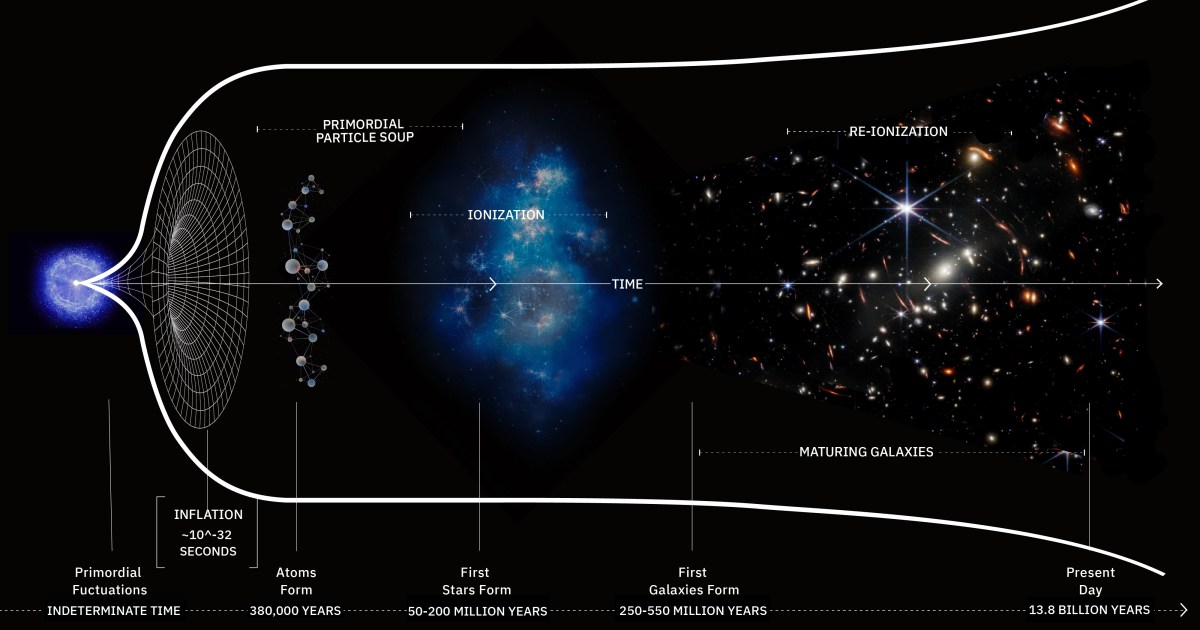
Hubble’s law links distance to recession speed: the farther away a galaxy is, the faster it appears to move away from us.
In 1923, Edwin Hubble identified a Cepheid variable star in Andromeda, helping astronomers measure distances to galaxies beyond the Milky Way.
By comparing those distances with shifts in the galaxies’ light, astronomers found evidence that the Universe is expanding.
The expansion rate changes over time and across space, so the name “Hubble constant” can be misleading.
Dark energy helps explain the variation across space, which surprised astronomers when it was discovered.
If dark energy is a cosmological constant, the expansion rate may become constant far in the future.

The Hubble constant describes the relationship between the distance of an object and its apparent recession speed.
The Universe’s expansion rate changes over time and is not the same everywhere in space at the present moment.
The article says dark energy helps explain why the expansion rate varies across space.
If dark energy is a cosmological constant, the Hubble parameter may eventually become constant far in the future.
Edwin Hubble identified a Cepheid variable star in the Andromeda galaxy in 1923, helping provide evidence for galaxies beyond the Milky Way.
- Who
- Edwin Hubble identified the first such star described in the article. The discussion concerns the Universe’s expansion.
- What
- The Hubble constant is not constant across time or space, according to the article.
- When
- The article describes observations beginning in the 1910s and 1920s. It does not state a specific date for the changing expansion rate.
- Where
- Across the Universe, including the Andromeda galaxy, where Hubble identified a Cepheid variable.
- Why
- The expansion rate changes with time, and dark energy explains why it varies across space. If dark energy is a cosmological constant, the Hubble parameter may become constant far in the future.
This story does not have two clearly opposing sides.
Vesto Slipher noted that some observed objects had spectral signatures shifted toward the red or blue end of the light spectrum.
Edwin Hubble identified a Cepheid variable star in the Andromeda galaxy.
Improvements in telescope technology and photographic plates allowed astronomers to identify individual stars in galaxies beyond the Milky Way.
- First identified extragalactic star
- Cepheid variable in Andromeda
- Star identified by
- Edwin Hubble
- Year of identification
- 1923
- Earlier observations
- Vesto Slipher noted spectral shifts in the 1910s
What people are saying
not only does the expansion rate of the Universe change with time, but it isn’t even constant across all of space right at this very moment.
there’s nothing constant about the Hubble “constant” at all!
dark energy may turn out to be the Hubble constant’s ultimate savior
Sources
Related news
NASA’s Perseverance rover sets record with 45.2km driven on Mars

F-47 fighter targets a 1,000-nautical-mile combat radius

Pramatra Space is building chip-based quantum security for networks

Sanyark Space is building satellites for navigation and communications

Norway proposes NOK 323.3 million for a second Andøya launch pad
Chinese Air Force to show several combat systems at Zhuhai airshow

Researchers identify a possible young neutron-star merger remnant in the Milky Way
A shared time standard may be needed for Moon missions

SpaceX set to send solar arrays and supplies to the space station

French astronaut Sophie Adenot says space brought a full range of emotions

KAI’s AAP drone completes first formation flight with FA-50
