

Science & Tech · Science & Environment · 1 day ago
Quantum spins nudge a centimeter-scale object for the first time
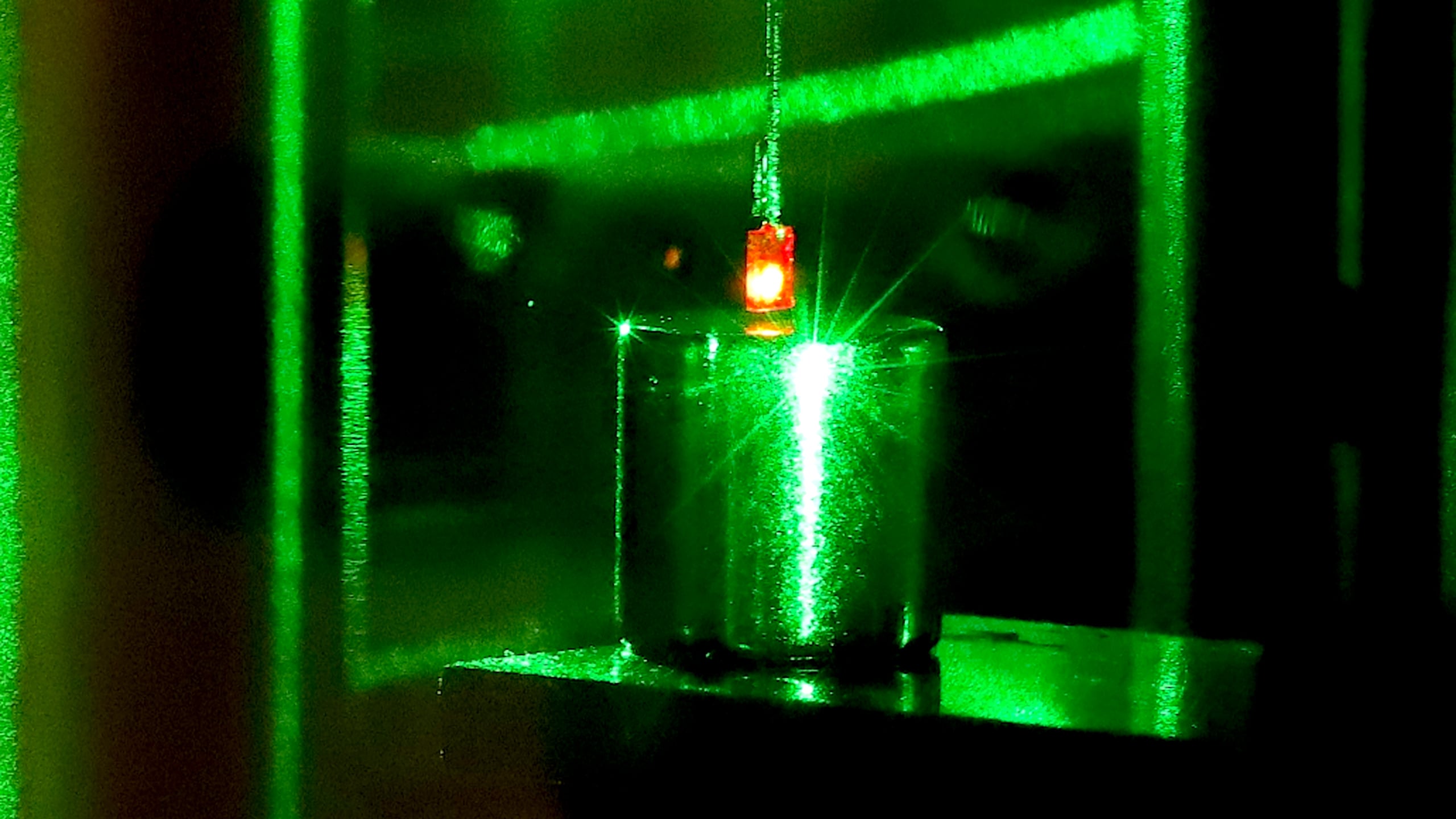
Researchers at the Okinawa Institute of Science and Technology in Japan used quantum electron spins to move a centimeter-wide setup.
The setup included a graphite plate held above magnets and a small diamond attached to it.
Laser light controlled the spins in the diamond, and another magnet turned their effect into movement.
The assembly weighed about 128 milligrams and shifted by roughly 100 nanometers.
The movement itself was classical; the important result is that a quantum force caused it in an object far larger than those used in earlier spin-mechanical experiments.
This gives scientists a new way to study how quantum physics behaves in objects large enough for gravity to matter.
The researchers hope the approach will eventually help put larger objects into quantum states, including superposition, but that has not yet been demonstrated.

Researchers at the Okinawa Institute of Science and Technology used quantum electron spins to move a centimeter-scale object.
The experiment shifted a graphite plate and attached diamond by about 100 nanometers.
The assembly weighed around 128 milligrams and was levitated above a checkerboard of magnets.
The movement was a classical response to a quantum force, not evidence that the object itself entered a quantum state.
The team says the approach could help future research into placing larger objects in quantum states.
- Who
- A team from the Okinawa Institute of Science and Technology in Japan.
- What
- Researchers used electron spins to trigger movement in a centimeter-scale object.
- When
- The study was published on October 10, 2026.
- Where
- Not stated
- Why
- To investigate quantum forces at larger scales and advance research into whether larger objects can be placed in quantum states.
This story does not have two clearly opposing sides.
There have been many efforts to test whether quantum mechanics holds for anything larger than a few tens of nanometers, so far without success
NV diamonds are well understood and easy to control
We're in the opposite camp – going from large to small
ScienceAlert reported on the study published by the team in Science Advances.
Researchers manipulated electron spins in a diamond with laser light and used a magnet to trigger movement.
The assembly shifted by about 100 nanometers.
- Research team
- Okinawa Institute of Science and Technology (OIST)
- Study journal
- Science Advances
- Object
- Centimeter-sized graphite plate with a 3-millimeter diamond attached
- Assembly mass
- Around 128 milligrams
- Movement
- About 100 nanometers
- Publication date
- October 10, 2026
Sources
Related news

Young people seek new opportunities in Italy’s hills and mountains

Thunderstorms forecast in nine Saudi regions, with rain possible in Riyadh and Eastern Province

Turkish students win record 78 medals at international science olympiads

Fungi season reveals the role of fungi in Anglesey’s dunes

Hurricane Simon and other weather systems bring heavy rain to Mexico

Bohai Bay plant cuts desalination energy use by more than half

Used cooking oil may damage modern diesel engines
Heavy rain expected in parts of Turkey as 13 provinces get yellow alerts

Three-volume series on weather support for China’s low-altitude economy published

Heavy rain and flash-flood risk forecast across parts of Saudi Arabia
Hunan launches AI platform for hybrid rice breeding